
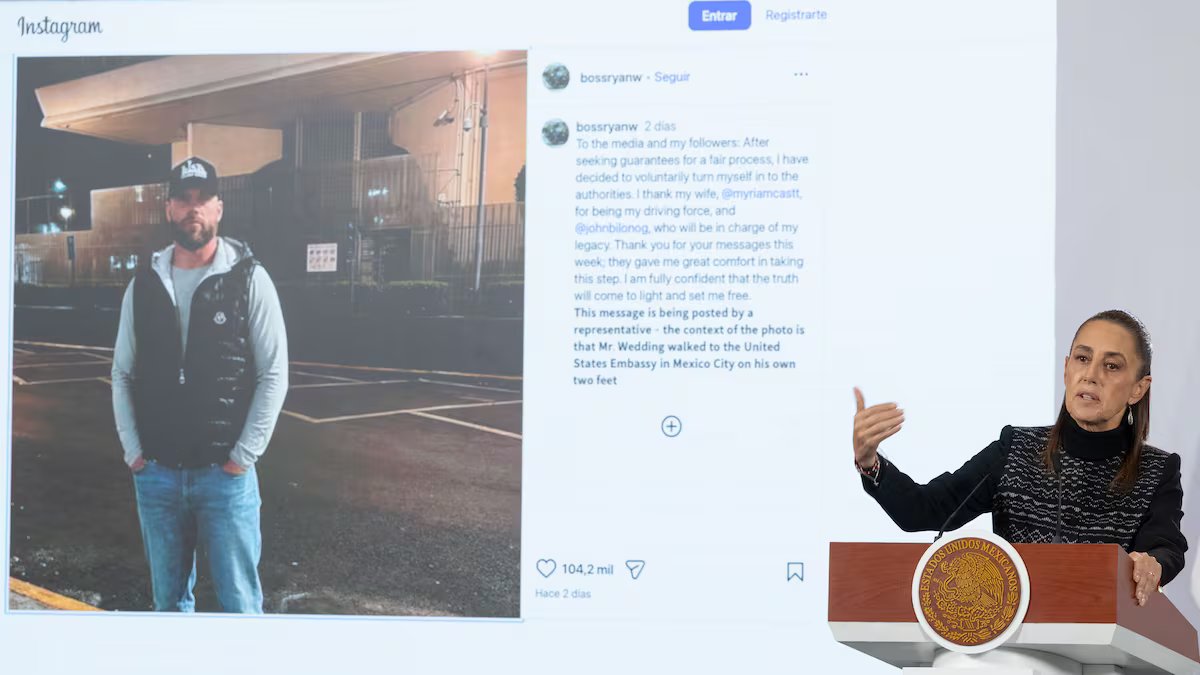
Mexican President Claudia Sheinbaum attempted to settle the debate on Monday with a photograph regarding the capture of Ryan Wedding, a high-priority FBI target wanted for drug trafficking and multiple homicides. The United States maintains that the alleged Canadian kingpin was arrested in a joint operation with Mexican authorities. The Mexican government, however, asserts that Wedding surrendered voluntarily to security forces, a version of events supported by the U.S. ambassador in Mexico City. What Sheinbaum did not anticipate was that the image, uploaded to Instagram, would become part of the discussion and fuel the mystery surrounding the downfall of the man known as the “King of Cocaine.”
The Canadian Broadcasting Corporation (CBC) questioned the veracity of the photograph on Monday, which shows Wedding at night outside the U.S. embassy in the Mexican capital. After analysis, the network concluded that the image had been fabricated using artificial intelligence. Five days after the former Olympic snowboarder’s arrest, the debate about what really happened has been reignited.
According to information initially released by the Mexican Secretariat of Citizen Security, Wedding surrendered to the U.S. Embassy on Thursday night. This message was later confirmed by the U.S. Ambassador to Mexico, Ronald Johnson. A public statement from the diplomat, dated January 23, corroborates the alleged surrender of the former Olympic athlete.
From Washington, however, a different narrative was promoted: that the alleged criminal was apprehended in an operation on Mexican soil. In an interview with Vanity Fair magazine, FBI director Kash Patel stated that he and a team comprised of the same agents who captured Nicolás Maduro participated from Mexico in the operations that culminated in Wedding’s arrest.
Adding to the conflicting accounts between the two countries is now the analysis from CBC, the national public broadcaster, which asserted that the image shared by Sheinbaum on Monday morning and uploaded to a social media account supposedly belonging to Wedding was a digital creation.
A delivery without consular service
The image, dated January 23, shows Wedding standing in front of one of the entrances to the U.S. Embassy building on Danubio Street in the Cuauhtémoc neighborhood, just steps from Paseo de la Reforma, one of the capital’s most iconic avenues. It was taken at night. The Canadian is wearing jeans, a long-sleeved shirt, a light padded vest, and a cap. “I have decided to voluntarily turn myself in to the authorities,” reads a portion of the text.
However, the diplomatic mission is no longer located there. The embassy moved to a new building last November after 61 years on Paseo de la Reforma. A security guard at the old building says that consular services have not been offered there for at least three months. The new offices in the capital are located in the Irrigación neighborhood, over three miles from the previous location. On Tuesday morning, a removal truck was parked at the former embassy building’s entrance on Danubio Street, loading office chairs.
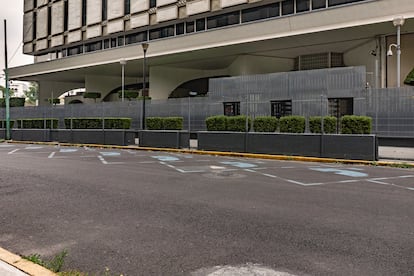
Wedding’s image also shows the parking spaces on the street. The paint is white. Security signs appear on the perimeter fence of the building behind him, as well as a cornice rising to the right. However, as EL PAÍS confirmed, there is no longer any trace of the security signs, and the parking spaces are painted blue. Furthermore, the cornice is located approximately 100 meters away from where it appears in the image on Wedding’s alleged social media profile. The composition of a real photograph does not allow this cornice and the alleged drug trafficker to appear together in the frame.
This newspaper contacted the U.S. Embassy for comment on the photo and to find out if there was any consular service on the night of Thursday, January 22, when Wedding entered “on his own two feet” — according to his supposed publication — but a spokesperson declined to comment and stated that they stand by the written version that Johnson released on January 23.
A distorted cap
Another detail that stands out is Wedding’s clothing. Upon his arrival in Los Angeles, escorted by Patel and FBI agents, Wedding was wearing a black cap, as shown in the images of the aircraft’s disembarkation. The cap, from the Rude Awakenings brand, features the letters “LA LA LA” in white, interlocking letters. In the Instagram photo, the white lettering on the visor is illegible and resembles a scribble. Analysts point out that artificial intelligence models often produce blurry, illegible, or distorted text in their images because they do not “understand” language or writing in the same way that humans do.
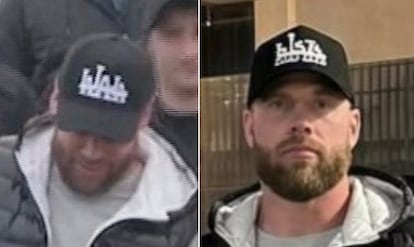
CBC has pointed out that the Instagram account where the photograph was posted, allegedly owned by Wedding, had already shared AI-generated images days before it was taken. When questioned about the image’s authenticity, Sheinbaum defended herself by arguing that social media platforms have policies regarding AI-generated content. According to the president, these platforms have labels warning that the content is not generated by humans. “There’s nothing from Meta [Instagram’s parent company] that says it’s AI, and every social network has that policy. In this case, there’s no indication that it’s AI,” Sheinbaum responded when asked about CBC News’ analysis.
This newspaper has attempted to contact Meta to learn about its policies and actions on Instagram regarding images and the use of AI, but received no response by the time of publication. Without a clear explanation of how Ryan Wedding came to be in the hands of the authorities, the mystery persists.
Sign up for our weekly newsletter to get more English-language news coverage from EL PAÍS USA Edition
