
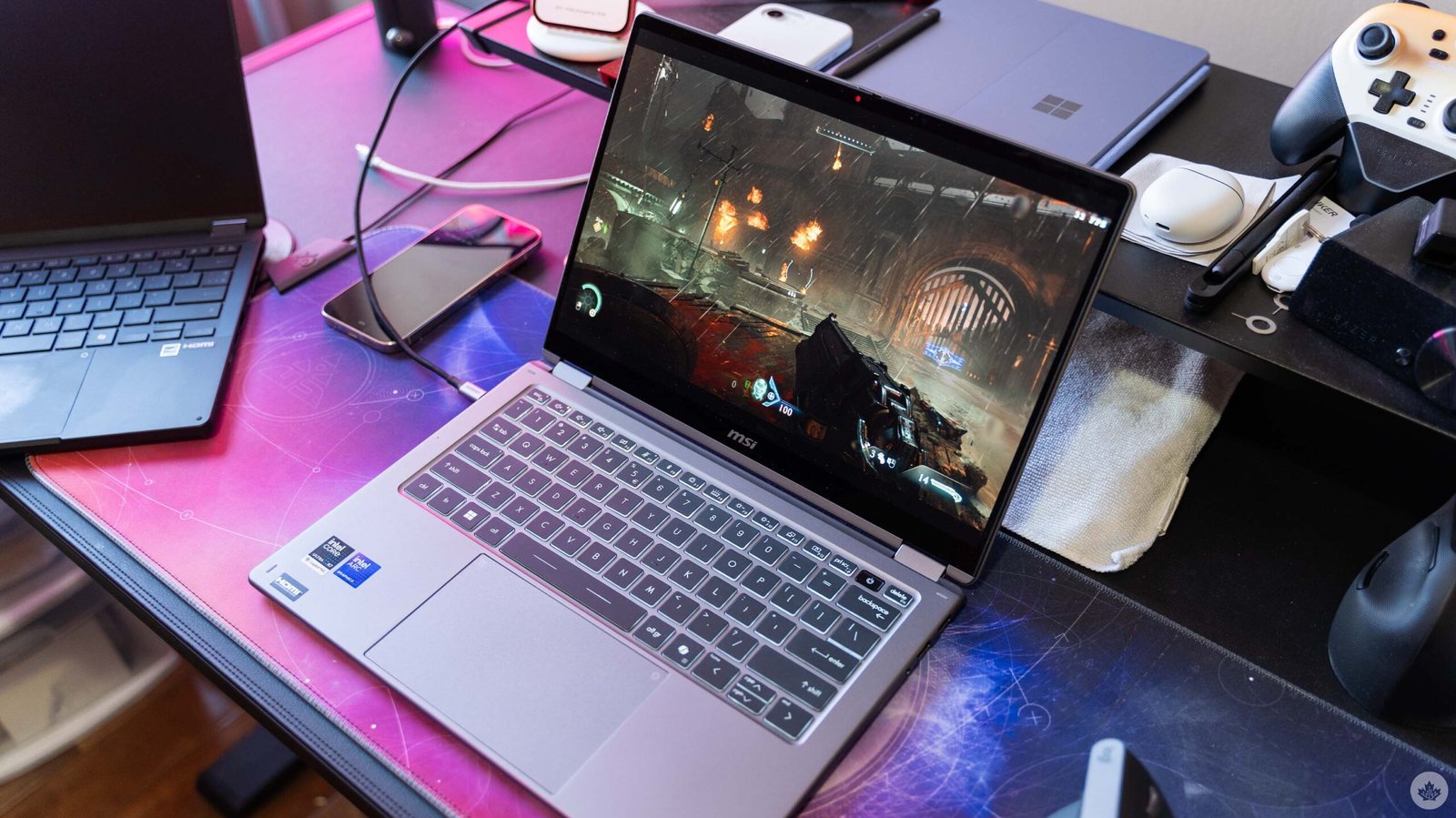
Earlier this year, I wrote about the MSI Prestige 14 Flip laptop. There was a lot to like about it, but I unfortunately wasn’t able to dive into one of the most interesting parts of the laptop: its chip. The Prestige sports Intel’s new Panther Lake chips — specifically, the Core Ultra X7 358H on the laptop I tried.
Having spent more time with the Prestige 14 now, I’ve been able to dive in and really put the Ultra X7 through its paces. And frankly, I’m impressed. It might not be enough for Intel to take back the crown, but it’s a huge step in the right direction for the company.
And more importantly in my eyes, we have — for the first time in a long time — a situation where three companies are pumping out solid chips for laptops. Four, if you count Apple (but I’m not, since M series chips are only available in Apple products, and you can’t get other chips).
Powerful when you need it, efficient when you don’t
First, lets talk daily use. Over the few weeks I used the Prestige 14 Flip, it was a battery champ. It routinely made it through my workday and the battery lasted well into the following day. In one test, I took it off the charger at 8:52 a.m. By the end of my workday at 4:30 p.m., it was only down to 54 per cent. The following morning when I sat down to work at 8:30 a.m., it was at 52 per cent.
That battery life is honestly even better than what I experienced using Qualcomm’s excellent Snapdragon X chips, which is a huge win for Intel. I can’t say how the Core Ultra X7 stacks up to Qualcomm’s second-gen laptop chips as I haven’t tested any (yet). But from a battery life perspective, Intel is leaps and bounds better than it was before and, finally, competitive again.
Moreover, the battery life was excellent without significantly hampering performance. In my experience with older Intel laptop chips, you could eke out longer battery life via Windows’ ‘best efficiency’ power mode toggle, but not without noticeable performance degradation.
That wasn’t the case with the Prestige Flip. I almost exclusively used it in ‘Balanced’ mode, and got both excellent battery life and never noticed a hiccup in performance. It was fast and smooth, handling every task I threw at it from hefty web browsing to photo editing and more.
It’s also worth pointing out that Intel has a new tool called the ‘Intelligent Experience Optimizer’ (IEO), which activates when the power mode is set to ‘Balanced’ to better handle power delivery without users needing to change power settings in Windows. In my experience with the Prestige, this worked really well, and effectively eliminated the need for me to fiddle with power settings. Instead, I left the Prestige in ‘Balanced’ mode and it took care of the adjustments for me, boosting performance when needed and scaling back to extend battery life when working on lighter tasks.
Intel has done a lot of work to improve performance while reducing power draw in Panther Lake, and it’s great to see that effort paying off. Some of the more notable changes include what Intel calls the ‘low-power island,’ a cluster of Intel’s Darkmont efficiency cores (e-cores), which handles most of the workload. The Panther Lake chips will draw on the performance cores (p-cores) when needed for more intensive tasks, while relying on e-cores for everything else to minimize power draw.
Yea, it can run Doom
While my real-world testing was very positive, the benchmark situation was also pretty impressive. I ran a few different tests on the Core Ultra X7, including Geekbench 6, Geekbench AI, Cinebench 2026, and Passmark. The Prestige 14 scored well across all of them both while plugged in (enabling maximum performance) and while on battery power.
While plugged in, the Core Ultra X7 was even able to rival the performance seen on some of Intel’s desktop CPUs, which is extremely impressive in a thin-and-light PC like the Prestige 14.
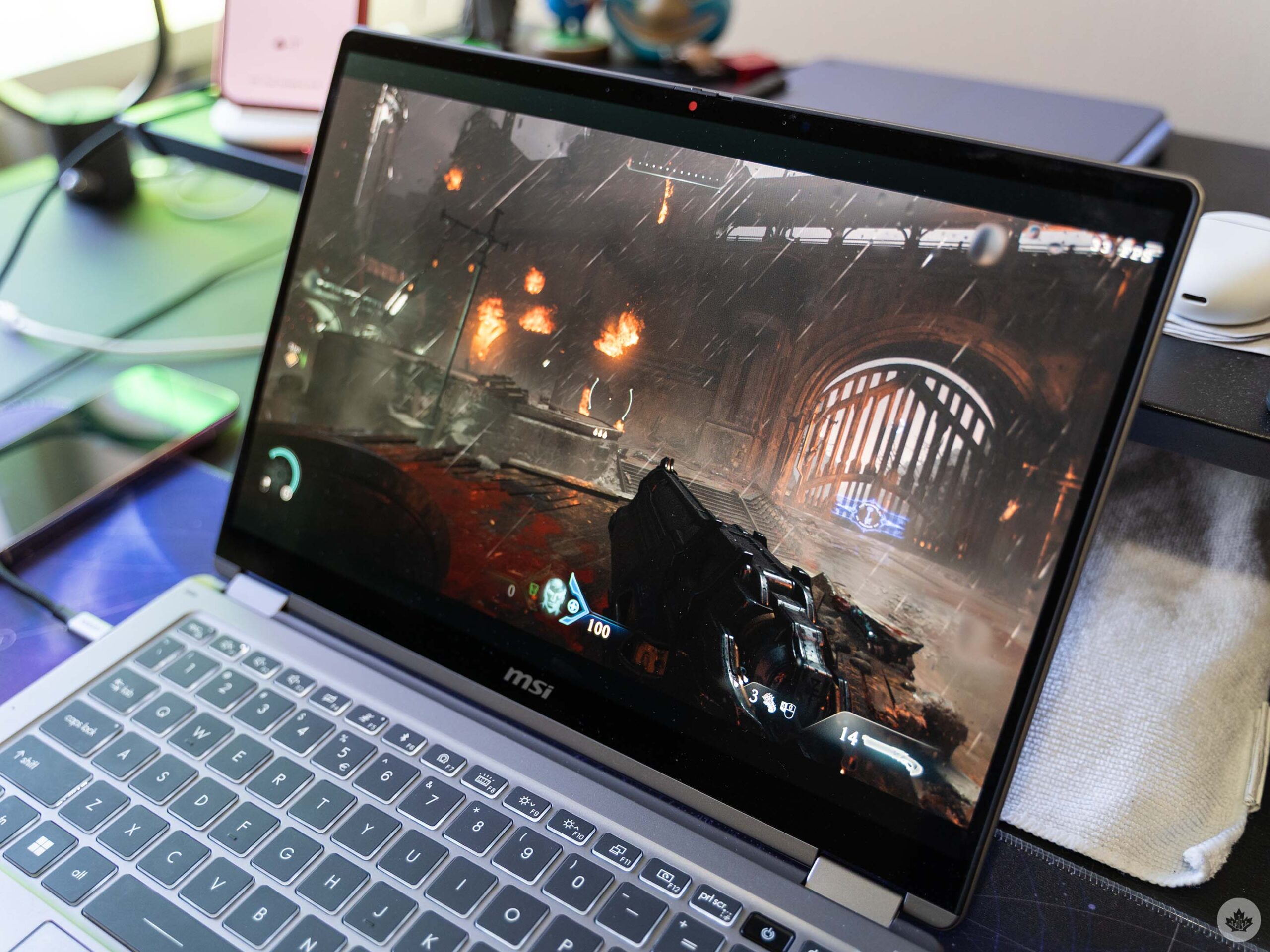
And while the Prestige 14 isn’t a gaming laptop, it does have some surprising gaming chops — yes, it can run Doom. Specifically, Doom: The Dark Ages. I gave the game a try on the Prestige 14 to see if it would live up to Intel’s claims and was honestly quite impressed, given that the laptop is only sporting the integrated Intel Arc graphics and not a dedicated GPU. Even with just that, it was able to manage a fairly consistent 30 to 45fps at 1080p on low settings while using Intel’s XeSS upscaling tech.
Sure, it doesn’t look nearly as good or feel nearly as smooth as it does on my gaming rig, but it was definitely playable. Moreover, I typically avoid upscaling tech like XeSS and DLSS because I’ve found them to be pretty lacklustre, but XeSS on the Prestige 14 wasn’t bad at all. Doom remained quite crisp and clear on the small laptop screen.
Ultimately, Panther Lake-equipped thin-and-light laptops like the Prestige won’t be replacing gaming PCs any time soon. However, the gaming experience was good enough that I could see myself using it while travelling. Typically, when I go on a work trip, I’ll bring along something like the Asus ROG Xbox Ally to game on in my downtime. But with what Panther Lake is able to do, I could stick with just my work laptop and save some space in my suitcase.
Still heats up under load
I will note here that the chip can still get quite warm under intense workloads. For example, after running my benchmarks, I measured temperatures ranging between 45 and 50 degrees Celsius along the top edge of the keyboard. Worse, after my gaming test, it climbed as high as 60 degrees. Granted, I was using the thermometer on my Pixel 10 Pro to measure, which isn’t the most accurate, and the temperatures weren’t out of bounds for a laptop like this. Still, it’s a bit too warm, leading to the Prestige feeling uncomfortable to touch after longer, intense workloads. And you definitely don’t want it on your lap while you game.
Despite the heat, I came away very impressed by the Core Ultra X7 and Intel’s Panther Lake. The company has made some impressive strides and in many ways has caught up to the competition. Last year, I would have recommended most people get a laptop with a Snapdragon chip, but so far this year, it’s looking like people will have a lot of choice.
Intel’s newest chips are great, Qualcomm is putting out impressive hardware, and AMD is no slouch either — we’re truly spoiled for choice right now… if only someone could figure out a way to bring RAM prices back to a reasonable range.
