
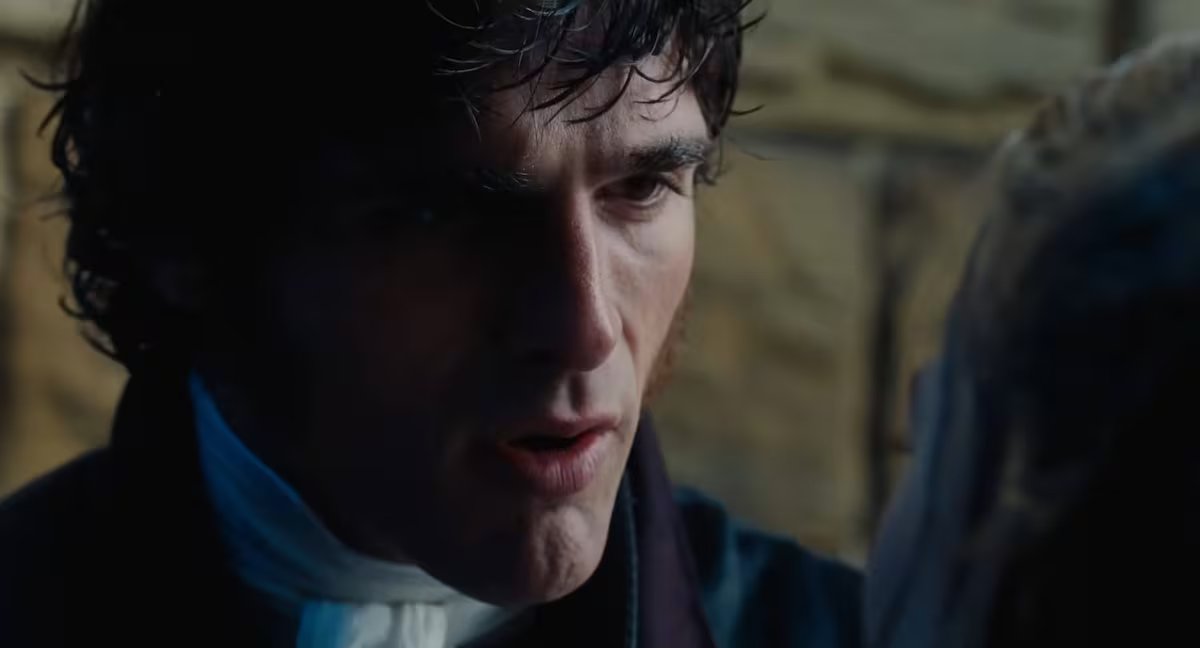
The devoted lover. The toxic narcissist. The sex symbol. The chaste beloved. The perverted necrophile. The Other. The one who lives among us. The proto‑Marxist rebel. The idealistic lunatic. The unscrupulous psychopath. The victim of the powerful. Or perhaps their ultimate executioner.
All of these descriptions could be used to describe Heathcliff, the central male character of Wuthering Heights, the novel written by Emily Brontë and published in 1847, just a year before her early death. Its latest film adaptation, directed by British filmmaker Emerald Fennell and starring Margot Robbie and Jacob Elordi, opens on February 13, and the promotional machinery has already begun to unleash the timely wave of Heathcliff‑mania.
But long before Elordi and Robbie embarked on their exercise in gothic‑romantic cosplay before the press, Heathcliff was already one of the most deeply rooted literary icons in the popular imagination. He is also one of the most complex and contradictory. Like other great novels such as Pride and Prejudice or The Princess of Cléves — and it can hardly be a coincidence that all these masterpieces were written by women in eras not exactly welcoming to them — Wuthering Heights has been interpreted in different ways at different times, and those interpretations say more about the era in which they were produced — its expectations, prejudices, and neuroses — than about the work itself.
Casting a canonical Hollywood sex symbol like Elordi as Heathcliff is both good and bad. Good, because the sexual allure presumed of someone with those characteristics is an effective way to suggest the feverish passion he inspires not only in Cathy, his beloved beyond death, but also in his wife, the unfortunate Isabella Linton. This is despite the fact that the novel never implies that the passion between Cathy and Heathcliff is ever consummated — something aligned with the strict Victorian morality of the time, but which also adds tension to an already fraught atmosphere.
The decision is also defensible because Elordi has just played Frankenstein’s monster under Guillermo del Toro’s direction, and the two characters share obvious parallels. Mary Shelley wrote her novel almost 30 years earlier, in 1818, at the dawn of the Romantic period, and her monster represented a warning about the aberrations that could arise from an excess of Enlightenment rationality.
Heathcliff, the monster of Wuthering Heights, arrived in the final stage of Romanticism with all its irrational and nihilistic force, programmed to destroy the very sacred order that had cast him out. Although most of the action is set a few decades earlier, in the late 18th century, the character is drawn from that radical Romantic consciousness (in fact, he has been linked to the Byronic hero, modeled on the English poet who was a friend of Mary Shelley).
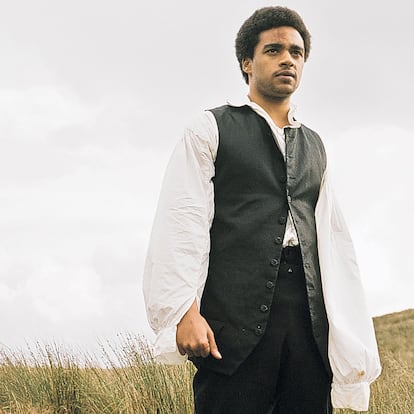
But Elordi is also a bad casting choice — or at least a debatable one — because Heathcliff in the novel has a more sombre quality, and he is also given somewhat ambiguous racial traits: he is described literally as a “dark‑skinned gypsy” and “that gypsy brat” — it was a different era — who arrives under equally murky circumstances in the port city of Liverpool. This has led to hypotheses suggesting Romani roots, but also Indian or Jamaican origins. It is striking that it took until 2011 for the first Western adaptation of the book to cast a non‑white actor: in Andrea Arnold’s version, which failed at the box office and among critics, he was played (very well) by Black British actor James Howson.
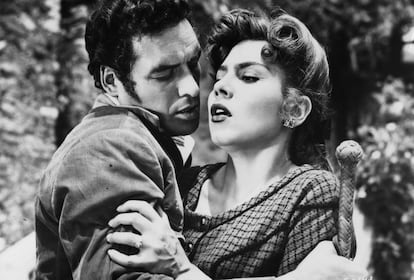
But it’s also true that Abismos de pasión (1954), the best film adaptation of the novel, directed in Mexico by Luis Buñuel, starred Jorge Mistral, a Spanish heartthrob with thick sideburns and a jaw strong enough to crack nuts. Buñuel, like most of the Surrealists, was fascinated by Brontë’s book, and he highlighted its necrophilic undertones and its amour fou dimension, all reinforced by Wagner’s intoxicating music. With its bargain‑bin actors, its wild, almost soap‑operatic tone, and its setting in the rugged rural Mexico of the Porfiriato, Abismos de pasión was a free and revolutionary film — and for that reason, it did more justice to the original material than any other adaptation.
Emily Brontë had drawn inspiration from the Gothic novel, built on ghost stories and bleak settings, when she set to work on Wuthering Heights. After its publication, critics received it with mixed reactions: some praised its literary merits, but it was also described as vulgar, violent, depraved, and excessively naturalistic. It sold moderately well, far from the enormous success of Jane Eyre, written by her sister Charlotte and published the same year (as was Agnes Grey, by the third sister, Anne).
Its moment of glory would not arrive until well into the 20th century, thanks to champions like Virginia Woolf and to the impact it had on the Surrealists. The book’s reach steadily grew, until mass culture domesticated the story and gave it a certain image of a teenage romantic fantasy, betraying its disruptive spirit.
That spirit is very much present in the more political interpretations, which bring Heathcliff closer to a kind of precursor of Terence Stamp’s character in Pier Paolo Pasolini’s art film Teorema. Under this reading, Heathcliff represents a time bomb planted at the heart of the bourgeois order that made the nascent Industrial Revolution possible, which is why he has also been hailed as a precursor of Marxist theory (Capital was published 20 years after Wuthering Heights) and as a furious anti‑capitalist avant la lettre.
All of this calls for a quick rundown of the plot: Heathcliff is a street boy taken in by a rural landowner and brought into his home, where he is integrated with the man’s legitimate children — the sullen Hindley, who hates him, and the proud Catherine, or Cathy, with whom he forms a contradictory and passionate bond doomed to fail. Heathcliff eventually leaves the family, and Cathy marries another neighboring landowner, Edgar Linton.
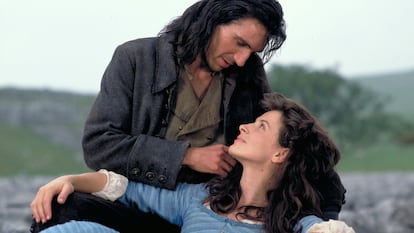
The runaway will return as a wealthy man, consumed by resentment and determined to corrupt and destroy that family, while at the same time trapped by his indestructible love for Cathy. New passions follow, along with much violence, various deaths, and a generational leap that almost no adaptation includes: one that did was the 1992 version directed by Peter Kosminsky, with a deeply tormented Ralph Fiennes — even by his usual standards — as Heathcliff, and Juliette Binoche in the dual role of Cathy and her daughter Catherine Linton. It has been one of the most debated versions to date. “Ralph Fiennes’ Heathcliff looks admirably unsavoury, though his pained expressions grow monotonous with time, as though he had permanent indigestion,” wrote critic Susan King in the Los Angeles Times.
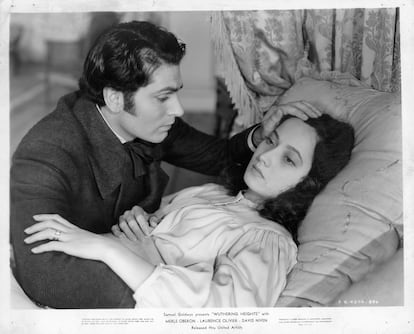
Continuing with film adaptations, one of the best‑known is William Wyler’s 1939 Hollywood classic, in which Cathy is played by Merle Oberon — who, in real life, kept her Indian heritage secret — and Heathcliff is played by the very British Shakespearean actor Laurence Olivier. Its popular success was decisive in softening how the work was perceived afterward.
In Truman Capote’s novel Breakfast at Tiffany’s, the protagonist, Holly Golightly, declares herself a fan of Wuthering Heights, but when the narrator realizes she is talking about Wyler’s film and not Brontë’s book, he reacts with a touch of disdain. Offended, Holly replies: “Everybody has to feel superior to somebody, but it’s customary to present a little proof before you take that privilege.”
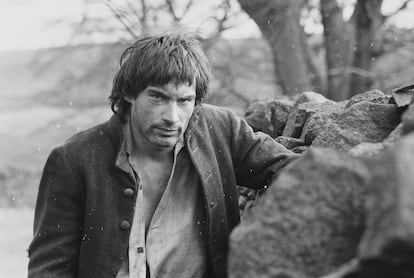
The softening of Heathcliff’s image was also helped along by a widely circulated 1970 television series in which the protagonist was a young Timothy Dalton, who would go on to play James Bond in two films at the end of the following decade.
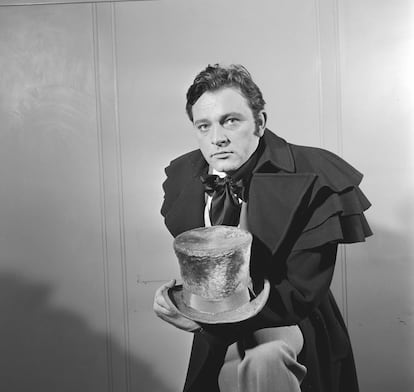
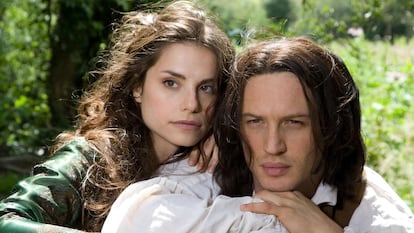
Before that, there had been at least three other television productions: one from 1958 with Richard Burton, another from 1962 with Keith Michell, and another from 1967 with Ian McShane. Like Wyler’s film, these television versions leaned heavily into the story’s romantic packaging, something that would be repeated in a 2009 miniseries, where a very rugged Tom Hardy — sporting long, silky hair — earned the highest praise.
The socially resentful outcast, the bad boy, or the darkly handsome brooder are all types with which Heathcliff can easily be aligned. Characters from literature, theater, and film such as Jay Gatsby in F. Scott Fitzgerald’s The Great Gatsby, Stanley Kowalski in Tennessee Williams’s A Streetcar Named Desire, or George Baines (Harvey Keitel) in Jane Campion’s The Piano (1993) all bear the mark of his cultural influence.
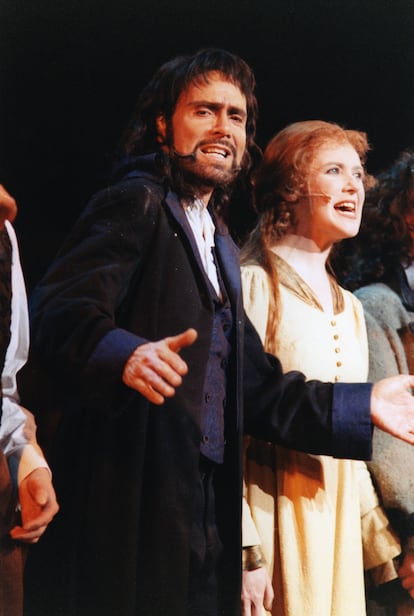
But so does the archetype of the rock star — the quintessential rebel insider — whose typically shaggy, disheveled look owes much to Emily Brontë’s untamed creation: Mick Jagger, Jimi Hendrix, Joey Ramone, and Kurt Cobain all evoke him powerfully. The New Romantics of the 1980s, the grunge movement of the 1990s, and their later revisions and reinterpretations — especially the indie scenes of the 2000s — also seem to spring from the mold Brontë forged in her only novel. It’s no coincidence that in the 1996 musical Heathcliff, the title role was played by rock star Cliff Richard. And the fact that this mold still resonates with younger generations is clear in a case like musician‑actor Mitch, the protagonist of Carla Simón’s 2025 film Romería.
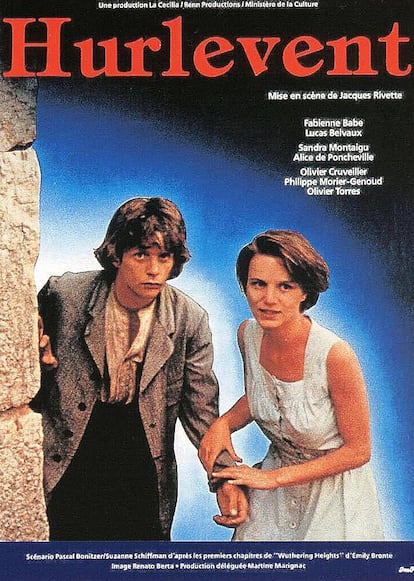
At the other end of the spectrum lies the most minimalist film version to date: the French‑language Hurlevent (1985) by Jacques Rivette, starring Belgian actor Lucas Belvaux in a far more restrained register, stripped of any romantic aura. There are also more exotic versions shot in Japan (Yoshishige Yoshida’s adaptation competed at Cannes in 1988), the Philippines, and India, as well as another from 2003 set in contemporary California, which received only the most limited distribution and had no cultural impact whatsoever.
Finally, in one of the best representations of the myth in popular culture, Heathcliff didn’t even make an appearance. This takes us to 1978, when a then‑unknown 19‑year‑old singer‑songwriter, Kate Bush, burst onto the pop scene with her song Wuthering Heights, accompanied by a delirious and wonderful choreography that fans still perform as a tribute.
“Heathcliff, it’s me, I’m Cathy, I’ve come home / I’m so cold, let me in your window,” the lyrics said, sung by Bush as a Catherine returned from beyond the grave. Or perhaps she wasn’t only embodying Cathy, but Heathcliff himself, since in the novel the two love each other with such intensity that they merge into a single being. Cathy says this to the maid Nelly in one of the most radical declarations of love in the history of literature: “Nelly, I am Healthcliff! He’s always, always in my mind: not as a pleasure, any more than I am always a pleasure to myself, but as my own being.”
Sign up for our weekly newsletter to get more English-language news coverage from EL PAÍS USA Edition
