
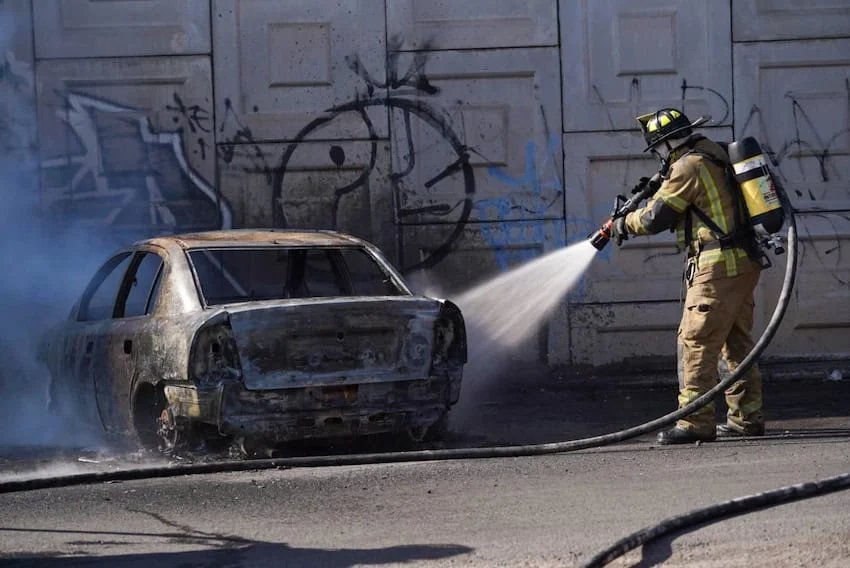
The most honest question right now — and the one I want to begin this editorial with — is: how are you?
As a Mexican, I am ashamed that this is the state of things. I am ashamed that images circulating on social media look like scenes from an act of terrorism. They are painful.
Yesterday, in an MND staff group chat, I told my colleagues that my view of what’s happening is a fundamentally positive one. Many see the events of this weekend as evidence of the government’s lack of preparedness to fight the cartels, but today I want to explain why my view is different. If you — like me — feel pain, helplessness, insecurity, or hopelessness about what you saw yesterday, I hope this can bring a little comfort.
CJNG and El Mencho: some facts
Back in 2022, we reported that the Jalisco New Generation Cartel (CJNG) has a presence in 28 of Mexico’s 32 states. In six states, they are the dominant force: Jalisco, Nayarit, Colima, Guerrero, México state, and Veracruz. These were the states where most of yesterday’s blockades were concentrated.
Beyond drug trafficking — production and distribution of synthetic drugs to the United States, Europe and other markets — the CJNG’s revenues come from extorting farmers, shaking down businesses, fuel theft and trafficking, control of ports such as Lázaro Cárdenas, and kidnapping.
Operating in 28 states in addition to an extensive international network demands manpower. According to DEA estimates, the Sinaloa Cartel and CJNG together total more than 45,000 members and collaborators, spread across more than 100 countries. More precisely, the Complexity Science Hub estimates the CJNG employs between 28,000 and 33,000 members — roughly 30,000 people deeply integrated into their local communities. Have you seen the holiday toy drives, where the CJNG gives gifts to the children of entire communities? That integration is part of their power.
Their weaponry
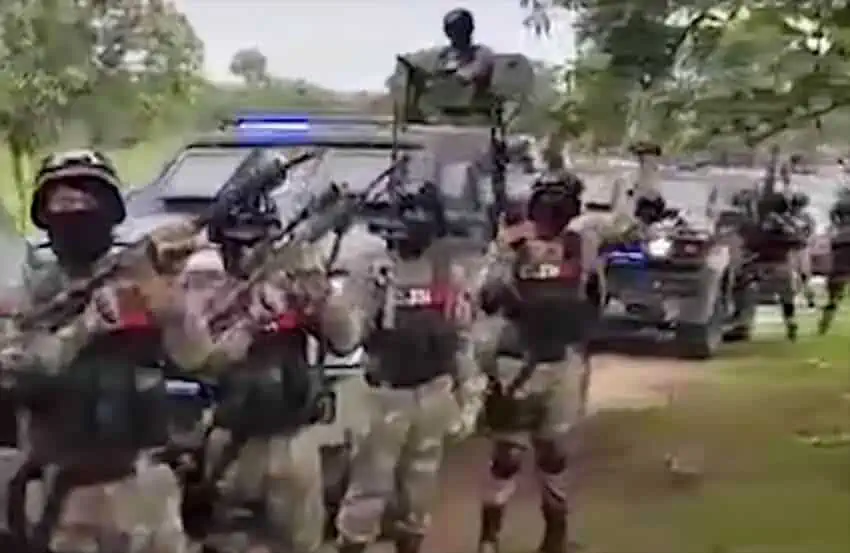
A couple of weeks ago, I discussed Carlos Pérez Ricart’s book “The Violence Came from the North”, which explains how the weapons used by Mexican criminal organizations are mostly legally purchased in the United States and illegally smuggled across the border. How the CJNG is armed also speaks to their economic heft. The ability to finance heavy weaponry, armored vehicles, networks and sustained campaigns of violence is an indirect indicator of their economic muscle, even if there are no reliable public financial figures on their total income.
Why capturing El Mencho mattered
El Mencho, the founder and leader of the CJNG, matters in the fight against organized crime because he changed the way cartels operate in Mexico. He changed the scale of violence, ruthlessly and horrifically expanding his power across swathes of the country for almost 16 years. If he controlled six states and had a presence in 22 others through terror, it is clear that capturing him became a priority for Mexican authorities.
Was the Mexican State prepared for this capture?
In short: no. At the same time, though, when could it ever be fully ready for an event of this magnitude?
But if you want to confront the cartels, you have to take action. And the Mexican government has.
What am I talking about?
The events of this weekend go beyond the death of El Mencho.
• On Friday, February 20, operations took place in Veracruz, resulting in 14 arrests, including the local Veracruz leader.
• Yesterday, in Acapulco, Guerrero, authorities arrested a local cartel boss.
• In Quintana Roo, on Monday, February 23, authorities reported that 248 CJNG members have been arrested over the past year.
The killing of El Mencho is the most important blow in a much larger operation that can be read as an attempt to dismantle the strongest and most violent criminal organization in Mexico. It is not the only part of that operation.
What happens next?
Once the head of a criminal group is captured, internal struggles for power typically lead — at least initially — to an escalation in violence. What we saw yesterday, I think, was a clear example of this phenomenon.
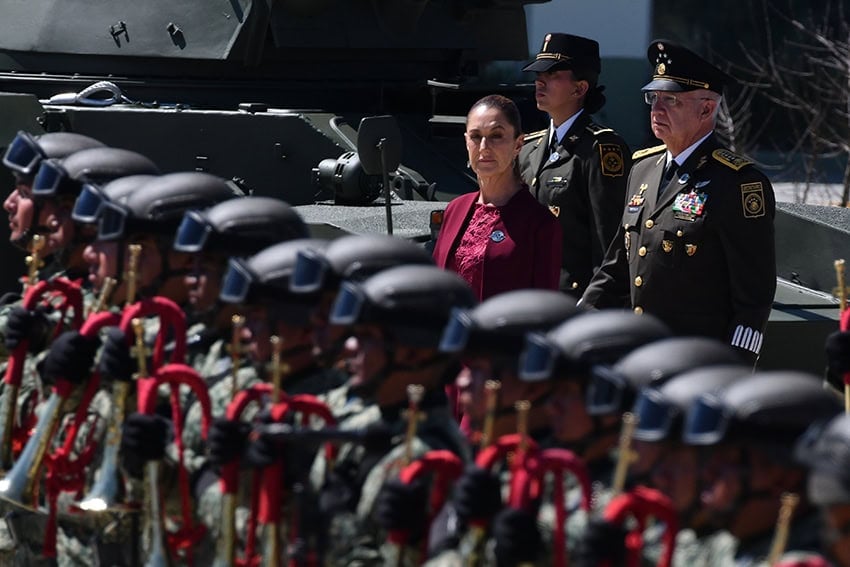
In the coming days, I believe we will continue to hear about violent acts in Jalisco and other areas controlled by the CJNG . I believe the capture of their leaders indicates the Mexican State understands the potential for this balkanization and has moved preemptively. Still, it bears remembering that the CJNG has roughly 30,000 members. Pacifying the country will never be easy. The Mexican State will never be fully prepared to confront all cartels.
But hasn’t much of the time been spent complaining about government collusion with the narco?
Bilateral cooperation
I have seen criticism and conspiracy theories that American forces actually made the capture, and I have seen praise for that cooperation. I have also seen denigrating comments toward President Sheinbaum, claiming her actions are solely because President Trump has been conditioning incentives, taxes and even the deployment of American troops to the country.
Be that as it may, isn’t this the outcome we’ve all been waiting for? For the leaders of these organizations be captured and for the impunity with which they operate to come to an end?
Closing thoughts
Taking down these criminal organizations is truly a tightrope act. Any blow will carry deadly consequences. The timing will never be perfect and there will always be critics.
Not acting is effectively letting them continue with impunity. The images we saw yesterday are hard to digest and yes, there may have been better ways to capture Mencho without disrupting security in Jalisco to such an extent, but I cannot think of an easy, clean way to carry out an operation of this magnitude against the most violent cartel in Mexico’s history.
What do you think?
Maria Meléndez writes for Mexico News Daily in Mexico City.
