
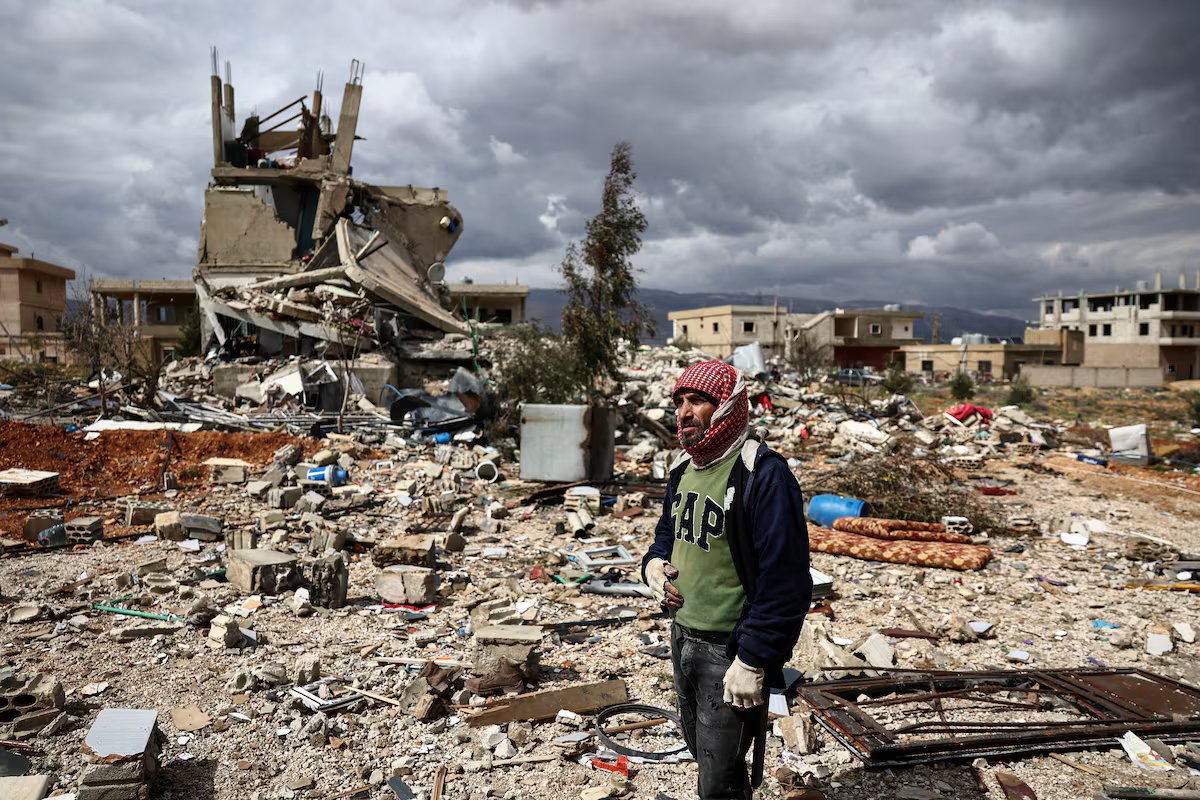
After a two-year offensive in Gaza with no legal or diplomatic repercussions, and amid the ongoing war against Iran, which dominates the regional spotlight, the Israeli army has intensified its air offensive on southern Lebanon and is signaling that it is preparing a ground invasion. Lebanese authorities put the death toll at 1,039 in three weeks of conflict. Israeli troops claim that more than half of those killed are members of the pro-Iranian militia Hezbollah, but the Lebanese Ministry of Health maintains that 158 were children or healthcare workers.
Dr. Mona Abozeid, director of a hospital in the southern city of Nabatieh, tells EL PAÍS that she is receiving “entire dead families” as a result of a military campaign that, in her opinion, “is targeting the civilian population” in a way unprecedented since the 2024 offensive, when Israel killed 4,000 people in Lebanon.
Israeli aircraft continued their bombing spree on Monday, targeting bridges connecting southern Lebanon to the rest of the country. After destroying the main highway that runs through Lebanon on Sunday, a projectile disabled a road over the Litani River that links the border area of Bint Jbeil with Nabatieh. Israeli forces have launched a dozen attacks on bridges and roads along the river since last week. Israeli Defense Minister Israel Katz announced on Tuesday that the Israeli military will establish control over the entire southern part of Lebanon up to the Litani River, which is located about 30 kilometers (18.5 miles) north of the border between the two countries.
The Israeli army presents the mass evacuation orders it has issued for southern Lebanon and the suburbs of Beirut as a wartime civil protection measure, urging residents to leave while any bridge remains open. However, several sources in Lebanon point to the illegalities of Israel’s attempt to empty the area.
The Lebanese Ministry of Health has recorded 128 attacks against medical facilities or equipment, many of them south of the Litani River, and categorizes them as violations of international law and the Geneva Conventions. Amnesty International states that “the absolute impunity Israel has enjoyed” in previous wars encourages the repetition of crimes such as the forced displacement of civilians, and adds that “making unsubstantiated accusations” that ambulances are being used for military purposes does not justify “treating hospitals and medical transport as battlefields.”
That southern region of Lebanon, home to a quarter of a million Lebanese in 150 municipalities, is the area Israeli forces are fighting to control. The head of the Israel Defense Forces (IDF), Eyal Zamir, on Sunday approved “the advance of ground operations” against Hezbollah, in an operation he anticipated would be “protracted.”
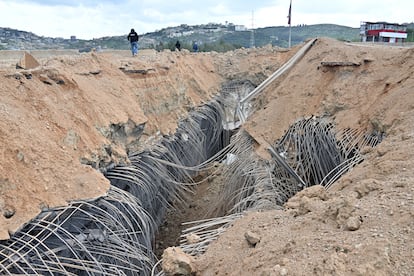
On Monday, ultra-nationalist Israeli Finance Minister Bezalel Smotrich explicitly called for the annexation of southern Lebanon, making the Litani River “the new northern border” of Israel. Last week, Katz, a fellow member of Benjamin Netanyahu’s political school, warned that Israeli authorities would prevent the return of the population south of the Litani until they felt Israel’s security was guaranteed and Hezbollah was neutralized.
The plan turns the Litani into a replica of the Yellow Line established in Gaza by last October’s truce, a kind of internal border that reduces half of the Palestinian enclave to a ghost territory in the name of Israeli security. On Sunday, the Israeli Defense Minister highlighted the parallel. Katz stated that he and Netanyahu had ordered the destruction of Lebanese border villages “in line with the model applied” in Gaza, where the Israeli army has destroyed more than three-quarters of the housing stock, adding that he had called for the “immediate” completion of the destruction of all bridges leading to the south of the country.
Attempts at negotiation
Katz’s words caused consternation in Lebanon due to the lack of distinction between civilian and military targets. But this does not alter the position of the Lebanese leadership, which, while denouncing the illegal aspects of the Israeli offensive, demand direct negotiations with Israel, a country that Beirut does not recognize.
Prime Minister Nawaf Salam stated Sunday on Saudi television channel al-Hadath that Lebanon is “working on forming a delegation” to discuss the end of the conflict, as well as a complete Israeli withdrawal and the return of the more than 20 Lebanese “detained in Israeli prisons.” Some of these prisoners are civilians kidnapped during the truce, but most are militants, including two Hezbollah fighters whom the Israeli army claims to have captured on Monday.
The Salam government outlawed Hezbollah’s armed wing on March 2, the same day the militia resumed attacks against Israel, dragging the Lebanese population into a devastating war for the second time in three years. Since then, Salam has been unable to contain the militia’s hostilities toward the Jewish State, at which it has been firing 150 rockets daily, according to the Israeli army, and where on Monday it seriously wounded one person in the northern town of Kiryat Shmona.
The Lebanese prime minister — who until 2025 was president of the International Court of Justice, where he oversaw South Africa’s genocide case against Israel over its actions in Gaza — has also failed to bring the Israelis to the negotiating table. Netanyahu’s government is repeating the pattern seen in Syria and the Strip, where it boycotts or obstructs agreements to prevent an Israeli withdrawal from border territories under its military control.
Dr. Abozeid, director of Najdeh Hospital in Nabatieh, says that the Israeli attacks “are targeting families and civilians” more than during previous wars. “We are receiving entire dead families, with the father, mother, and children,” she explains by phone from the hospital, which is run by the Lebanese People’s Relief. From the hospital, perched atop a hill, one can see the destruction wrought by the 2024 Israeli offensive in the heart of the town, located just north of the Litani River.
The doctor states that Lebanon’s long-standing economic crisis, with the local currency devalued by more than 90% since 2019, prevents many civilians from fleeing their homes in the south for safer areas. Now, the disappearance of the bridges hinders this exodus and restricts medical care in the border region, where international law protects the right of civilians to remain. “There will be shortages of personnel, medical supplies, and fuel,” she warns.
The medical difficulties caused by the bombing of civilian infrastructure are compounded by direct hostilities against healthcare workers. Paramedics interviewed by the British newspaper The Guardian say they have taken measures in response to what they describe as “systematic attacks” against medical personnel. They now work in teams of two instead of three; they avoid visiting family and friends while on duty so as not to endanger them; and they sleep alone in isolated ambulances so that a hypothetical attack would only kill one person.
In three weeks, the hospital in Nabatieh has received 100 bodies and 277 wounded. The doctor is pleading with the world to help Lebanon end the war, and says she doesn’t understand “what weapons they are using” after witnessing the destruction that Israeli ammunition is causing “to buildings and to people.”
Sign up for our weekly newsletter to get more English-language news coverage from EL PAÍS USA Edition
