

The Israeli government of Benjamin Netanyahu, which views Iran as its main enemy and rarely holds back when issuing threats, has nevertheless maintained an unexpected silence for weeks regarding the war drums that U.S. President Donald Trump has been beating against Tehran. This silence is all the more striking given that last June Israel launched a war against the Islamic Republic (later joined by Washington), and just a few weeks ago it seemed imminent that it would initiate another round of attacks to cement its military dominance in the Middle East.
Netanyahu has spent years speaking about toppling the ayatollahs’ regime. His tone has grown increasingly messianic, as if history had assigned him the role of saving the Jewish people. The end of the Islamic Republic would also give him a major achievement to brandish ahead of the October elections, where polls suggest he is unlikely to win.
But wishes are one thing, and military and intelligence assessments are another. And the latter are concerned that a premature intervention could be counterproductive, and they also know that Tehran — despite its weakness — still has the ability to fire volleys of missiles at Israel. In short, the cure could end up being worse than the disease — the Middle East is full of casualties from foreign interventions that, at first glance, looked like flawless plans.
Sara Isabel Leykin, from the Middle East and North Africa Center at the Italian Institute for International Political Studies, notes in an analysis that Israel’s “predominantly cautious, wait-and-see approach” would have surprised both insiders and observers just a few weeks ago. Israel is certainly interested in the fall of the ayatollahs’ regime (“It is difficult to imagine a worse state of relations between the two countries than the one that currently exists,” she says), but it is also “keenly aware” that a miscalculation “could negate any potential benefits” of military action.
The Israeli military establishment has admitted, in anonymous statements, that a poorly timed U.S. attack could shift attention away from the regime’s brutal repression of protests and instead rally the population against foreign interference, rather than fueling an internal uprising. In fact, as The Washington Post revealed, Israel had notified Iran in the days before the protests that it would not launch an attack. The message was relayed through Russia, and Iran responded with the same commitment in return.
It is not the same situation now. Whether or not Netanyahu orders his fighter jets to strike Iran directly, the response will affect Israel, given its close, multi‑level alliance with the United States. Tehran’s regime, moreover, accuses Netanyahu of having instigated the protests.
On Tuesday, Ali Shamkhani, one of the top advisers to Iran’s supreme leader, Ali Khamenei, posted a message on X in Hebrew — leaving no doubt about its intended audience — in which he threatened missile strikes “at the heart of Tel Aviv” in response to “any military action by America, of any kind and at any level.” “[It] will be considered the start of a war, and the response will be immediate, comprehensive, and unprecedented, directed at the aggressor, at the heart of Tel Aviv, and at all who support the aggressor,” he wrote, dismissing as an “illusion” the idea that Washington could carry out a “limited strike” without regional consequences.
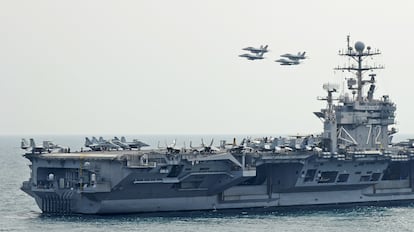
This is, in fact, only one of the possible consequences. Experts note that the Islamic Republic has other cards up its sleeve: closing the Strait of Hormuz (with the resulting impact on global trade and hydrocarbon prices — a fifth of the world’s oil and gas passes through it), damaging the oil infrastructure of U.S. allies in the Gulf, such as Saudi Arabia, or mobilizing its allied militias — weakened, but still standing. These include Hezbollah in Lebanon, the Houthis in the Red Sea, and pro‑Iranian armed groups in Iraq.
Raphael S. Cohen, director of the Master of National Security program at the RAND Corporation, wrote last week in Foreign Policy magazine that Netanyahu has thus far had compelling operational reasons for postponing a new round of attacks. In fact, the U.S. military deployment two weeks ago (when Iran closed its airspace because an attack seemed imminent) did not guarantee the interception of projectiles aimed at Israel in a potential retaliation, according to military analysts. It has been significantly reinforced since then.
Since August, the Israeli arms industry has been ramping up production of Arrow 3 interceptors, the missile defense system it used most extensively during the June conflict. Israel says it intercepted 86% of the 550 ballistic missiles it received over those 12 days, attacks that killed more than 30 people. The missiles were aimed mainly at military targets, though the extent of the damage remains shrouded in secrecy. Arrow 3 is the same system Israel has just sold to Germany in the largest arms deal in its history, valued at around €5.6 billion ($6.7 billion).
Beyond the technical considerations, there is widespread skepticism in Israel that an airstrike campaign could topple a regime so different from Venezuela’s. A senior Israeli official with direct knowledge of planning between the two allies told Reuters this week that Israel assumes such a campaign would also require “boots on the ground.” Even if the United States were to kill Khamenei, Iran would “have a new leader that will replace him,” without losing control of the situation, the source said.
Moreover, although Israel is a nationalist and militaristic country that tends to close ranks socially in times of conflict, there is little appetite for another round of hostilities. It is not being attacked or threatened by Tehran — quite the opposite. A survey last September by the Israel Democracy Institute showed that international isolation or boycotts worried Jewish Israelis who identify as centrist or left‑wing (29% and 43%, respectively) far more than Iran’s nuclear program, which ranked notably low in response to the question: What is the greatest external existential threat to the State of Israel?
Balance of pros and cons
For Israel, the balance of pros and cons has shifted. On the one hand, it cannot wait for Tehran to rebuild its air defenses, which were severely damaged in the rounds of direct clashes since 2024, Cohen explains. The fighter jets idly circling Tehran’s skies in the last conflict demonstrated Israeli air supremacy. In fact, after deploying its most advanced stealth aircraft, the F-35, to destroy radars and surface-to-air missile batteries, the Israeli military was able to send in older fighters, such as the F-15 and F-16.
But Iran does not appear to have recovered. Half a year later, former Iranian president Hassan Rouhani admitted that “the skies over Iran have become completely safe for the enemy.” “We no longer have a real deterrence. Our neighbouring countries – Iraq, Syria, Lebanon, Jordan – all have airspace controlled by the United States and Israel,” he said in December.
Israel’s strategic superiority — it has not occupied so much foreign territory or imposed its will so extensively in the region in decades — now allows it to widen its advantage over its great regional nemesis. All the more so after significantly weakening Iran’s allies, especially Hezbollah, which proved too fragile and constrained to fire even a single rocket in defense of its patron during the June war.
In that conflict, Israel — whose nuclear arsenal is an open secret — and the United States damaged, though apparently did not destroy, Iran’s nuclear program. Now Netanyahu wants to go after its missiles, which — unlike the opaque atomic program — are not a matter of international controversy but rather part of Iran’s national sovereignty.
In March, Netanyahu used the Purim holiday (which commemorates the episode recounted in the Book of Esther, set in ancient Persia) to draw on a misleading parallel he favors: “More than 2,000 years ago in ancient Persia, an antisemitic enemy arose, the wicked Haman, who sought to wipe the Jewish people off the face of the Earth,” he said. “As in ancient times, like our brothers, we are also united. We are fighting and will be victorious.”
Sign up for our weekly newsletter to get more English-language news coverage from EL PAÍS USA Edition
