
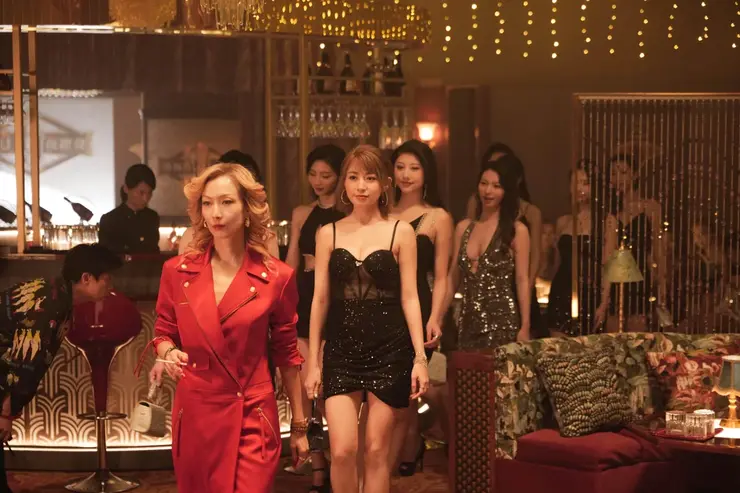
Jack Ng splashed onto the directorial scene with his previous film, A Guilty Conscience, and has also written films such as Anita, Monster Hunt 2 and That Demon Within. He returned to the big screen with his sophomore film Night King, an incredible and tender film about camaraderie and unity during difficult times. Night King viewed this through a unique lens, as it focuses on the survival of a hostess club, a profession not many Westerners may be aware of.
In this exclusive interview, our writer Robert Ewing asked Jack Ng about his latest feature, Night King. We discussed how he balances comedy with drama, how he managed to authentically capture the Hong Kong spirit, Sammy Cheng’s song, and more.
Thank you to Ventris Ma for translating the interview.
TPM: Your film uses Hostess Clubs as a lens to explore Hong Kong’s economy or economic decline, and especially as a profession. Hostess Clubs are a very Eastern kind of profession that is quite unknown to Western audiences, so what made you choose that profession over a more universal one for the story?
Jack Ng: Actually, there are two most important factors behind choosing Hostess Clubs. One of them is a commercial one because there has been a long time since they haven’t shown any beautiful people or the glamorous sides, or beautiful clothes in Hong Kong cinema. The second reason is that in 2012, in East Tsim Sha Tsui, there were a lot of nightclubs. But at that time, the biggest nightclubs, like the Big Boss and the New Fortune Nightclub, both closed at that time, and the people who worked in these nightclubs felt very insecure because they didn’t know where they could go. They didn’t know what to do; it was very frustrating. This kind of reflects what the Hong Kong people are feeling at the moment as well. They think that even if the story is set in 2012, it will resonate with the Hong Kong audience as well.
There are a lot of things about Night King that I really loved, and we’ll get into some of these later on, but another thing is, you talk about how the Nightclub stuff is more than just the glitz and the glam and the neon-drenched signage and everything like that in the film. The Nightclub reflects the economy as I’ve just mentioned, so with that in mind, do you think that a thriving nightlife generally signals a place’s economic health, or is it simply an interesting pattern rather than a reliable indicator?
Jack Ng: Yes, it’s absolutely an indicator; it’s not just the nightclubs but also the bars or karaoke, all of those reflect the economy of a place. Because when people are wealthy, these places will be bustling, very busy. I’m not sure about other countries, but this is definitely an indicator for Hong Kong. In the 80s and 90s, the nightclub business was at its peak, and it was also the golden era of Hong Kong as well. Just like the taxi business, it’s another indicator as well, because these businesses are the ones on the front line to show the economic status of the place.
You mentioned earlier as well about how the film shows the Hong Kongers spreading that camaraderie. That’s another film I really loved, about the film, as well as this idea of loyalty and camaraderie. You captured this idea many times throughout the film, that Hong Kongers stand by one another. You see how Foon treats his staff, and near the end, when the economy worsens, how he even treats his customers there for them. In your opinion, what makes this sense of loyalty uniquely tied to the Hong Kong spirit? And how did you approach capturing that cultural character in Night King?
Jack Ng: It’s one of Eastern culture versus different cultures. In Western culture, you go for individualism, but Eastern culture is for collectivism, more like seeing everyone as a close family, like when we see our friends, we have a kind of brotherhood, we talk about our loyalty towards our friends as well. Firstly, in the nightclubs, the customers and the staff there, especially in the 80’s and 90’s, have a kind of loyalty between them, their customer relationship. Actually, in my research, we heard some true stories, some customers who were wealthy and spent a lot of money in the nightclub, and they lost everything during the financial crisis, so they would invite them back to the nightclub to talk with them.
I love all of that, and even during the more emotional moments, you have great humour in the film, and you do a good job at balancing between drama and humour. How did you make sure the comedy enhanced the drama rather than undercutting it, and do you think that during tough periods, humour is something people rely on to keep going?
Jack Ng: First, talk about the balance between drama and humour or comedy. Comedy has been very popular in Hong Kong. I have one principle: I want to use comedy to make the audience fall in love with the characters. You know, when they are happy, enjoying their comedy moment, it’s easier for them to fall in love with the characters in the film, so I usually put the comedy in front of the story to make the audience immerse in the story earlier, and then we will start to dive into the deeper part of the characters. I feel that humour is essential, especially in difficult times. We all know that we have to hang in there and struggle a bit, but when you struggle with a smile, it’s better than to struggle with tears and how to rise from the bottom. Humour is important because sometimes humour means hope as well, and how we insist and carry on and move on.
Yeah, I think that’s really a perfect encapsulation of humour, especially as we progress through the film. I don’t want to spoil the final act, but the film takes a direction I didn’t expect, yet it feels entirely believable. From a writing perspective, how do you ensure that the third act remains grounded and doesn’t cross into territory that might feel like it’s jumping the shark in terms of believability?
Jack Ng: In Hong Kong people who once visited the nightclub will know that the nightclubs where kind of like and intel centre, there were a lot of people from different industries like the Jockey club, the financial sector, solicitor business, the people would exchange intel there, it was quite a unique thing at the nightclub, folks didn’t just meet for fun, they would discuss business there and people would use this place to disclose or spread some information as well. So, I am not worried that people will think that it will be something like jumping the shark, as this is what really happened in nightclubs before.
It’s quite interesting that it’s something that is very much grounded in reality. I found that quite surprising. You mentioned that a couple of times, it’s grounded in reality. But another thing that I really loved about this film as well is that, despite the film depicting courtesan work, the women are never objectified or framed through a male gaze. So, was it important for you during production to ensure that they were portrayed with dignity and respect, rather than as visual ornaments for the camera?
Jack Ng: I think if you objectify women, it’s because you look down on them first. If you don’t do it, you won’t have the kind of typical male gaze on them. For me, I think the courtesans or the older staff in the nightclub, they are very respectable. I want to add that I find the hostesses are very smart and competitive. They are good at people; they can observe or make good observations and then cope with different people. I believe that if they didn’t work in the Nightclub, but in some big companies in the human resources department. They would excel at it as well. When I had the chance to visit the nightclub and saw them, I really admired what they did and their ability. That’s why under my camera, I wouldn’t objectify them.
I had a feeling because there’s so much respect for the women from that response, you had a lot of respect for your cast as well. Speaking of that, Night King features truly outstanding performances. Many of the cast members also worked with you in your previous film. Do you feel that this familiarity helped you draw out the performances that best served the film? And what was the process like building rapport with the new cast members working with you for the first time?
Jack Ng: Absolutely, because they knew each other well and had that kind of chemistry. Almost the whole group of characters and the crew are from A Guilty Conscience. In this film, there are many scenes that involve a group of people, characters, not just individual shots. I didn’t need to spend as much time communicating with them. This helped me a lot and made my work a bit easier because if it were with the new actors and actresses, they need to find a way to work together, and you have to guide them on what to do. But after the last collaboration, the cast and I and the cast themselves have built a kind of friendship. We know what each other wants or means, so it really helped me a lot.
I think that the cast is all incredible, especially because there are not many sets or locations within Night King, but the cinematography remains vivid and visually striking throughout. What was the collaboration like with cinematographer Anthony Pun to ensure these limited spaces were captured in such unique and captivating camerawork?
Jack Ng: I would communicate with the cinematographer beforehand. We checked a lot of references to see how the camera work should be, what the colour tone should be and what kind of style I want. Before I would tell the cinematographer what kind of scenes that are necessary for me, that are needed. For me, I am more sensitive to the word and the development of the characters But less sensitive to the camera work So I would just tell the cinematographer what to do and give him the autonomy to design because film is a collective work, it is Anthony’s strength in cinematography So I will entrust him in that, I collaborated with him for two times We used this kind of mode of work, and it worked very well.
It is good to have a good relationship with your cinematographer; you can trust them to get the job done. For this next question, it is quite interesting; it has been quite a while since I have seen the film. The film features, or a big part of the promotion of the film is this re-recorded version of Sammy Cheng’s single “Everyone is a Superstar”, and I wanted to know how this incorporation came about, and whether you think its inclusion adds to the film’s thematic resonance?
Jack Ng: Actually, it was the editor whose name is Alan Cheng Wei Lun’s suggestion. He kind of randomly picked a Sammy song and added it. When I saw it, I was really hit by the lyrics because the first few lines are “If it’s possible, we’ll give it all, everyone can be a superstar”. This kind of matches what was seen when Foon told the girls that they can be something. The beat and the tone of the song really matched the film as well. When Sammy saw the rough cut, she really loved to have this song included in the film. She suggested that this is a new film, so why don’t we have a new recorded version? So, this is her idea to have a new version.
I think it’s such an incredible song, I’ve been listening to it since I saw the film. Just because I’m cautious of time, before we finish, I just want to ask one question. I was told that your work at APA was noticeably darker than your recent theatrical work. Is returning to that darker style something you’d want to explore in a future project?
Jack Ng: How did you know about this?
I’ve got my sources
Jack Ng: It depends on the trend or how the society is, because once an industry veteran told us that when the environment or the society is tough. We should do more comedy because they can encourage people and help them get over it. But when the time is good, we can have some more serious drama or charity drama, to remind people that there are still some people out there who are living a tragic life. When would I do more dark themes? It really depends on the atmosphere of the society.
Night King is out now in UK cinemas.
Related
Discover more from
Subscribe to get the latest posts sent to your email.
