
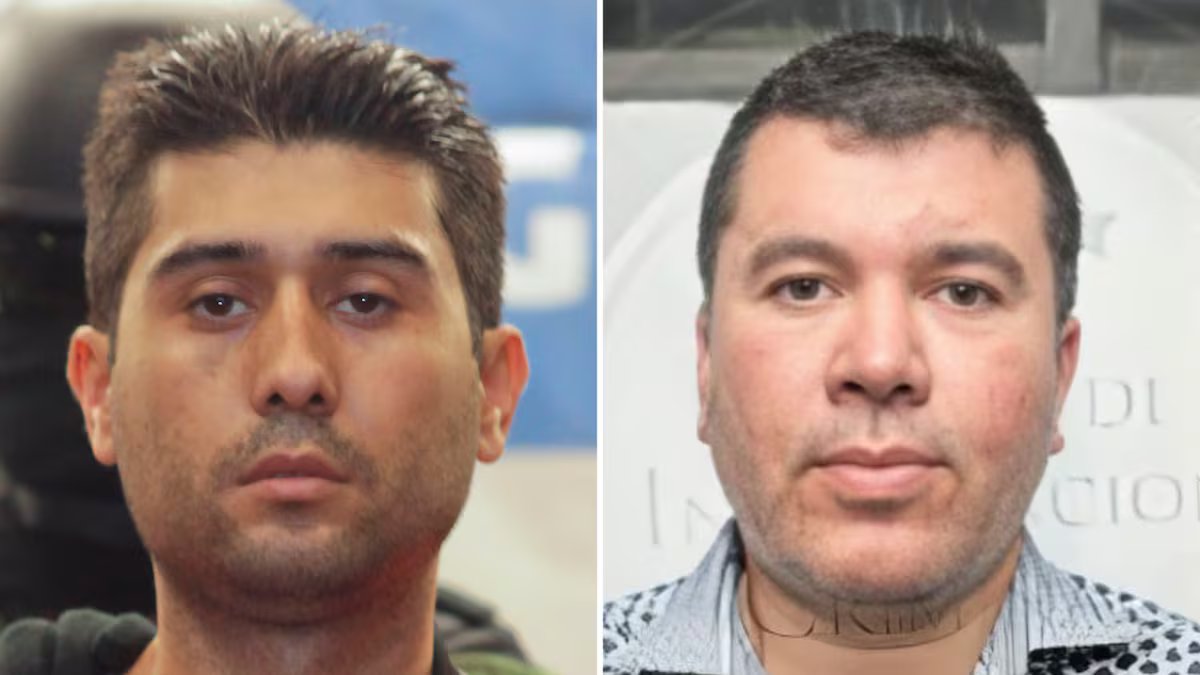
Presented in a broad-stroke narrative, devoid of much detail, the death of Nemesio Oseguera Cervantes, alias “El Mencho,” the leader of the Jalisco New Generation Cartel (CJNG), in a military operation two and a half weeks ago, suddenly appears as the prelude to the legal proceedings against two of his former associates. Having been transferred to the United States in the last year, Erick Valencia, alias “El 85,” and Abigael González, alias “El Cuini,” former collaborators of El Mencho, are expected to plead guilty in the coming months in U.S. courts to various drug trafficking charges, further weakening the family ties in the formation of the criminal group’s future leadership.
The fallout from El Mencho’s death seems endless right now. Doubts about the military operation, which still dominate reporters’ questions to President Claudia Sheinbaum and her Security Cabinet, top the list. Uncertainty about the succession within the CJNG itself shares the same space. That is, if there is a succession, and if the different groups that comprise the cartel or have previously been allies don’t engage in infighting.
Recent developments in the United States have opened a new path in the post-Mencho world, following the undisputed leadership of the CJNG for a decade and a half. The documents submitted to the court by the defense teams of El 85 and El Cuini make their cooperation seem likely. While the terms and conditions of any agreements they reach with the Department of Justice remain unknown, their long-term future is likely to be in prison, a world they will share — and in fact already do — with El Mencho’s son, Rubén Oseguera, alias “Menchito,” Antonio Oseguera, El Mencho’s brother, who was also extradited to the U.S. last year, and El Cuini’s brothers, Gerardo and José, who have also been convicted in U.S. courts.
History awaits the reasons; the possible connection between the downfall of the drug lord and the reluctance of his former allies to acknowledge the crimes they are accused of. Perhaps there is none. Some decided to cooperate with U.S. authorities a long time before El Mencho’s demise, given the mounting charges on the court’s desk, as was the case with Gerardo González, El Cuini’s brother, who was arrested in Uruguay 10 years ago and later extradited to the United States. Others chose not to, like Menchito, sentenced last year to life imprisonment, or Cuini’s other brother, who was also sentenced in 2025.
Whatever the case, the future of the CJNG shows signs of diverging from its founders and their families. Some 15 years ago, Erick Valencia and Nemesio Oseguera created the main acronym of what is currently Mexico’s largest criminal organization, with a presence in practically every state in the country and a good number of nations in the Americas and Europe, among other territories. But back then, at the dawn of the second decade of the 2000s, theirs was just one of many gangs trying to establish themselves in the criminal landscape of Michoacán. Controlling even Jalisco seemed like a pipe dream then.
Arrested a couple of times since 2012, and finally extradited to the United States a year ago, El 85 witnessed the CJNG’s massive expansion from prison: he was incarcerated from 2012 to 2018. By the time he was released, that old Michoacán gang — infamous for massacring more than 30 people in a Veracruz tourist area — had become an empire. It remains unclear what happened: whether he tried to return, if he did, or if El Mencho welcomed him back. What was said at the time was that he tried to challenge El Mencho for control of some municipalities and trafficking corridors, that their old friendship had ended. Authorities arrested him again in 2022.
Although it may sound similar, due to certain parallels in their imprisonment, the case of El Cuini is different from that of El 85. González is El Mencho’s brother-in-law, as the CJNG leader was married to his sister, Rosalinda González, alias “La Jefa.” She has also been imprisoned a couple of times for money laundering and other white-collar crimes, but she was released and her name now appears in the running for the succession, along with “El 03,” another of El Mencho’s sons. Arrested in 2015, El Cuini’s incarceration represents the ills of the Mexican prison system: from the various facilities where he was held, he maintained his power, bolstered by the enormous profits from drug trafficking.
Without El Cuini and his faction on the scene, La Jefa, El 03, and the CJNG’s regional leaders appear as the logistical and emotional hubs of the criminal group, now that their leader is gone. Symbolically, the predictable legal defeat of two of Mencho’s former allies foreshadows a future with new faces, such as Gonzalo Mendoza, alias “Sapo,” or Audias Flores, “El Jardinero.” That is, unless the government works to arrest them and dismantle the group at its root before the succession process is complete.
Sign up for our weekly newsletter to get more English-language news coverage from EL PAÍS USA Edition
