
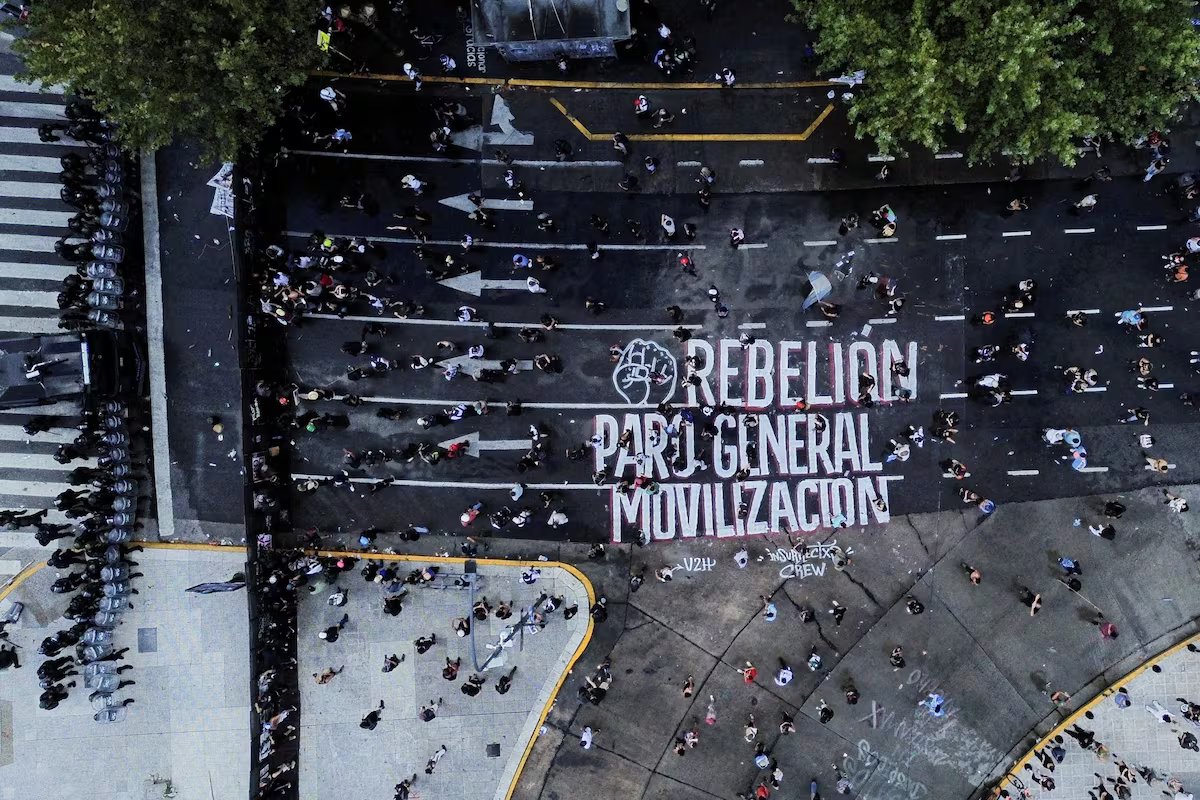
Argentine President Javier Milei promised to dismantle the pillars of the Argentina he inherited from Peronism — the populist movement founded by former president Juan Perón — and rebuild a new country from the ground up. One of these pillars, which withstood the onslaught of previous right-wing governments, is labor legislation, whose foundations date back to 1974. This week, the Senate is poised to pass a labor reform that modifies 200 articles of the Employment Contract Law, rendering it unrecognizable. Unlike the attempts made by former presidents Carlos Menem, Fernando de la Rúa, and Mauricio Macri, Milei faces weakened and discredited unions. Also working in his favor is a labor market that has already fragmented and shifted because of technological change and more than a decade of economic stagnation.
The reform incorporates long‑standing demands from Argentina’s business sector. It makes dismissals cheaper, reduces employer contributions, limits unions’ bargaining power and the right to strike, loosens working‑hour rules, and eliminates the obligation to pay overtime. Other ideas were put back in the drawer — saved for better times — such as Article 44, which would have cut the salaries of workers on sick leave or injured by up to 50%.
Unions and opposition parties criticize the law, arguing that it was not negotiated with all parties involved and does not contain not a single article that benefits workers. In their view, the Labor Modernization Law does not adapt to the times, but instead sets the country back 100 years.
Running counter to international debates about reducing working hours — such as the one underway in neighboring Brazil — the new Argentine legislation extends the maximum workday from eight to 12 hours, as long as the weekly total does not exceed 48 hours. Overtime pay, which many workers rely on, will no longer be mandatory and may be replaced with a compensatory day off.
The unions have tried to halt the reform with street protests and a general strike. “Political leaders tell us how we have to work and how much we have to earn, but none of them get up at 3 or 4 a.m., leave their families, and travel 3,000 kilometers [1,870 miles],” union leader Pablo Osuna told truck drivers last Thursday. Osuna warns that the government wants to strip workers of their right to strike by forcing a minimum service level of 75% in transportation, health care, education, energy, and water — sectors it considers essential.
Scandals and mass protests
Some of the measures included in the reform had been attempted long before, with little success. Menem approved an employment law in 1991 that left unions’ power untouched. In 2000, De la Rúa pushed a labor reform that went down in history as the “Banelco Law” because of the vote‑buying scandal in the Senate that secured its passage. That law marked the beginning of the end of his government a year later. Macri, who governed from 2015 to 2019, sought gradual agreements that never materialized. He promoted others that were so fiercely resisted in the streets that they reinforced Argentina’s image as a country where passing unpopular reforms was nearly impossible.
Milei, by contrast, is one step away from getting his law approved and is already celebrating. “The past is gone,” his economy minister, Luis Caputo, wrote on social media after the bill passed the lower house last Friday. “There are moments in history when history changes. We are finally living one of them,” Caputo added. The government has the votes for final approval in the Senate on February 27.
The political push is easier due to the economic and social climate. The economy has not grown since 2012, and that stagnation has been devastating for the labor market. During that time, formal private‑sector employment grew just over 2%, while informal work surged 22%, and the number of monotributistas — small self-employed taxpayers under a simplified tax system — expanded by more than 50%. “That shows the economy has already created alternative mechanisms, often to avoid the costs and risks of the current legislation,” says economic consultant Iván Carrino.
According to official data, of the approximately 21 million workers in Argentina, registered salaried employees are a minority: the private sector employs 6.2 million and the public sector, 3.4 million. By contrast, nearly 10.5 million people work under other types of arrangements: 5.7 million work for someone else but without a contract, and 4.7 million are monotributistas. Another 6.3% of the total workforce — about 1.3 million people — are unemployed.
The average gross salary for salaried workers in Argentina — 1.6 million pesos, or about $1,150 a month — is three times higher than that of informal workers. As a result, having a job is often not enough, and many people juggle three or even four jobs to make ends meet. Ninety‑two percent of Argentines report feeling stress and extreme exhaustion due to work — the highest rate in the entire continent, according to the Burnout study conducted by the consulting firm Bumeran.
The labor landscape has worsened under Milei. Since late 2023, nearly 300,000 jobs have been lost, two out of every three of them formal salaried positions in sectors such as industry, construction, and commerce. Unlike the 1990s — when factory and business closures caused the unemployment rate to triple — today many of those pushed out of the formal labor market are being reabsorbed in precarious work. The clearest example is the rise of service platforms like Uber, Cabify, or Rappi. Working for these apps has become a way to cushion the blow of losing a job or to supplement insufficient income in a country where one in three people lives in poverty.
Curbing labor lawsuits
The far-right government criticizes the current labor model as obsolete because it was designed for a society with widespread salaried employment, which no longer exists. It promises that the new regulations will create formal jobs and reduce informal work. According to the government, this will happen because business owners will no longer fear bankruptcy if they face a labor lawsuit.
This fear is echoed by everyone, from owners of modest cafés to small and medium-sized business owners, and it is supported by statistics. In 2025, 350 new lawsuits for workplace injuries were filed every day, and most were settled in favor of the employees, who received substantial compensation. Milei’s reform puts an end to that scenario: severance pay will be calculated using only one base monthly salary per year worked — excluding bonuses, vacation pay, and other extras — and payments may be split into as many as 12 installments.
Economists aligned with Milei’s ideas, such as Carrino, acknowledge that despite the changes introduced by the law, “the necessary condition for job creation is that the economy begins to grow.” Carrino compares the current reform to the labor‑market deregulation carried out by Menem in the 1990s, which — far from creating jobs — accelerated job destruction, especially when the 2001–2002 crisis hit and unemployment surpassed 20%.
“If the macroeconomy is functioning disastrously, nothing can generate employment, as happened in the late 1990s. The difference now is that the economy is recovering, and we need to look at specific bottlenecks, such as labor legislation, which makes things very difficult for companies,” says Carrino, who is an associate researcher at Faro, at Chile’s Universidad del Desarrollo.
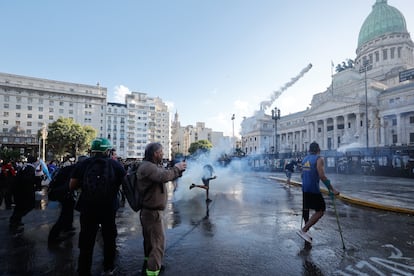
For economist Marina Dal Poggetto, changes are urgently needed because “as more and more people fall outside the formal employment system, the current system becomes fiscally unsustainable.” Informal workers don’t contribute to social security, and those registered under the simplified tax regime (monotributistas) contribute only minimally. “It takes approximately 25 self-employed workers to finance a minimum pension,” warns Dal Poggetto, who describes this type of employment as a “medium-term fiscal drain.”
The need for change is also acknowledged by critics of the law, such as labor law specialist Mario Ackerman. He believes that Milei’s reform doesn’t solve current problems but rather exacerbates them because it “excludes broad sectors from labor law, especially new forms of work, instead of regulating them and recognizing their minimum rights.” This is the case for workers on food delivery or ride-hailing apps. At the same time, Ackerman adds, “those who remain formally employed are seeing their historical rights reduced.”
“Transfer of fear”
Ackerman recalls that during the 2023 election campaign, Milei described Article 14 bis of the Argentine Constitution, which guarantees labor rights, pensions, and the entire social security system, as “a cancer.” He promised to repeal it. “He never hid that objective,” says Ackerman.
Among the most controversial changes, he points to the drastic reduction in the right to strike and the creation of a severance fund that will deduct approximately $2.5 billion annually from the pension system and facilitate layoffs. “There’s a transfer of fear. Today, employers think twice before firing a worker without cause because they have to pay high severance, and employees have some peace of mind knowing their working conditions won’t change. With the new law, it’s the employee who is afraid to refuse changes for fear of being fired,” he argues.
Historian Victoria Basualdo views the phenomenon in a long-term and regional context. She believes it is the “most audacious and extreme in regressive terms” reform ever enacted in Argentina, but one that fits into a historical sequence that began in the 1970s. “This must be interpreted as successive stages in a capital offensive against labor that has evolved over time: dictatorships, the reforms of the 1990s, and the business and technological transformations of the 21st century. It is not just a law, but an attempt to reconfigure the relationship between capital and labor,” she explains.
Previous labor reforms ran up against strong unions, fragile legislative majorities, or economic crises that undermined their legitimacy. Today, the relative weight of formal workers — the historical base of union power — is smaller. Unions will lose even more strength when collective bargaining agreements expire due to lack of consensus and company‑level agreements begin to spread, as promoted by the new law, replacing sector‑wide agreements as they exist today.
This weakness of unions explains, in large part, why a project that once met immediate resistance is now advancing in Congress. Basualdo also points to the international financial backing for Milei — from the International Monetary Fund and the government of Donald Trump — as a factor in breaking down resistance. “Being able to showcase this reformed Argentina is a symbolic objective,” she emphasizes.
The opposition has already announced it will challenge the labor reform in court, and the case is expected to reach the Supreme Court. But even before taking effect, the Labor Modernization Law marks a turning point. For the first time since Argentina’s return to democracy, a government is simultaneously attacking the legislation, institutions, and social balance that sustained the labor framework built by Peronism.
Sign up for our weekly newsletter to get more English-language news coverage from EL PAÍS USA Edition
