
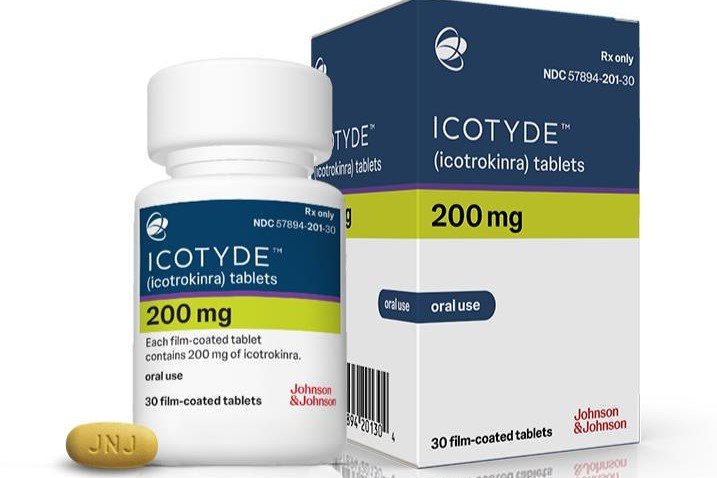
For plaque psoriasis patients whose disease does not adequately respond to topical treatments, the next choice of therapies is typically injectable drugs. FDA approval of a Johnson & Johnson drug gives patients an alternative: a medication that goes after the same target as many of those shots but in the form of a once-daily pill.
The Wednesday approval of the drug, known in development as icotrokinra, covers the treatment of moderate-to-severe plaque psoriasis in patients age 12 and older who weigh at least 40 kg, or about 88 pounds. Plaque psoriasis is the first of potentially several indications for the drug, brand name Icotyde, which J&J has projected could top $5 billion in peak annual revenue.
The excessive immune response that drives plaque psoriasis leads to inflamed and scaly skin that can be both itchy and painful. Of the estimated 8 million Americans who have the disease, about one quarter have cases considered moderate to severe. These are the patients who would turn to systemic therapies administered by injection.
Icotyde is an orally administered peptide designed to block the IL-23 receptor, preventing it from binding to the IL-23 signaling protein that drives inflammatory and immune responses. The FDA-approved plaque psoriasis treatments that work by blocking the IL-23 pathway include AbbVie’s Skyrizi and Sun Pharma’s Ilumya, both injectable medications.
IL-23 is a target J&J knows well. Plaque psoriasis is already a big part of the company’s portfolio through Stelara, an injectable antibody drug designed to block the IL-12 and IL-23 signaling proteins. Stelara is J&J’s second-largest product by revenue. While it tallied $6 billion in 2025 sales across all of its approved indications, that figure is a 41% decline from the prior year due to growing biosimilar competition. J&J’s third-largest product is the IL-23-blocking antibody Tremfya. Across all of its approved indications, including plaque psoriasis, Tremfya accounted for $5.1 billion in sales last year, a 39.8% increase compared to the prior year. This drug’s patents do not begin to expire until 2031.
Patients have had an oral option for plaque psoriasis through Bristol Myers Squibb’s Sotyktu, approved in 2022. This drug is a small molecule designed to block TYK2, an enzyme that plays a role in signaling pathways that drive inflammation. Sotyktu has not become a big seller. Companies such as Alumis and Takeda Pharmaceutical are vying to enter the plaque psoriasis market with TYK2-blocking oral small molecules that could top Sotyktu.
J&J’s submission for Icotyde was based on four Phase 3 studies that enrolled about 2,500 patients. The clinical program included two studies that tested Icotyde head to head against Sotyktu. While results showed Icotyde handily beat a placebo in skin clearance rates, the J&J drug also bested Sotyktu. The rates of adverse reactions for Icotyde-treated patients were low, and these problems included headache, nausea, cough, fungal infection, and fatigue.
Icotyde came from a collaboration between J&J and Protagonist Therapeutics that began in 2017. Speaking during a Wednesday morning conference call, Protagonist CEO Dinesh Patel described Icotyde as offering “placebo-like safety.”
“This combination of efficacy, safety, and convenience of an oral pill makes icotrokinra a compelling choice, and should be a very favorable treatment option for individuals with inflammatory and immuno-modulatory chronic diseases like psoriasis,” Patel said.
Protagonist’s annual report shows the company had received $337.5 million in milestone payments from J&J through the end of 2025. FDA approval of Icotyde triggers another $50 million milestone payment and the biotech and could receive up to $580 million more tied to the development of the drug for other indications and its ability to reach sales targets. Protagonist will also receive royalties from J&J’s sales of Icotyde. J&J’s ongoing clinical trials for the drug span active psoriatic arthritis, moderately to severely active ulcerative colitis, and moderately to severely active Crohn’s disease.
Photo by Johnson & Johnson
