
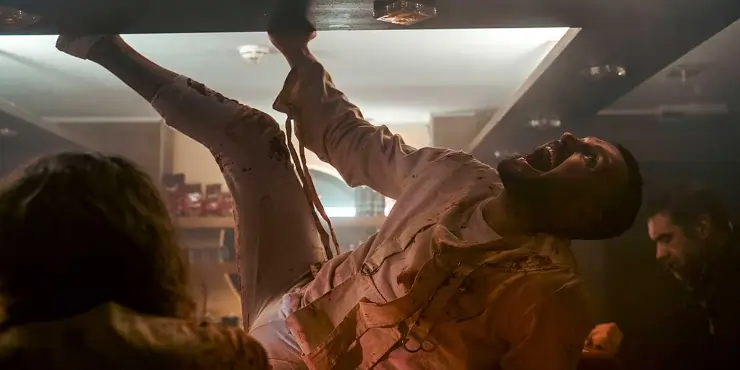
Co-writer of arguably the most controversial horror film of all time, Aleksander Radivojević makes his directorial debut with Karmadonna, a satirical cluster bomb aimed at the scorched-earth despotism inflicted by mythical deities.
Soon-to-be single mum Yelena receives a random call from a sinister man claiming to be a divine being. Sensing her understandable incredulity, he wastes no time in demonstrating his questioned omnipotence with a violent show of vintage Old Testament-style child cruelty. Having laid cynicism to rest, the grumpy god presents Yelena with a brutal moral conundrum. It transpires he doesn’t have the power to snuff out scumbags who have violated his perverse and hypocritical moral code because they have ceased to believe in him. Subsequently, he commands Yelena to murder specific individuals on his celestial shit list or see her unborn baby assassinated by his heavenly hand.
Ok, lets herd the unmentionable elephant straight out of the room. Those expecting generational levels of depravity can retreat from the fainting couch. Although Aleksander Radivojević’s nasty, mean-spirited movie has plenty of visceral violence, such as dicks in blenders, it never gets close to vaulting over the appallingly high bar set by A Serbian Film, nor does it intend to.
Certainly, Radivojević’s reputation precedes him, and despite a cheeky, self-aware opening shot, Karmadonna focuses on deconstructing the counterintuitive loyalty of wrath-based belief systems rather than triggering outrage and shitting on censorship. While Radojevic’s previous film served as a devastating analogy for the struggles of his homeland, this film presents a powerful, more literal case against the hypnotic codeine of religion and society’s exhausting addiction to mobile devices and media.
Vast leaps of faith and suspension of logic and reasoning are required to digest Karmadonna’s absurdist coda. However, this is less problematic than you might think, given its theistic foundations. Nothing that happens within its grim narrative is any more fantastical or bizarre than those preached in any given religious doctrine subscribed to by millions of devoted followers worldwide.
Indeed, it seems almost churlish to deride its bonkers narrative and cavernous plot holes when the very ideologies it roasts are equally demented and resistant to rationale. Furthermore, upon adding an unhealthy application of surrealism to the open sores of the human condition, the boundaries between the two blur into insignificance. There is nothing that occurs in this insane film that isn’t reflected or amplified in umpteen religious texts.
The film features a plethora of human slime as Yelena confronts extreme misogyny and unabashed narcissism. Most of the characters are simply bizarre. At one point, our anti-heroine visits a nightclub with giant screens displaying images of muscular Komodo dragons tearing apart deer carcasses, while a dwarf mingles among the guests wearing a mirrored mortar board hat adorned with an array of complimentary lines of cocaine. It’s both distasteful and hilarious, much like the majority of the film itself.
The interactions between Yelena and the disgruntled deity are wry and lean in to the black comedy angle of the movie, highlighting the ridiculousness of an entity that is paradoxically merciful and vengeful. Part Monty Python, part Black Mirror, the film grasps for Lynchian credentials that never fully materialise. Gore hounds will be left a little frustrated by Karmadonna. While the aftereffects of trauma are truly top-tier, the acts of violence themselves are sadly muted. The camera frequently pulls away, and the CGI elements, like bullet hits, are surprisingly insipid. In some instances, it’s likely for the best, but one can’t help feeling that Radojevic is trying too hard to confound expectations.
Karmadonna is a fun ride. Brave in its battering of blind faith, and uncompromising in its thematic vision. As a salvo of WTF cinema, it succeeds in providing a dopamine hit of madness and mayhem that will upset as many viewers as it entertains.
★★★★
Screened at Glasgow Frightfest on March 7th / Jelena Đokić, Sergej Trifunović, Miomir Mima Karadžić, Milica Stefanovic / Dir: Aleksander Radojevic / Bad Tattoo / 18
Related
Discover more from
Subscribe to get the latest posts sent to your email.
