
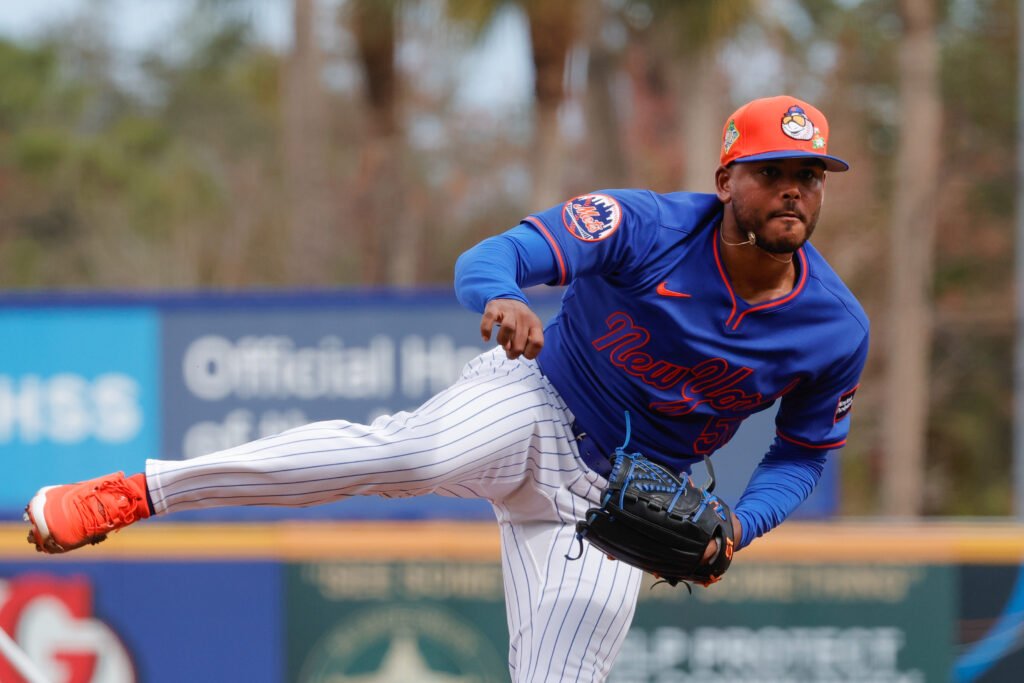
The Mets and right-hander Freddy Peralta still haven’t had any serious extension talks, reports Ken Rosenthal of The Athletic. The report suggests the talks will likely ramp up at some point but the two sides will likely have different priorities. President of baseball operations David Stearns has shown a preference for short-term agreements with pitchers but Peralta tells Rosenthal he would prefer to sign a long-term pact.
Almost as soon as the Mets acquired Peralta in January, speculation began about the club potentially signing him to an extension. Stearns already traded for and extended Peralta once, when he was with the Brewers. Now Peralta is just one season away from that extension ending, as he’s slated for free agency after the 2026 campaign.
Despite the logic, it was quickly reported after the trade that the Mets wouldn’t be rushing anything. They planned to let Peralta get comfortable with his new club for a while. That means it’s not really too surprising that the Mets haven’t yet made a hard push. Some players prefer not to negotiate contracts during the season, though it’s unclear if Peralta has any such preferences.
Whenever talks do get more serious, it’s notable that Peralta and the Mets are potentially starting out with different goals. “I would prefer to go long and make sure I’m going to be in the place where I want to finish my career,” Peralta says to Rosenthal.
That’s in contrast with the general approach of Stearns as a baseball operations leader. As shown in MLBTR’s Contract Tracker, he has avoided long-term deals for pitchers, both during his time with the Brewers and now with the Mets. He did give five-year extensions to Peralta and Aaron Ashby during is time in Milwaukee, but those deals were for pitchers in their mid-20s. Other than those two early-career extensions, he hasn’t signed a pitcher to a deal longer than three years. Even though he’s now working with one of the largest payrolls in the league, Sean Manaea‘s $75MM deal is the largest guarantee Stearns has given to a pitcher. Rosenthal mentions that the Mets did offer a 12-year deal to Yoshinobu Yamamoto, but that was a special case since he was only 25 years old at the time.
Peralta will turn 30 in June and will therefore be going into his age-31 season when he is a free agent. Getting a lengthy deal at that age should be possible for Peralta if he has another strong season. Last offseason, Max Fried got an eight-year deal going into his age-31 campaign. The prior winter, Aaron Nola got seven years ahead of his age-31 season. Dylan Cease is going into his age-30 season, so he is a year younger than Peralta will be in that sense, but his birthday is in December. Peralta’s birthday is in June, so it will only really be a difference of about six months.
In terms of the guarantees, Fried got $218MM, Cease got $210MM and Nola got $172MM. Cease’s deal had notable deferrals, putting the net present value in the $180-185MM range. Peralta has an argument to get into that range next winter, especially when comparing him to Cease.
Over the past five seasons, Peralta has thrown 738 1/3 innings with a 3.30 earned run average, 29.6% strikeout rate and 9% walk rate. In that same span, Cease took on a bigger workload of 884 innings but a higher ERA of 3.72. Cease’s 29.7% strikeout rate was a near match for Peralta’s, with Cease having a higher walk rate of 9.7%. Peralta’s 37.7% ground ball rate was marginally higher than Cease’s 37% clip.
If Peralta is looking to get something resembling the Cease deal, Stearns would have to go to new territory to keep him with the Mets. A deal in that range would require Stearns to more than double his previous high water marks, both in terms of length and guarantee. Perhaps he is willing to buck his previous tendencies since he clearly loves Peralta.
Peralta would be taking on some risk in not signing now, as it’s always possible for a pitcher to get hurt. Perhaps there’s some middle ground that could work for both parties now, where Peralta doesn’t fully max out his earnings by going to free agency next winter, but still locks in a really significant guarantee.
Photo courtesy of Reinhold Matay, Imagn Images
