
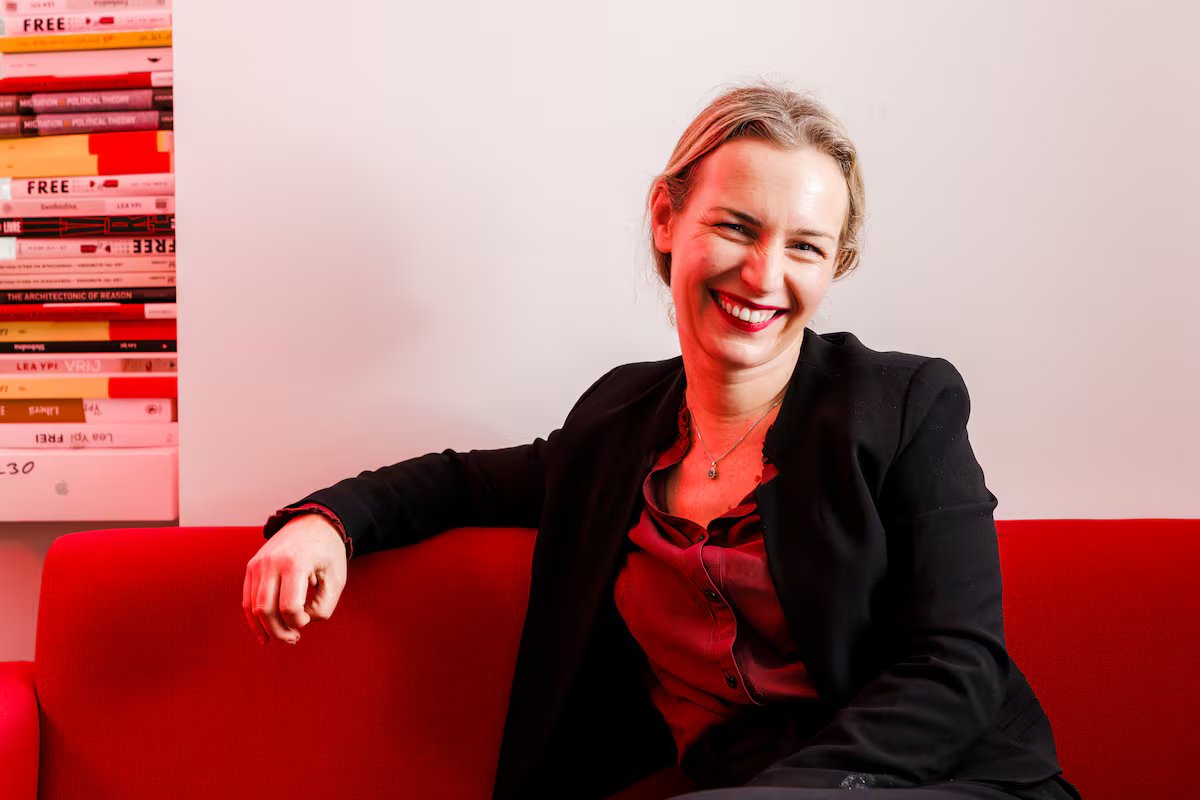
Lea Ypi grew up in communist Albania. The Eastern European country was ruled with an iron fist by Enver Hoxha, whose regime lasted from 1944 until 1985. At the age of 18, she left to study abroad, first in Italy, then at Oxford. Today, she teaches at the London School of Economics.
Ypi, 45, specializes in Marxism and critical theory. The Tirana-born political scientist has written forcefully about the flaws and shortcomings of the capitalist system, in works such as Class Borders: Inequality, Migration, and Citizenship in the Capitalist State, an essay from 2018.
In her first book, Free: Coming of Age at the End of History (2021), the Albanian academic delved into her childhood memories, in order to tell her story in a kind of novel-essay that launched her to fame. Translated into more than 30 languages, the reactions to that book contained the seeds of Indignity: A Life Reimagined (2025).
Ypi comes from a cosmopolitan family that was harshly persecuted by the communist regime: her paternal grandfather — a classmate of Hoxha’s during his student years in Paris — was sentenced to 20 years in a labor camp. And her grandmother was forced to leave her apartment in Tirana, which was confiscated by the state, and work on an agricultural cooperative, where she raised her only son (Ypi’s father).
In her latest book, Indignity, she blends some of the material that she found in the archives with a fictionalized account of her grandmother’s childhood in Thessaloniki, the second-largest city in Greece, and her arrival in Albania. Both the documented and imagined narratives resonate, along with her reflections on the meaning of memory and dignity.
“Everything that is written in the book is based on some historical document… but the characters are often composed characters. So, they’re constructed based on other characters, [who] were [alive] at the same time,” she clarifies, in her office at the London School of Economics (LSE), where this interview took place on Monday, March 9.
Question. In the book Indignity, do you feel like you’re writing as a researcher, or as a member of your family?
Answer. I wanted to combine history with literature. I think what literature does is it constructs characters and uses the imagination to reflect on characters that don’t necessarily exist… but they symbolize certain historical forces, or certain trends, or they make us think about the things that the historical archives leave out.
I didn’t want to write as a family member. I wanted to combine the facts [with] personal memories, [while also being] able to have some kind of license to use the imagination to create these characters, who make us reflect on the time [period] with the tools that literature can give you.
Q. At the beginning of Indignity, you quote a criticism that you received on social media, where you were accused of attacking capitalism while also benefiting from the system. You were also accused of forgetting your grandfather, who was persecuted by the communists. Is this book a way of expanding on the explanation you offered in Free — of defending your Marxist position despite having grown up under Hoxha’s regime?
A. Yeah, absolutely. One of the things that [frustrated me about] the reception of Free was that people seem to think it’s a logical contradiction that, if you’re someone who has lived [under] Albanian communism, you cannot possibly be someone who’s also critical of capitalism. People couldn’t [put] these two things together.
[Now,] thinking about the history of my family: my grandfather was a social democrat. And [when] he came out of prison, he was also critical of capitalism. So, for me — both in the case of my grandfather and of my grandmother — it became a question of who defines the legacy of people who are no longer there to speak for themselves.
Q. In the book, do the opinions that your grandmother expresses about Albania contain your own reservations about the country?
A. I think it’s an accurate reconstruction — from an outsider’s perspective — of the reality on the ground at the time. The fact was that these were cities that weren’t quite cities; there were all kinds of rural people — in a country that had just become independent from the Ottoman Empire — [who were] trying to modernize. [Albania] was catching up with the rest of the world, but also trying to do this in its own way, because it [cared] about its own independence.
[While writing] the book, I found, both in the history of Albania, but also in the history of Europe, that there are many patterns that repeat themselves. So, you read about the 1920s and 1930s, but actually, you [discover] a lot of things about the present. A lot of the dynamics that I explain in the book are also about population movements, the rise of nationalism, and war.
Q. In the book, you express a clear critique of the role that the United Kingdom played in Albania’s destiny.
A. That comes from what I found in the archives. One of the main [reasons] why [my grandfather] ended up in prison is that he’d been in touch with these British intelligence officers.
Q. It seems rather coincidental that your grandmother and grandfather ended up in Albania. Neither of them grew up there.
A. Well, it was both random and not random. I mean, of course, [they] could have gone somewhere else… but, on the other hand, there were these [large] movements of people in the 1930s. He was born in what is now Macedonia and she was born in Greece (both nearby countries).
There was this question: “Where do you actually belong?” Everybody was forcing [them] to answer it. Oftentimes, language, or the place that the family originally came from, carried weight.
Q. You offer many definitions of the concept of dignity and ask whether it’s something that outlives individuals. Do you have an answer?
A. The conclusion I reach is that you can reconstruct a person’s dignity through literature, because it allows you to incorporate different points of view and positions. And, in much of the book, the dignity that I speak of has to do with a correct reading of the past… and that means it speaks to the present.
Q. To what extent has Indignity helped you reconcile opposites?
A. It helped me, for example, understand why the communists came to power in Albania. Why did Albanian communism have these features? How is what I believe connected to what happened to my grandfather? So, [writing the book kind of helped me] work out certain biographical and personal connections. And, to some extent, it also helped me figure out some of my broader philosophical commitments. But I wouldn’t say that I got closure… I think this is an open process.
Q. You write that you have never felt like a victim. Is there something rebellious about this renunciation of resentment?
A. Yeah. I feel people also often use victimhood for personal advantage. And there’s a kind of manipulation of the status of victims [by] descendants of victims. I don’t think I was personally ever persecuted. And so, I feel like if I were to say that I was persecuted because my grandmother was persecuted, there’s a kind of indignity… it’s an offense to her pain and to her suffering.
If I go around and I claim that I’m a victim, then you don’t really see the difference between the real victim and the [person] who is just claiming victimhood.
Q. But shouldn’t the injustices of the past be addressed?
A. For me, historical injustice only matters [if it’s] still present. Like insofar as this historical injustice is still the source of some injustice that’s going on in the present. And when that’s not the case, then historical injustice isn’t really injustice anymore: it’s just history. But there’s a very big discussion in philosophy about this, because a lot of people would say, “No, historical injustice is different from present-day injustice. It’s a different kind of injustice.”
Q. In what sense?
A. Many people think that the injustices of the past can be resolved with information about who did what… but the truth is that you need to know why, not so much who. The individual isn’t that important.
Q. One of the people you consult in your research asks you if you’re desperate to find good communists.
A. I think he asked that question because he’s reflective of this mentality in Albania, [which considers] all communists [to have been] terrible and all the anti-communists [to have been] great people. And so, for me, the whole book is about finding nuances.
Even Gustav, the Nazi character [in the book], does the right thing at the end, motivated by some sense of humanity. It’s impossible to resist the humanity within us. I wanted to resist the black-and-white view, which is dominant in societies that have suffered trauma.
Q. In the book, an imaginary Enver Hoxha tells your grandfather that dignity is a privilege, a luxury.
A. Yes, that’s the reductionist view of morality held by some Marxists, who see it as a form of power. I don’t agree with that position.
Q. In your 2018 essay, Class Borders: Inequality, Migration, and Citizenship in the Capitalist State, you say that capitalism must be overthrown.
A. The two biggest problems of the 21st century are capitalism and nationalism. This combination — of the nation-state and capitalism — is producing a lot of friction and a lot of contradictions. Many of the conflicts that we experience are caused by that.
I’m anti-capitalist in the sense that I think you have to be radical in [your] criticism, even if you want small, reformist improvements. Because, otherwise, you don’t get anything.
I’d say that my vision of the future [involves] engaging critically with the legacy of state socialism and, on the other hand, engaging critically with the legacy of capitalism.
Q. Many Eastern European thinkers witnessed the collapse of the world in which they grew up. Do they have any nostalgia for the past?
A. I think Eastern Europeans — because we’ve seen the system change — we think, “well, it can change again.”
I’m not naive. When I say that we need to bring down capitalism, I think that, even if you want to keep capitalism in some humane form, you have to want to bring it down. Do you know what I mean? Like, in the 1960s and 1970s, the forces that gave us the social welfare state weren’t pro-capitalists. And, in the 19th century, the forces that gave us democratic emancipation weren’t aristocratic elites. It was the workers’ movement… it was all these movements that were trying to fight the system and eventually made it a little bit better.
Q. How do you articulate your critique of communism?
A. Well, with the communist past, there were no free elections; [there was] no free speech, no free press, no freedom of association, no kind of vibrant civil society. And, if you don’t have democracy, then you can’t have [legitimacy]. It’s very simple.
Q. At the end of Indignity, you talk about lessons. Which ones did you want to convey?
A. The lives of people like my grandparents, who were committed to progressive enlightenment, and their efforts are meaningless if subsequent generations don’t take them into account.
The publication of Indignity has by no means brought her story to a close. Ypi recounts that, when it was already published, she found the original photograph that opened the book: it’s a portrait of her grandparents on their honeymoon, looking beautiful and glamorous. They were in Cortina D’Ampezzo, a town in Northern Italy, in 1941, while the war raged across the Old Continent.
Meanwhile, the descendants of one of the British spies who maintained contact with her grandfather have also contacted her. And, of course, her research in the archives will yield much more.
Sign up for our weekly newsletter to get more English-language news coverage from EL PAÍS USA Edition
