
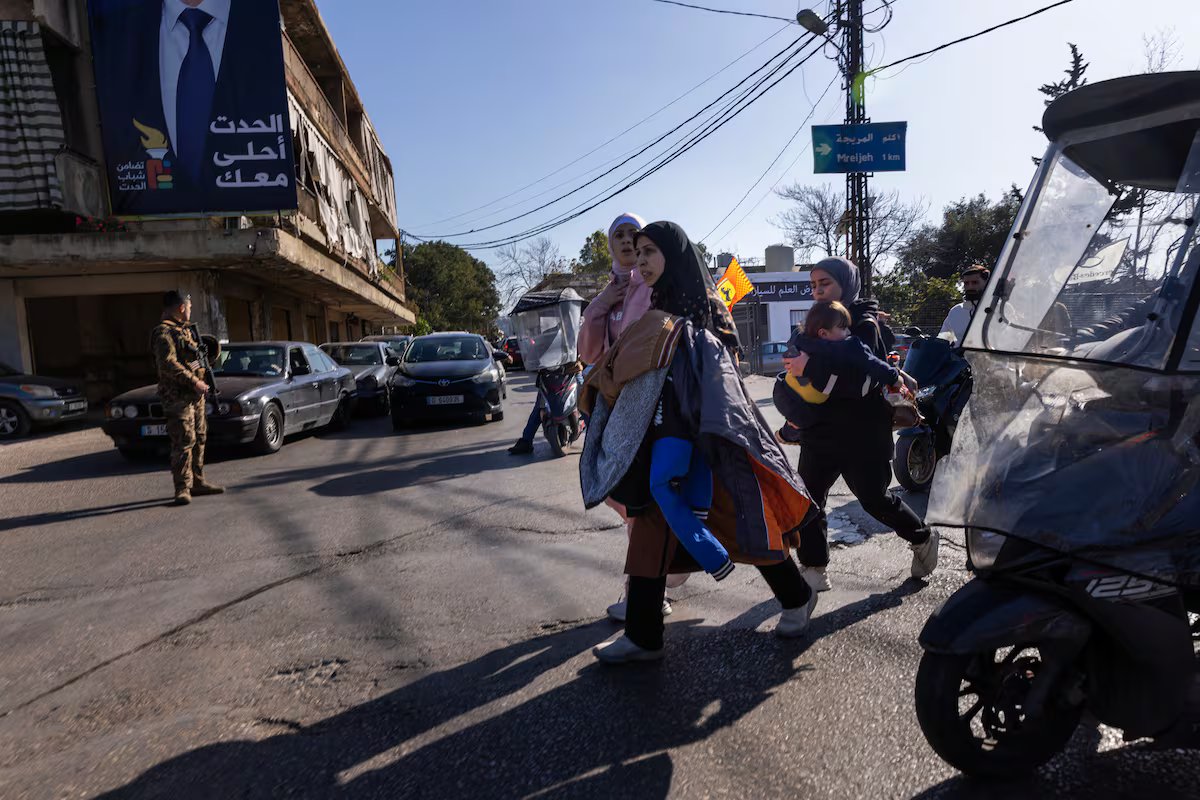
Hussein speaks cautiously. He is surrounded by a crowd moving in and out of the building, an educational center on the outskirts of Beirut that is currently serving as a shelter. Like him, many of the 1,000 families spending their days on mats in the inhospitable hallways are Hezbollah sympathizers. Questioning the rocket fire the pro‑Iranian group launched on Monday — triggering the brutal Israeli offensive that forced them to flee their homes — could offend sensibilities. Suddenly, after referring to the abuses Israel has committed against Lebanon “during the past 15 months of the ceasefire and for decades before,” Hussein opens up: “A war with Israel was inevitable, but this was not the time.”
The second war that the Hezbollah party‑militia has fought with Israel in three years — the third in two decades — has impacted Lebanon’s predominantly Shia communities (where Hezbollah is the de facto authority) much faster than in previous rounds of conflict. On Thursday, after ordering all residents of southern Lebanon to evacuate the day before, Israeli military spokesperson Avichay Adraee triggered further chaos by extending the evacuation order to the densely populated suburbs of Beirut. Together, the two directives affect more than 800,000 people.
Since Monday, the spread of Israeli airstrikes into areas where Hezbollah has no presence has hit communities beyond the Shia population — groups that, during the 2024 war, largely stayed on the sidelines and were able to maintain a degree of normality. This shift, combined with the arrival of waves of displaced people into regions already suffering economic hardship, is heightening social tension and fueling rhetoric that blames Shia communities as a whole for the renewed conflict triggered by Hezbollah, the largest Lebanese organization of that religious denomination.
Both sides point to the government as the main culprit. Those who are tired of the regional ventures of Hezbollah — long considered the most powerful armed militia in the Middle East — lament that the cabinet formed in 2025 failed to disarm the group in time, as required by the 2024 ceasefire agreement, even if no deadlines were set. They also criticize Hezbollah for tying Lebanon’s fate to that of Iran.
Meanwhile, Hezbollah’s supporters argue that the authorities, despite being the most pro‑Western in years, have been unable to prevent Israeli occupation and airstrikes.
“I couldn’t convince her,” said Hussein Ayash, 33, a resident of Chiyah, one of the four townships — along with Haret Reik, Hadath, and Bourj el Barajne — that Israel ordered to evacuate before striking Hezbollah. He was talking about his 73-year-old mother. “She says she doesn’t want to end up on the street,” he told the local press. “She’d rather die at home, so we’re staying.” Others left with only the clothes on their backs. “I haven’t told my children anything,” said a mother fleeing the area who preferred to remain anonymous. “I only told them we had to leave. But on the road, they understood everything and started crying.”
The route that thousands of families took on Thursday in search of safety felt like a corridor lined with recent defeats and scars. Before leaving Dahieh (Arabic for “the southern suburb”), they passed the craters where Israel destroyed residential towers in 2024. Farther along, hundreds of vehicles were jammed in front of a Blom Bank branch — the same one where Lebanese citizen Sally Hafez showed up with a gasoline can in 2022 to demand access to her own savings. That incident became the first of several popular bank raids amid strict capital controls.
Many people gathered near the Grand Serail, the site of the 2019 protests against Lebanon’s sectarian political system — demonstrations that ultimately ended in deep disappointment for a generation. Others stopped in Martyrs’ Square, the front line of the civil war until 1990. To the east, others moved away from the drones along the coastline of the Christian-majority area, where the Beirut port explosion occurred in 2020.
A portion of the exodus has reached the Muslim neighborhood of Hamra. There, Fatima, 21, welcomes them as a volunteer with a community project that distributes food, clothing, and hygiene supplies to the displaced. Fatima, wearing a hijab, is one of them. She lives in Deir Ames, a town near the Israeli border affected by the evacuation order, but she rents a room in Beirut, where she travels each week to attend university.
She uses the first-person plural when speaking about Hezbollah. “This didn’t start on Monday or October 7, 2023 [the day of the Hamas attack on Israel], but much earlier,” she said quietly, defending the new regional front opened by the Lebanese militia. Then her tone sharpened: “Everyone knows that [the Israelis] want to have Greater Israel [which could incorporate parts of southern Lebanon].”
Concerned, a coordinator from the project approaches her and asks her to lower her voice: “We are a humanitarian mission and we cannot become a target.” Fatima takes off her vest and goes outside to continue her argument. “I don’t know how anyone can say that the war started on Monday; the war never ended and things couldn’t be left like this. There are children who, during the ceasefire, saw their parents bombed before their eyes!”
On the other side of Beirut, as the sound of warning gunfire from residents in Dahiye echoes just a few miles away to alert residents about the evacuation order, Hussein recalls that Israel’s grievances against Lebanon go back to “before the birth of Hezbollah,” in 1982. “Israel has bombed us relentlessly during a 15-month ceasefire. When we respond, everyone protests,” he said.
He continued: “War with Israel was inevitable. That said, if you ask me, I don’t think it was the right time.” The global balance of power “is the same” as during the 2024 war, making it impossible “to achieve different results.” He notes that the community around Hezbollah is exhausted and impoverished. “Many people have no money, no home, and no way to move forward.”
In Ashrafieh, Beirut’s Christian district, Camille Mourani, head of political relations for the liberal and anti-sectarian National Bloc party, fears that the spiral of violence in Lebanon will change the country’s destiny. “What is happening this Thursday marks a turning point,” he said, referring to Israel’s demand to evacuate the suburbs. He believes Lebanon could become “the new Gaza,” and warns that the arrival of Hezbollah supporters into neighborhoods that are “fed up” with the organization could spark “unrest.”
Mourani believes the government should have disarmed the organization “by force” last year, since, he asserts, “it has the support of 70% of the people and the international community to do so.” He accuses the militia of having plunged the country into sterile debates for decades. “We’ve spent 40 years debating whether Lebanon should have one, two, or three armies. This is about common sense, not something open to multiple interpretations. And the existence of a militia is not something that can be debated.”
Sign up for our weekly newsletter to get more English-language news coverage from EL PAÍS USA Edition
