
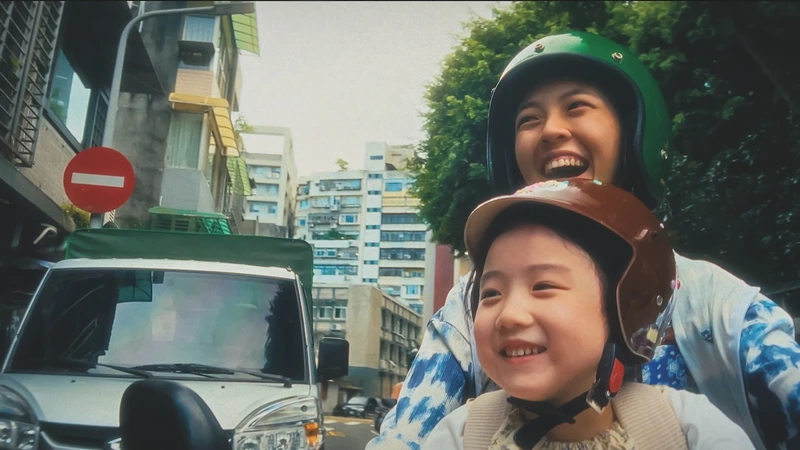
“Why is she eating with her left hand?” asks a grandfather (Akio Chen) to his family when he sees his youngest granddaughter, I-Jing (Nina Ye), eating her food with her left hand. I-Jian has just moved back to Taipei with her older sister, I-Ann (Shih-Yua Ma), and their mother, Chu-Fen (Janel Tsai), who has just opened a small restaurant in one of the stalls in a big night market. As they struggle to adapt to life in the big city, I-Jing starts behaving mischievously and oddly, believing that the devil is making her left hand do bad deeds.
Left-Handed Girl invites us to see the world through the eyes of a young kid through the cinematography, camera angles, and excellent performance by Nina Ye, a child actor who impressively delivers a sweet and touching portrayal of the main character. This allows us to witness the entire story through the eyes of a child who can easily believe that the devil leads her left hand if her grandfather says so. In many scenes, the camera quite literally puts the audience in the position of I-Jing. This is also true in the opening when the camera shows us the colourful world inside a kaleidoscope as I-Jing plays with it. The movie also often uses low angles to illustrate the perspective of a kid visually, and in shot-by-shot sequences.
The relationships between characters are key to the overall plot of the movie and the building blocks of its success. All the relationships between the main characters are portrayed very naturally and effortlessly, thanks to the great chemistry between the cast members. With moments of conflict as well as heartwarming connection, it perfectly portrays what being a family means, including the negative and less positive sides of it. This is especially true of I-Jing and I-Ann, whose sweet, playful, and sometimes conflicting bond drives some of the most emotional and best scenes of Left-Handed Girl.
Over the course of the film, the audience is immersed in the culture of Taipei. From their house to the local market where Chu-Fen has a stall, the viewers slowly become familiar with the city and its neighbourhoods. As the sisters reunite with their grandparents and the rest of the family, it also shines a light on familiar relations and responsibilities that many people can relate to but remain very culturally specific to Taiwan. Similarly, one of the biggest plot points of the whole movie – the negative suspicion around using your left hand that the grandfather often insists on – reflects the ideas of an older generation that ring true to traditional ideas in Taiwanese culture.
Overall, Left-Handed Girl is a charming and compelling drama about three generations of women and their journey of self-growth as they navigate both a new city and the traditional expectations that are placed upon them by society, and reinforced by the people around them. The film is an excellent solo directorial debut for Shih-Ching Tsou, who also co-wrote this with Sean Baker, which shows a clear voice and vision and makes us even more excited to see her future projects.
★★★★ 1/2
Screened at part of the 2025 BFI London Film Festival / In Select UK cinemas on November 14th, on Netflix from November 28th / Nina Ye, Janel Tsai, Shih-Yua Ma/ Dir: Shih-Ching Tsou / Netflix / 15
Related
Discover more from
Subscribe to get the latest posts sent to your email.
