

New airlift, targeted marketing campaigns and a sharpened focus on what makes it different are all tools in Los Cabos’ toolbox that it will be using to further stimulate its rapid growth in the Canadian market.
Speaking in Toronto recently, Rodrigo Esponda, managing director of the Los Cabos Tourism Board, made it clear that Canada is no longer a secondary play, but a priority market with a strong upside — particularly in Ontario and Eastern Canada.
Observing that Los Cabos has made a significant investment in Canada, Esponda said: “It’s the second largest international market after the United States,” he said, noting that Canadian visitors stay twice as long as American visitors.
Los Cabos welcomed roughly 215,000 Canadian visitors last year, with demand still heavily weighted toward winter travel. But the destination sees room to grow, especially as it works to convert indirect traffic into nonstop bookings.

“Out of all the cities, Toronto has the highest indirect travel,” Esponda said, pointing to a clear opportunity to expand direct service.
Discussions are already underway with airline partners, with Porter and Transat both eyeing potential new routes. “Porter will fly from Toronto… and they are analyzing other cities, Ottawa for example,” he said, adding that Transat is looking at Montreal. The goal is to have additional lift in place for the upcoming winter season. “This winter. From November. That’s the big season.”
But airlift is only part of the story. Los Cabos is also working to shift how Canadian travellers perceive the destination and how the trade sells it.
While often grouped with Mexico’s all-inclusive beach markets, Esponda positioned Los Cabos as something fundamentally different.
“I think it’s fair to say that it’s a luxury destination where the luxury is not in the hotels,” he said. “The luxury is in the experiences, in the connection that you can get.”
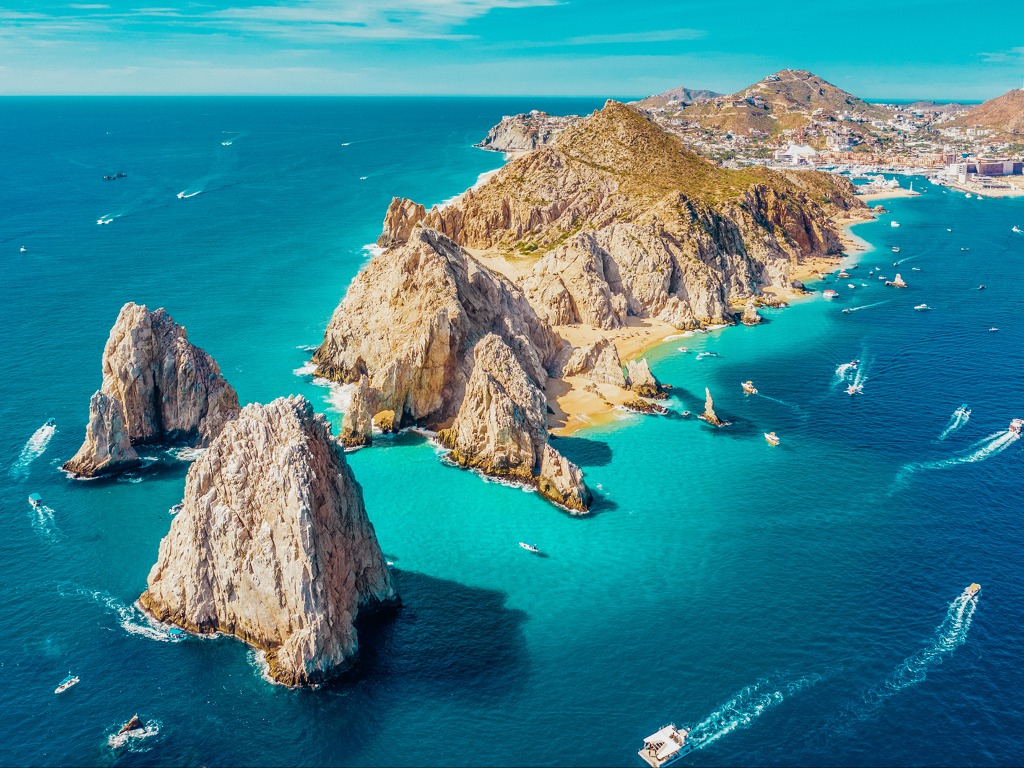
That message is rooted in the region’s geography. Located at the southern tip of the Baja Peninsula, Los Cabos brings together desert, mountains and ocean in a way few destinations can match.
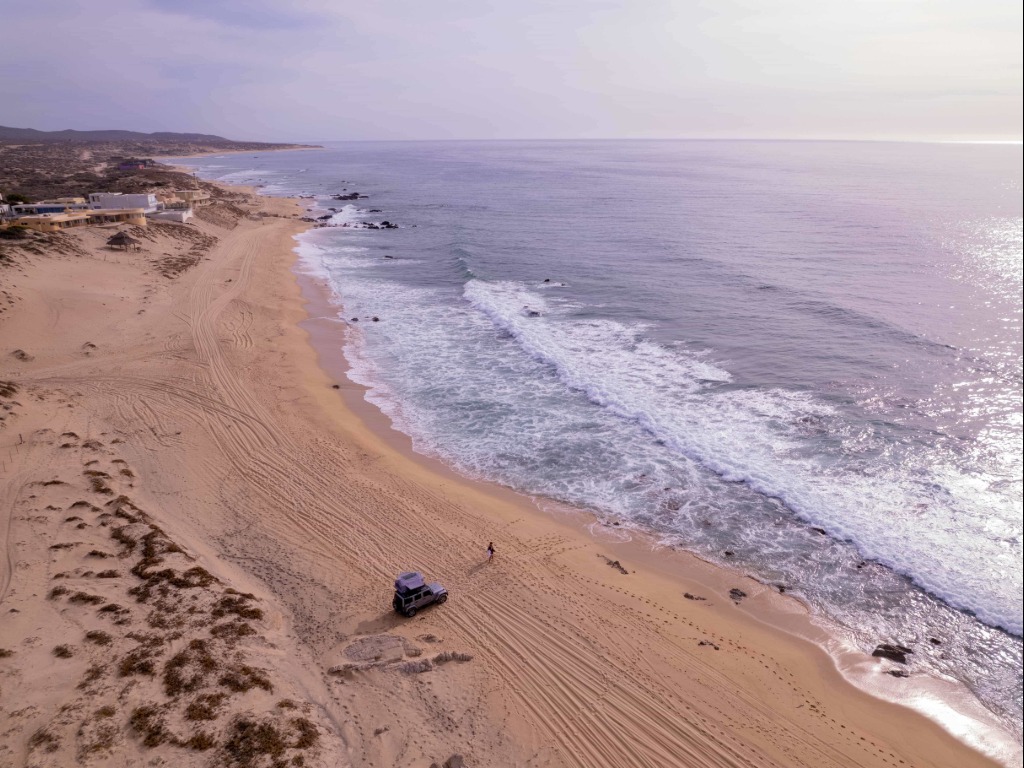
“It’s a combination of three ecosystems just in one spot, the desert, the ocean, and the mountain,” Esponda explained. “And the best of the destination is not inside the resort… the experiences are outside.”
That includes everything from hiking in the Sierra de la Laguna to wildlife encounters offshore, where the meeting of the Pacific Ocean and Sea of Cortez creates rich marine biodiversity. Visitors can regularly spot whales, rays and other species depending on the season.
It also means a year-round outdoor offering supported by a dry climate, a point Esponda highlighted with a touch of humour.
“In the winter, in the summer, you can do a hike or play golf because there’s no humidity,” he said. “I know that everybody loves mosquitoes, but we don’t have mosquitoes because it’s not humid.”
Beyond product, service is another key differentiator. Esponda pointed to the consistency of service levels across the destination, not just in hotels, but throughout the community.
“The service … not only in the hotels,” he said. “If you go out, the taxi driver… when you go to the Walmart store, the tellers, they all speak English.”
That, he noted, is a reflection of Los Cabos’ economic structure. “We don’t have any other industry,” he said. “We don’t have manufacture, mining… so the focus on the service is very strong.”
While Los Cabos has built a reputation as a luxury destination, Esponda acknowledged that it still offers a range of product, including high end all-inclusive resorts, but with a different positioning than more mass market destinations.
The emphasis remains on quality, personalization and experience, rather than scale.
For Canadian travellers, many of whom default to Cancun or Riviera Maya when considering Mexico, the challenge is awareness. Esponda said first hand exposure remains the most effective tool.
“We have been doing many different things with partners, with many media coming to the destination,” he said. “But we believe that that’s the only way that they will understand the destination.”
Even with presentations and visuals, expectations often shift once visitors arrive.
“Once they come, the feedback… is, ‘This is nothing what I was expecting.’”
To accelerate that shift, Los Cabos is aligning its marketing closely with airline partners, committing support tied directly to capacity.
“As soon as the flight is launched, we are going to support them heavily with some dedicated marketing campaigns,” Esponda said.
For the trade, the takeaway is clear. Los Cabos is not trying to compete on the same terms as other sun destinations. Instead, it is leaning into its differences, from geography and biodiversity to service and experience, while building the connectivity needed to support further growth out of Canada.
As Esponda put it, that aligns closely with how traveller expectations are evolving.
“Travellers now are not just looking for experiences,” he said. “They want to connect their emotions with the place.”
