
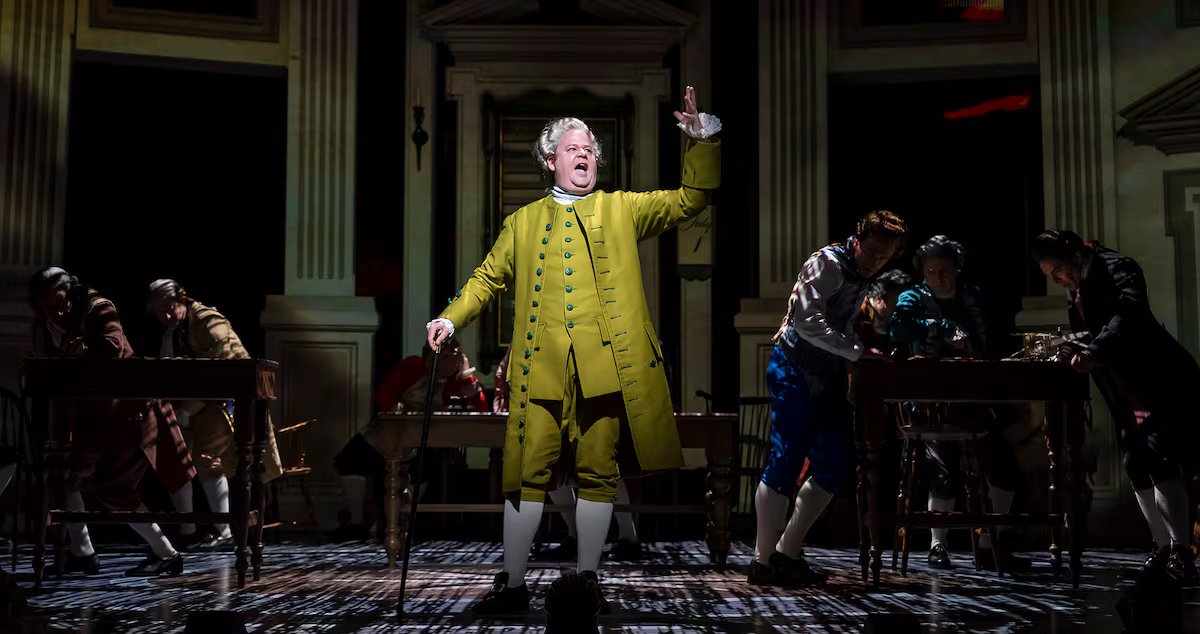
On the stage of the prestigious Ford’s Theatre, the director and choreographer Luis Salgado is presenting a new version of the play 1776, which sets up a dialogue between the past and present of the United States. The March 18 premiere coincided with the beginning of the 250th anniversary celebrations of the country’s independence, a fact that Salgado considers significant. One of the most active voices of Latino theater in the United States, Salgado not only revisits a classic of the musical genre, he does so from a perspective that directly questions the country’s fundamental contradictions. “For me it is a great honor that they have selected a Hispanic director to tell the story of what the Declaration of Independence is,” he says.
While reconstructing the debates of Congress around independence from Great Britain, Salgado’s version of the play adds a new layer to its interpretation. The director focuses on one of the central tensions of the text: the decision to move towards freedom while overlooking the rights of enslaved people. “It’s precisely this central issue that drew me in when I saw the material for the show,” Salgado explains to EL PAÍS. “All of these founding fathers decide to fight for the Declaration of Independence at the cost of erasing and ignoring the clause that upheld the human rights of those who were enslaved at the time.”
Salgado’s vision also incorporates a sound element that expands on this historical conflict. Together with Colombian pianist and composer Daniel Gutiérrez, Salgado introduces Afro-Antillean nuances into the original score. “It is a dialogue and collaboration between the military drum and the African drum. They’re not competing, they’re talking to each other, because all of our voices matter,” he explains.
Directing a work deeply linked to American identity from a Latino perspective is not without its issues. However, the manner in which the production has been received has confirmed to Salgado that he was on the right track. “For me, satisfaction is listening to and reading the Anglo reviews that focus on exactly what I am telling you,” he says. “The work is wonderful, the book, the music is incredible, and I thank life and the gods of art that this work has been put in my hands.”
The balance between reinterpretation and respect for the original has been one of Salgado’s main challenges. In a traditional theatre such as Ford’s, where diverse audiences converge, the director has opted for a strategy of dialogue rather than confrontation. “I was very aware that I don’t win if I’m so provocative that the audience leaves me halfway through the first act,” he says. “I have been conscious of being very cautious with my proposal for its direction.”
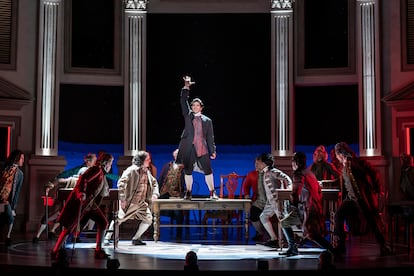
It is this same spirit of dialogue that Salgado hopes to inspire in the audience. More than offering answers, Salgado seeks to open up the debate. “For me it would be beautiful if, at the end of the show, people who see the world with different perspectives want to go out and have a beer together and talk about 1776,” he says. And he flags up the importance of reaching new generations: “The public that comes also includes many high schools, many university students. [It is important] that these young university students have the desire to continue learning and to continue questioning our history and American patriotism itself,” he says.
Born in Puerto Rico, an unincorporated territory of the United States, Salgado states that patriotism is fine as long as we are aware “that we only have 250 years of history, and that before we were here there was a lot of other history that we cannot ignore, and that within our history there are the many mistakes that we have made” as a country. Remember, he says, that all this must be taken into account “before going to vote, before going to protest, before criticizing a person who seems to be different.”
Salgado establishes explicit parallels between the debates of 1776 and the current political climate: “I think that is the magic,” he says. “One of the most beautiful things about this show is that, before there was independence, there was debate.” He adds that, in his opinion, the tragedy of today is that “in our current political system there is almost no debate; we are moving towards a system that is somewhat totalitarian.” And he flags up the fact that ICE agents (Immigration and Customs Enforcement) are now deployed at the country’s airports.
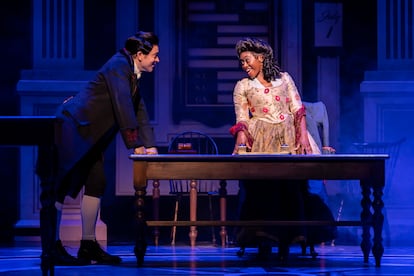
And although Salgado insists on the importance of debate and different ways of thinking, he also insists that “within that difference of thought we have to listen to each other, looking for what is the best result for the country. And that is precisely what happened in 1776.”
The play acts as a reminder to Salgado of the importance of disagreement and compromise: “Let’s not stop listening, let’s allow debate and, through debate, let’s find the most coherent answer for our nation,” he says. “It’s important that we also know that there are people who are trying to fight for that kind of debate, for that kind of balance, but we’re calling them leftists and radicals, and we’re censoring them,” he adds.
Salgado’s career is currently taking off beyond explicitly Latino narratives. With a trajectory that includes Broadway, off-Broadway and international stage productions, including In the Heights and On Your Feet, Salgado champions a broader vision of the place of Latino artists in American theater. “For me, redefining American theater through the Latino lens is my mission right now,” he says. “But think about it. When can we, as Latinos, tell stories, like 1776? That’s where expansion has to happen.”
Running alongside the premiere of 1776, which can be seen at the Ford’s Theatre in the capital until May 16, Salgado is preparing the debut of Aguardiente at the GALA Hispanic Theatre on April 30, an original project developed over three years with the Colombian composer Gutiérrez. “Aguardiente is our new baby,” he says.
Both productions, although different in themes and origin, explore identity, memory and belonging. In Salgado’s hands, the theater becomes a meeting space where history is not a closed story, but an ongoing conversation.
Sign up for our weekly newsletter to get more English-language news coverage from EL PAÍS USA Edition
