
Gustavo Prado, director of Trendo.mx, an agency that tracks trends in Mexico, recently
argued that, unlike previous waves, today’s migrants are not contributing anything to
Mexican culture. To illustrate his point, he invoked the long list that history offers of
earlier counterexamples — Edward Weston, Leonora Carrington, Luis Buñuel, Tina
Modotti — entire constellations of people who remade the country’s cultural landscape.
I don’t think you need to be a public figure, much less a famous one, to leave a mark on
Mexican culture. Every day lives, anonymous practices, and small decisions also
reshape how we live. Still, Prado’s comment did inspire me to revisit those migrants who
did become visible and who chose Mexico as their home — and, in doing so, changed
the way our culture is built, seen, and felt.
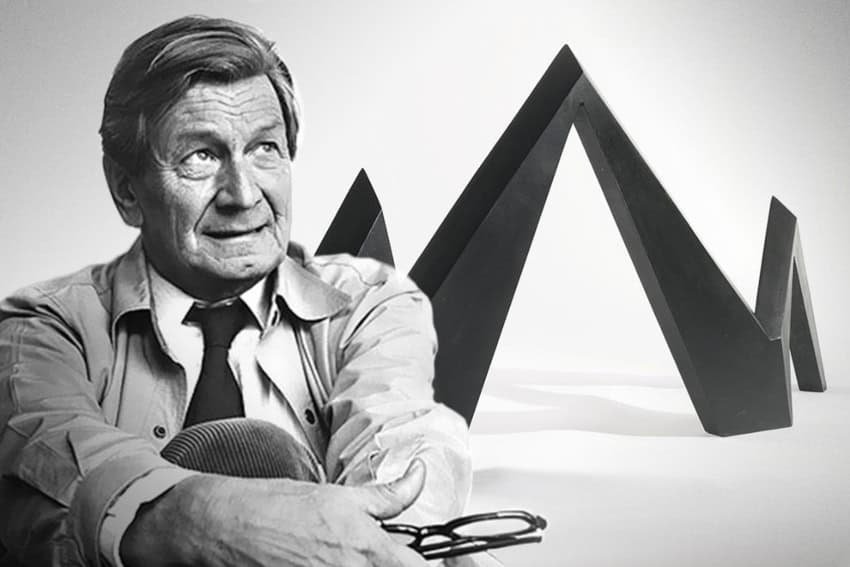
I want to begin with Mathias Goeritz, because his name quite literally helped construct
Mexican modernity. Without him, the streets of Mexico City — and our visual idea of
what “modern Mexico” looks like — would be radically different.
Who was Mathias Goeritz?
He was born in Danzig, Germany, in 1915, and we know relatively little about his
childhood beyond the fact that it unfolded between two world wars. As a boy, his family
moved to post–World War I Berlin, then perhaps the most cosmopolitan city in Europe:
a place of cabarets and cinemas, manifestos and street protests. His father, a counselor
and mayor of Berlin, was a cultivated, liberal man deeply committed to the democratic
ideals of the Weimar Republic. He died before witnessing the collapse of those ideals
and Hitler’s rise to power in 1933, but not before passing on to his son a love of freedom
and of the German cultural tradition — a legacy that Goeritz carried, and questioned, for
the rest of his life.
As a young man, Goeritz came into contact with artists who were transforming
Germany’s cultural landscape through the avant-garde. Those encounters were decisive.
They nudged him toward philosophy, which he studied formally, eventually completing a
doctorate in Art History. That combination — philosophical training and artistic
obsession — would later surface in his theory of “emotional architecture.”
Leaving Germany
With Nazism on the rise and another war looming, Goeritz left Germany and settled in
Morocco. From Tetouan, he wrote to his mother, who had stayed behind: “I feel as if I
were walking through a distant past, in a strange biblical environment, and I do not
know how to reconcile this new reality with that other one I am fleeing from.” Morocco
never quite became home.
Goeritz moved on to Spain, where he spent four years. On a visit to the cave paintings
of Altamira, facing images that were both prehistoric and startlingly contemporary, he
became convinced that he needed to call on young Spanish artists to set aside their
quarrels and unite around shared principles of harmony and a more global imagination.

In Franco’s Spain, this sounded dangerously utopian. His almost hippie-like appeal for
unity was badly received, and he was gradually ostracized. Realizing that an artistic
career in Spain would be nearly impossible under those conditions, Goeritz decided to
move again. This time, his destination was Mexico.
Mathias in Mexico
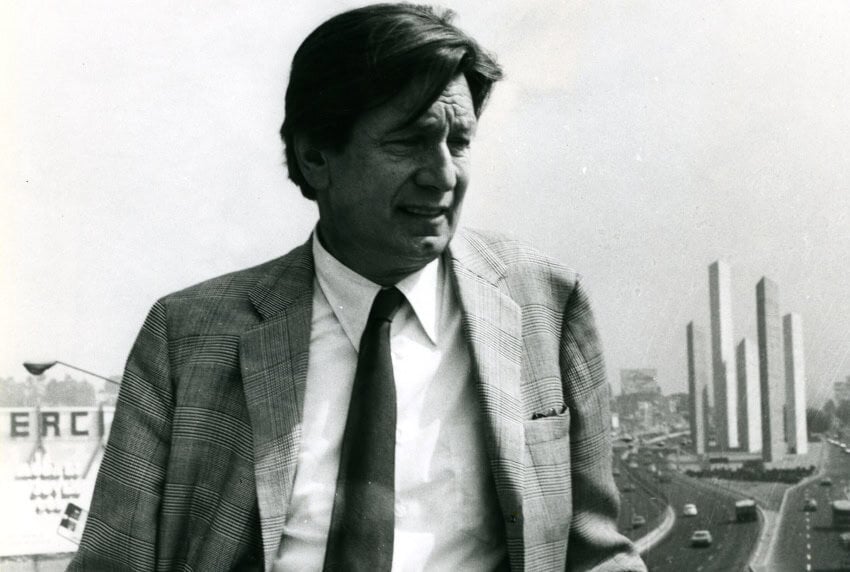
Goeritz arrived in Mexico in 1949 to teach at the new School of Architecture in
Guadalajara. He quickly found a circle of refugee artists and Mexican creators willing to
listen to his ideas and argue back. It was a fertile environment for a newcomer who saw
art as a conversation rather than a monument to the past.
From the beginning, he was struck by Mexican urbanism, by pre-Hispanic architecture,
and by the expressive power of sculpture. His teaching in Guadalajara brought him
closer to key figures of Mexican modernism. His new friends eventually convinced him
to move to Mexico City, where the artistic scene truly was.
By the 1950s, the nationalist art that had defined postrevolutionary Mexico no longer
spoke to younger artists. For those poised to succeed Diego Rivera, David Alfaro
Siqueiros, and José Clemente Orozco, painting revolutionary heroes and slogans more
than thirty years after the end of the Mexican Revolution felt like repeating a script
whose urgency had faded.
In this context, he positioned himself squarely on the fault line between official muralism
and new abstract tendencies. His artwork made him a target for the hardline group of
artists led by Siqueiros, who publicly attacked him as hedonistic and detached from
national concerns. That conflict cemented Goeritz’s position as a cosmopolitan outsider,
challenging the nationalist canon and proposing a different way of understanding what
is “Mexican”: less illustrative, more spiritual, more urban.
Why does he matter in Mexican culture?
If I had to condense his impact, I would highlight three key areas.
Monumentality
Drawing on pre-Hispanic art and theoretical texts, Goeritz embraced monumentality as
both homage and discipline. It was his way of honoring Mexico’s pre-Hispanic past while
forcing himself to work with extremely simple forms capable of enormous visual impact.
Think of the Torres de Satélite or the sculptures of the Ruta de la Amistad: austere
shapes, massive scale and almost no figurative detail.
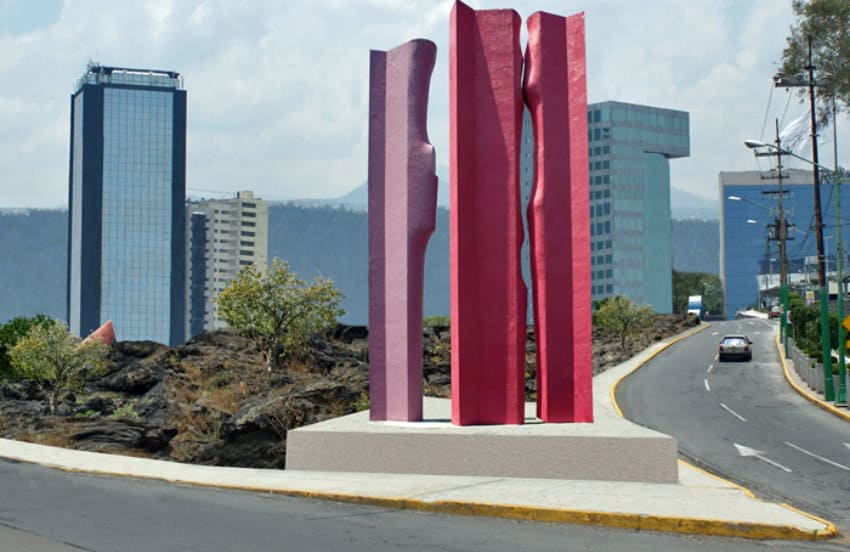
In these works, the “heroes” are no longer generals or workers, but geometry, color,
volume and rhythm. Monumentality becomes a language of forms that anyone can
read, whether or not they know the names of the artists involved.
Public art and the urban landscape
Monumentality, for Goeritz, was inseparable from the idea of public art. He was
convinced that art should be experienced by everyone and woven into the everyday
fabric of the city. As a man in love with modernity, he placed his pieces along newly built
avenues and highways, not hidden in museums.
By situating works beside the Periférico beltway, he calculated that they would be seen
at high speed, and that this movement would transform how people perceived them.
The Torres de Satélite and the sculptures of the Ruta de la Amistad were conceived as
experiences for motorists: abstract forms unfolding as you drive, turning a commute into
an unexpected aesthetic encounter with your own city.
Emotional architecture
Remember that Goeritz began as a philosophy student, and his concept of emotional
architecture grows out of a strand of modern German thought that resisted both pure
functionalism and empty aestheticism. For him, architecture should offer an aesthetic
and almost religious experience, not simply maximize efficiency or productivity.
Spaces, in his view, had to provoke feelings: awe, silence, disorientation, contemplation.
He wanted buildings and sculptures that did not just guide bodies through space, but
also unsettled and reoriented the inner life of those bodies.
Which Mathias Goeritz works can I see in Mexico?
Experimental Museum El Eco (1953)
El Eco was conceived as a “total work” and as the first full exercise in Goeritz’s idea of
emotional architecture. It breaks sharply with the functionalism that dominated Mexican
architecture at midcentury. The building operates as a kind of labyrinth: asymmetrical
walls, sudden shifts in scale, and dramatic contrasts of light and shadow are all
orchestrated to provoke an emotional response in the visitor. Inside, you can still see
the monumental Serpiente de El Eco, a sculptural piece that descends from his early
experiments with animal forms.
Torres de Satélite (1957–58)
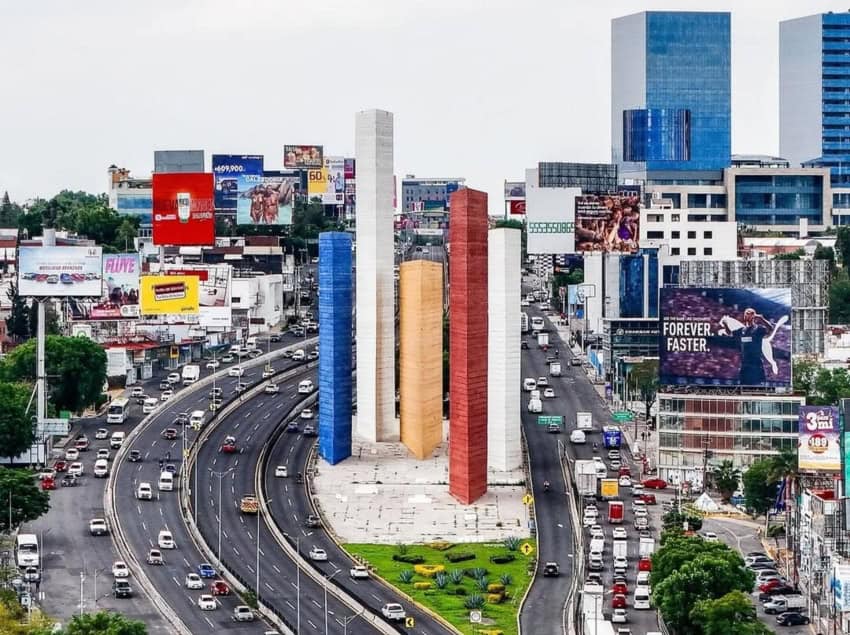
Designed together with Luis Barragán and Jesús Reyes Ferreira, the Torres de Satélite
are five triangular concrete prisms of different heights and colors that rise at the
entrance to Ciudad Satélite, becoming an emblem of Mexican midcentury modernity.
They are among the earliest examples of large-scale urban sculpture in the country,
conceived explicitly to be seen from a moving car: five blind concrete towers, in varying
heights and tones, set against the endless flow of traffic.
Barragán and Goeritz thought of the ensemble as an exercise in emotional architecture:
planes of color and volume designed to trigger awe, contemplation and an almost
spiritual sensation right in the middle of the highway.
Ruta de la Amistad (1968)
As coordinator of the sculptural project for the 1968 Olympic Games, Goeritz laid out a
corridor of abstract sculptures by international artists along the southern stretch of
Mexico City’s Periférico beltway. The intention echoed that of the Torres de Satélite: to
give drivers a sequence of monumental forms that would turn the ring road into a kind of
open-air museum, a moving dialogue between local modernity and global artistic
networks.
The Ruta de la Amistad — seventeen kilometers long, with nineteen main sculptures
and several additional invited works — helped cement Mexico’s role as a host for
international public art, even as some of its pieces would later suffer from neglect and
urban expansion.
Final thoughts
Goeritz opened the way for a younger generation of artists to move away from
nationalist themes — the very kind of instrumentalized imagery that had pushed him out
of his own country. For him, art was not a propaganda device but an aesthetic
encounter that needed to step outside the museum and enter public space,
transforming buildings, highways and plazas into places that could make us feel.
He did not simply impose his vision on Mexico; he allowed himself to be transformed by
the country’s landscapes, histories and contradictions. In that sense, he embodies
exactly what I believe about migration: that it enriches not only those who move, but
also the places that receive them — not through fame alone, but through new ways of
seeing and inhabiting the world that gradually become part of everyday life.
Maria Meléndez writes for Mexico News Daily in Mexico City.
