
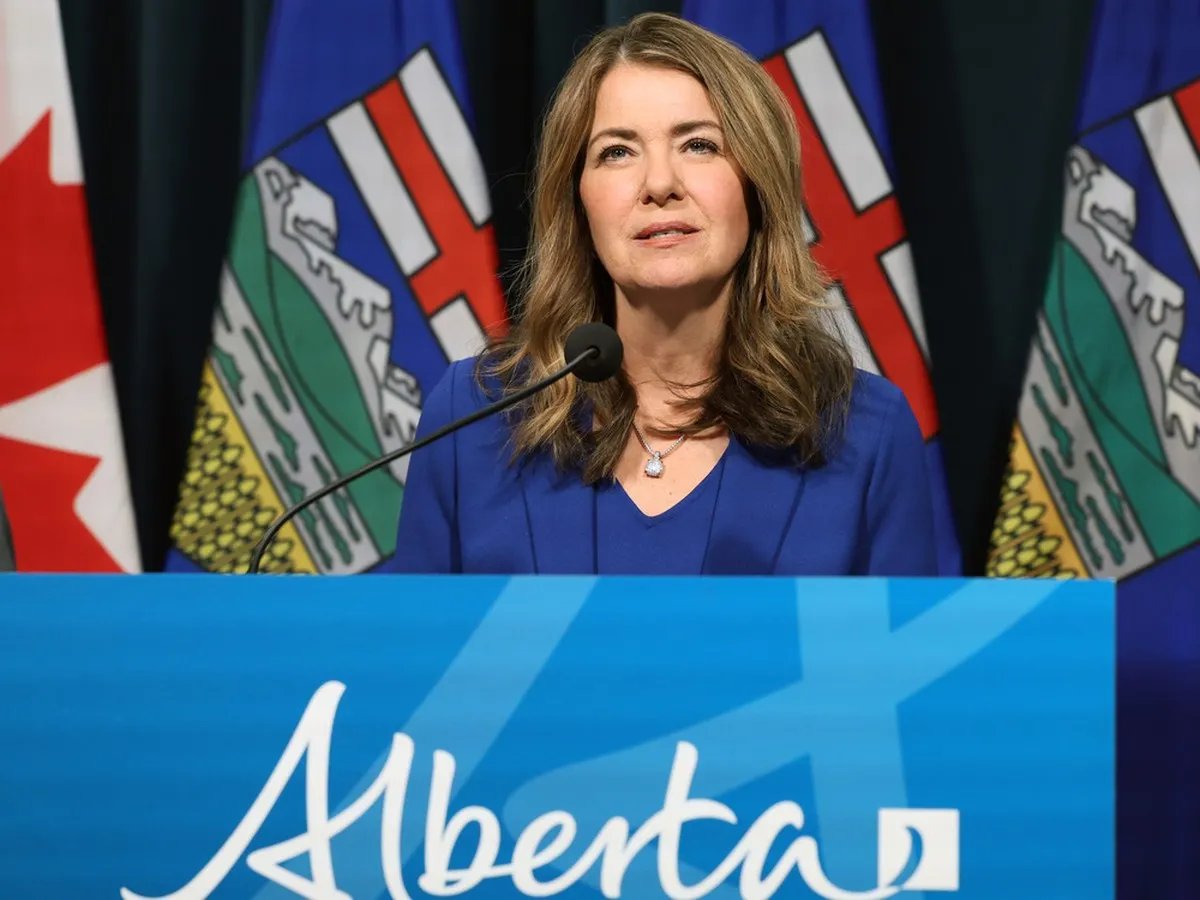
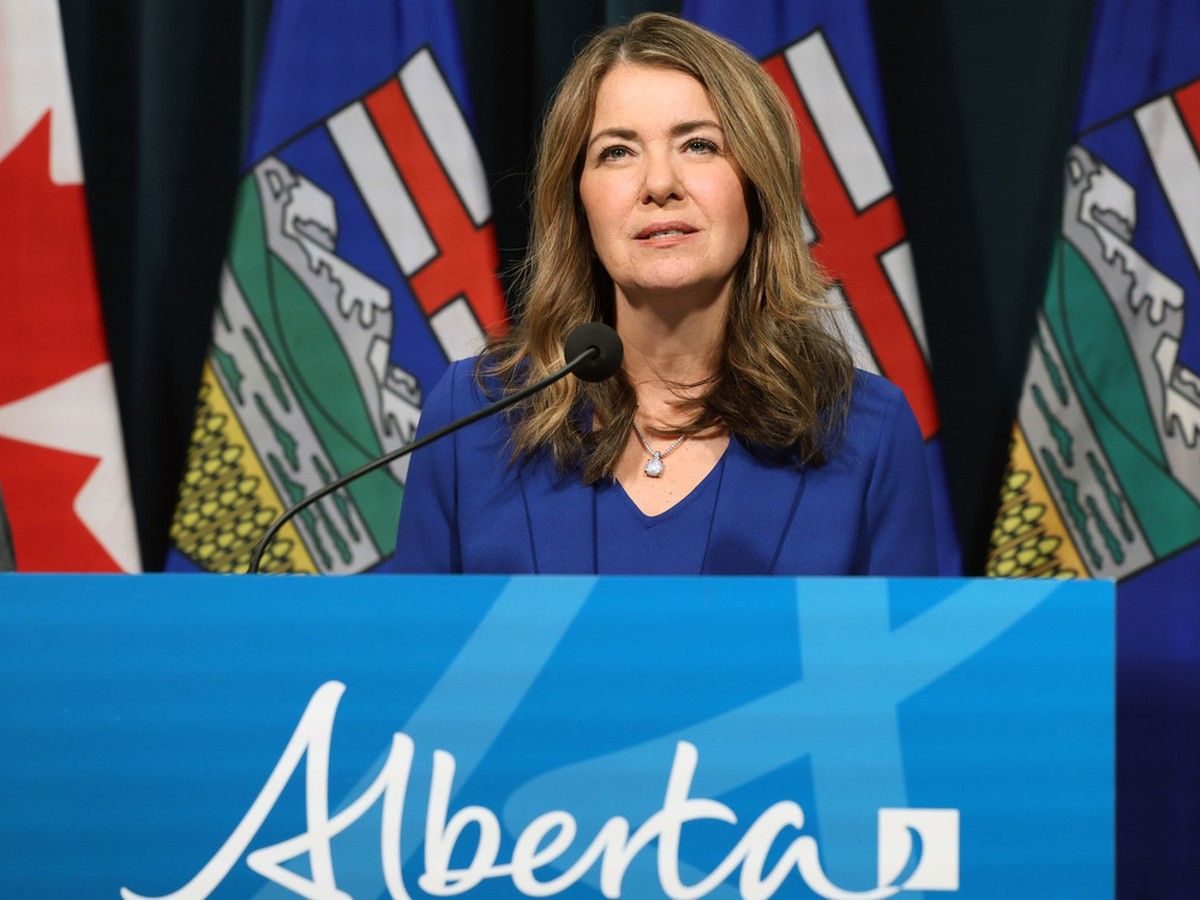
Most Albertans support Premier Danielle Smith’s immigration-related policy proposals, including a referendum question aimed at restricting non-permanent residents from accessing health care, education and other public services in the province, according to a new Postmedia-Leger poll.
Asked whether they would agree with confining such services to Canadian citizens, permanent residents and provincially approved immigrants, 63 per cent of respondents said they supported the proposal, with 37 per cent “strongly” in favour and another 26 per cent “somewhat” supportive. By comparison, 25 per cent strongly or somewhat opposed the idea, while the remaining 12 per cent said they weren’t sure.
The question is just one of nine that Smith
intends
to put to Albertans in a referendum later this year, which comes as record-high immigration levels have put greater strain on the province’s health-care and education systems.
Those pressures came into sharper focus late last month when Alberta
projected
a $9.4-billion deficit in its annual budget, partly as a result of lower oil prices at the time but also due to a rapid increase in spending on social services. As part of a
televised address
to Albertans on Feb. 19, Smith proposed a range of referendum questions centred around trimming immigration levels and paring immigrants’ access to health care and education, among other things.
In the Leger poll, respondents were also supportive of a separate referendum question that considers forcing non-permanent residents to pay “a reasonable fee or premium” for access to health care and other services. To that proposal, 64 per cent of respondents were strongly or somewhat supportive, while 24 per cent were opposed and 12 per cent didn’t know.
Survey respondents were most supportive (66 per cent in favour) of a proposal to force non-permanent legal immigrants to live in Alberta for at least 12 months before applying for provincial social support programs.
Andrew Enns, executive vice-president of Leger’s central Canada operations, said Alberta’s proposal to adjust access to public services for newcomers appears to have support across regional and even partisan lines.
“The results say to me that Premier Danielle Smith and the government have landed on policy positions that are in sync with a strong majority of Albertans
— positions that enjoy
strong support in Calgary, Edmonton and elsewhere in the province,” he said in an email. “The policies even have reasonable cross-party support, with a sizeable per cent of NDP supporters open to the positions.”
Openness to such proposals comes as concerns about the stability of the health-care system — in Alberta and other provinces — runs high.
According to the Leger poll, health care was the single-biggest concern among respondents, with 24 per cent saying it was the most important issue facing the province. That result is much higher than the next-biggest concerns, which were the economy (13 per cent), inflation (10 per cent) and Alberta separatism (nine per cent).
On the matter of separation, respondents were largely in favour of Alberta remaining a part of Canada, with 70 per cent saying the province should stay put. Seventeen per cent said the province should become an independent country, four per cent said it should join the United States, and nine per cent said they weren’t sure. That is mostly in line with Leger’s last survey in January 2026, which found 71 per cent of respondents in favour of remaining in Canada.
Still, a majority of people said they were concerned about the prospect of Alberta separating from Canada, with 27 per cent “very” concerned and 32 per cent “somewhat.” Thirty-seven per cent were not concerned and five per cent said they did not know.
Leger’s Enns said there is likely a mismatch between pro-separatist and pro-confederation voters in terms of the degree to which they hold their respective views. That in turn might help explain why the independence issue attracts so much attention but seems to enjoy decidedly minority support, he said.
“I’m not surprised that there seems to be a disconnect between what is seen in the public versus the actual positions held by Albertans,” Enns said. “The term ‘silent majority’ comes to mind. I suspect those advocating for separation hold the view more intensely than those who want to remain in Canada.”
Smith has not explicitly backed Alberta’s separation effort, and has instead held a
position
of a “sovereign Alberta within a united Canada.”
The premier has also remained at odds with Ottawa on various policies including Prime Minister Mark Carney’s continuation of the gun buyback program and environmental policies targeting oil and gas producers. Like Quebec, Alberta has proposed establishing its own police force and pension plan to create further separation from federal policymakers.
On the question of whether Alberta should establish its own Provincial Pension Plan and break away from the federal asset manager, 55 per cent of respondents to the Leger poll said “no” while 25 per cent said “yes,” almost exactly in line with public opinion in August 2024. (Twenty per cent of respondents said they were not sure.)
Smith’s approval rating increased one percentage point since October 2025, with 39 per cent saying they approve of Smith as a leader. That is almost equal to the 38 per cent who approve of NDP Leader Naheed Nenshi.
The Leger poll surveyed 1,001 Albertans online between March 2 and 4. A margin of error cannot be determined in an online panel survey, but for comparison purposes a probability sample would have a margin of error of plus or minus 3.1 per cent, 19 times out of 20.
Our website is the place for the latest breaking news, exclusive scoops, longreads and provocative commentary. Please bookmark nationalpost.com and sign up for our daily newsletter, Posted, here.
