
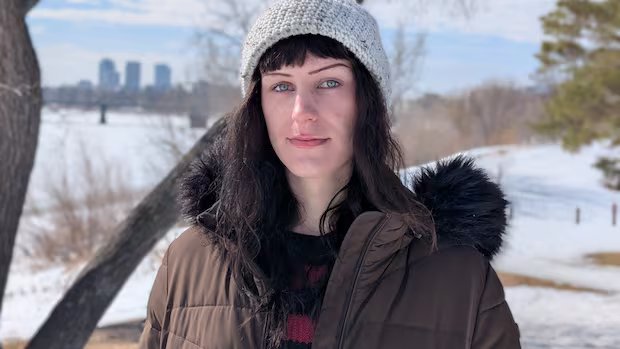
A Ukrainian refugee says Manitoba’s rejection of her requests to help her remove her deadname from official documents leaves her exposed to transphobia and infringes on her right to express her gender.
Martha Hozha, 25, says she’s been trying to change her legal name since she arrived in Canada about two years ago, but the provincial government will not accept the documents she has proving her identity.
“This misrepresentation creates a loop for harassment and transphobia,” Hozha said.
“Using [the] right pronouns and right names, legally, is [a] pretty important thing.… It basically affects [the] majority of your life.”
Officials issued Hozha a refugee protection ID — a document that confirms a person has made a claim — when she applied for asylum around 2023. The Canadian-issued ID identifies Hozha by her birth name, and also says she’s male.
Hozha said it’s her only government photo ID because her Ukrainian passport was seized when she claimed asylum.
Immigration, Refugees and Citizenship Canada said last fall that foreign nationals who are in the country must make a request with their associated provincial or territorial authority in order to change the names that show up in the documentation, except for clerical errors.
A decision accepting Hozha’s asylum claim from October referred to her by her birth name, saying she was also known as Martha Hozha. Hozha said the Manitoba Vital Statistics Branch, which processes name-change applications, didn’t accept the decision or the photo ID.
Susan Ursel, a partner with law firm Ursel Phillips Fellows Hopkinson, said Hozha has an argument that the refusal violates her Charter rights as well as protections under Manitoba’s human rights code.
“I think that it’s discriminatory,” the Ontario-based human rights lawyer said.
“It’s discriminatory against the refugee on the basis of their gender identity and their gender expression, and potentially their national and ethnic origin.”
Refusal ‘not clearly wrong’
The Manitoba ombudsman told Hozha in February it would not be launching a formal investigation into the matter, saying the refusal was “not clearly wrong or unreasonable.”
The decision said the province accepts citizenship certificates or permanent resident cards for name-change requests but not foreign passports, foreign birth certificates, landing documents or refugee protection ID.
“I know I could change my name after getting a permanent residency…. but it’s already been two years,” Hozha said.
“I’m currently waiting for a permanent residency, [which] might take nearly a year and a half more. So, I believe three years is a pretty long time to live without matching documents.”
The ombudsman’s decision said provincial officials were advised by Immigration, Refugees and Citizenship Canada that changing names based on refugee protection ID could create opportunities for people to commit fraud. An identity could be self-declared if an asylum seeker came to Canada without identity documents, the federal department advised.

A spokesperson for Manitoba Public Service Delivery Minister Mintu Sandhu, whose portfolio includes the Vital Services Branch, said the province is committed to reducing barriers while “balancing safety and transparency.”
The spokesperson said accepting anything other than citizenship or permanent residency documents could impact a person’s asylum claim. Immigration, Refugees and Citizenship Canada does not recognize name changes for foreign nationals that occur abroad unless their foreign passport is amended to reflect the new name.
“I’m not sure that the answer that they cannot change the name because other government offices might get confused … would withstand scrutiny,” Ursel said.
“Any other person is able to change their name, regardless of the fact that they might have involvement with, let’s say, [the Canadian Revenue Agency]. So, I mean, these things can be solved.”
The ombudsman said in a statement that the office can’t comment on specific matters but that it’s impartial when it looks at government’s practices and whether they’re consistent with the law. The office said it is not an advocate and does not have authority to direct public policy.
Rights can’t be taken for granted: advocate
Celeste Trianon, founding director of Juritrans — a Montreal-based legal clinic that helps trans people who want to change their ID — said she regularly sees cases where trans migrants don’t have documentation that’s accepted by provincial officials. Trianon said there’s often “no way out of it,” which can make life for a trans person “untenable.”
“Let’s say … [you’re signing] a lease,” she said. “You show the ID, the photo is completely different than who you were five years ago. Your name appears different, the gender appears different. Suddenly, you’re seen more as a liability than … anything else.”
Trianon said that while Manitoba expanded its human rights code to cover gender expression last year, this case shows those rights can’t be taken for granted.
“A protected person … becomes a member of Canadian society,” she said. “That person … is a Manitoban. So, why isn’t the Manitoba government treating her as such?”
Lenny Emson, director of development with KyivPride Canada, said he’s seen similar cases to Hozha’s in Ontario, where he lives.
He said with changes in immigration policy and long wait times for processing, there’s no guarantee Hozha will get the documentation she needs any time soon.
“When they use your deadname, it really triggers your gender dysphoria,” Emson, who is trans, said.
“Very often, I get emails and mail … addressing me by my deadname,” he said. “Every time … my heart just drops. That’s how it works.”
