
Large pharmacy benefit managers have come under scrutiny for their opaque business practices so much so that the term PBM has become mainstream. PBMs are routinely blamed for driving up costs of prescription drugs and have been regularly mentioned in the mentioned in the corridors of Congress as an industry needing reform. The top 3 PBMs in the U.S. manage 80% of the nation’s prescriptions.
But there are alternatives to the vertically integrated PBM behemoths. One such is Abarca Health, which is adopting a flexible approach to pharmacy benefit management. In this approach, multiple partners can engage with payers based on each entity’s strengths, and that fundamentally reshapes how PBMs operate. This model also addresses the issue of lack of transparency that has dogged legacy PBMs.
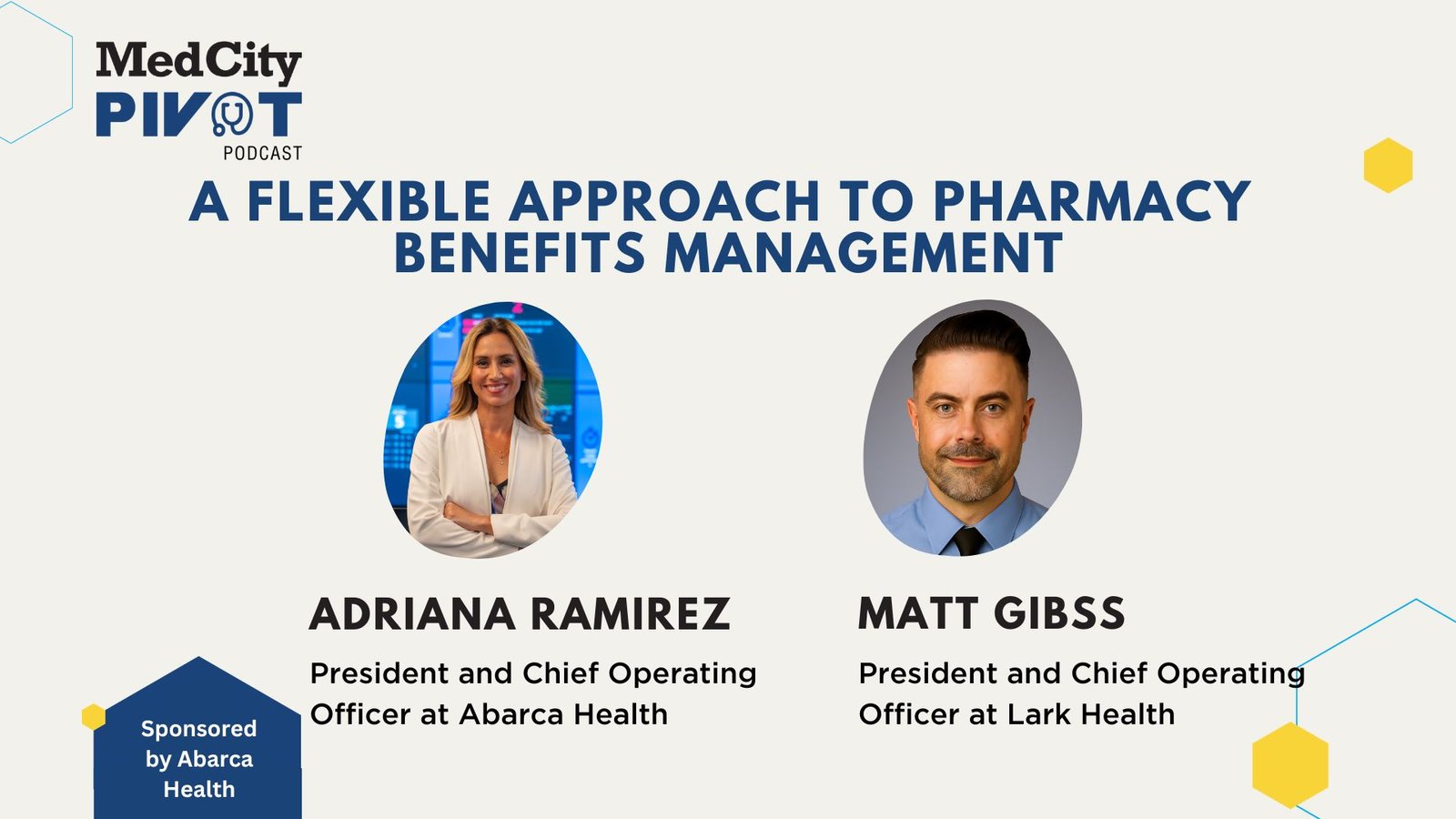
In this episode of the MedCity Pivot podcast, Adriana Ramirez, the company’s president and chief operating officer, and Matt Gibbs, president and chief operating officer of Lark Health, dive deeper into this modern approach toward how PBMs operate.
The episode is presented by Abarca.
View the discussion here
Here’s the audio of the podcast.
Here’s an AI-generated transcript of our conversation:
Arundhati Parmar: Hello and welcome to Med City’s Pivot Podcast. Today we’re talking about pharmacy benefits management and a more flexible approach to it. Now, each year, employers and payers are battling the rising costs for providing pharmacy benefits. There is some evidence to show that they’re looking for new approaches to manage and reign in these costs.
In fact, Mercer published a study earlier this year that showed that 61% of employers with 500 or more employees were reevaluating new approaches to either manage or offer the pharmacy benefit. In fact, there is some evidence also that companies and payers are reevaluating their current relationships with their PBMs.
So what is this flexible approach? We have two guests today that will help address what those new approaches to pharmacy benefit management can be. We have Adriana Ramirez, president and Chief Operating Officer of Abarca, a modern PBM, and Matt Gibbs, president of Lark Health, which offers coaching round the clock for people battling chronic conditions.
This episode is sponsored by a Abarca.
Arundhati Parmar: Hello, Matt and hello Adriana. Welcome to MedCity’s Pivot Podcast.
Speaker 2: Hello. Thank you for, for having us.
Arundhati Parmar: So Matt, let’s start with that quick definition. What do you actually mean by a flexible or modular approach to pharmacy benefits management?
Matt Gibbs: Sure. I, like to think of it as, you know, we’ve all been to an all you can eat buffet, whether we want to admit it or not. And you go and you pay your $20 and you’ve got all these options to eat, but all you know is you paid $20. So if you ate nothing but crackers, they made a lot of money that day. If you ate prime rib for an hour, they probably lost money.
But here’s the thing, you never know what you, what you really ate in terms of your value and that, and that is what’s. Kind of thinking about the food metaphor here with pbm, it’s sort of an all you can eat scenario where you’re able to pay a certain price and you get a whole set of services, but you don’t really know what those individual services cost.
And if you tried to negotiate one thing. Everything else moves along with it. And so when you break it apart, you get visibility into what we would call unit economics, which puts you in a much better negotiating place and gives you visibility into your actual costs by, by, by service stream, if that
makes
Arundhati Parmar: So, um, yeah, it does. So Adriana, if you could drill a little bit deeper into that, given that you are a flexible, um, you know, PBM, you’ve adopted that approach, uh, within your company, uh, what. You know, talk to me a little bit about how that system works. In other words, when you go to a pair or if you go to an employer, what are the strengths that you can say you are very good at?
So then they can decide, okay, you know what? We’re gonna go with a markup for this and this and this.
Speaker 2: Yeah. Well, I, I think that the point that Matt makes is really important because there’s, the whole piece around transparency is critical. So that that’s the first. But what we’re hearing from payers is that. The market is changing. Uh, they’re demanding more of payers, uh, not only in terms of affordability, but differentiation to to compete and to really better serve their members.
So if you’re in a traditional PBM model, you generally get the standard offerings available. There’s really limited, if any, opportunity to customize and integrate other solutions into the mix. So payers are having really an appeal for a more flexible model. It just allows ’em to differentiate, to have better control and customization, and not to be beholden to one single entity.
One of the things, uh, that we bring to the table. Not only that from a philosophy perspective, we’re agnostic in terms of the different entities that a client may wanna bring to the table. Us also, the piece around the technology, which is Darwin, which is really the. Foundation for enabling a successful, um, flexible model.
Um, the other thing I’ll say is pharmacy care touches so many domains. Clinical care, digital engagement, specialty drug management, uh, network, and you know, the list goes on and on. Um. The, the expertise that’s needed across all those areas just doesn’t always live inside a single organization. Our philosophy is we don’t pretend to be all things to all people, and we really believe that no single company can be the best at every single component of the pharmacy care.
And I, you know, from our perspective, a flexible PBM model really gives payers, uh, a backbone in our case. Uh, uh, Darwin, but it really allows ’em to plug and play in the right, bringing in the right specialist partners where they believe it truly matters. So let’s say, uh, they may wanna bring a particular partner to do specialty capabilities that they wouldn’t get with their.
Boxed, uh, PBM solution that they have. In our case, our position is, come on, absolutely bring it, uh, to the extent that that serves to differentiate and to really provide something new to the market. Why not? So for me, like the piece around allowing, um. The payer to have control, customization, and the point that Matt brings around more transparency is really combined with the piece around the technology really, uh, has been differentiating for us.
And like that’s what I we’re hearing from, from the market. There’s, there’s a lot of appetite for that. The last piece I’ll, I’ll share there is that because there is a plug and play of different entities that are, uh, that the client may, may wanna bring to the equation, uh, they have the option depending on how the market is shifting and their needs to plug and play.
Uh, so they don’t need to be stuck to one solution. Um. Through throughout, uh, right. A lot of these PBM relationships last for a long time because it’s very difficult to, uh, uncouple. But if it’s already uncoupled and you have a very strong technology partner and foundation that is flexible not only from a technology perspective but from a service mindset perspective, that plugin and playing to adapt to the client needs is, uh, much more, um, flexible and attractive.
Arundhati Parmar: So Matt, um, Adriana mentioned the lack of transparency, which has dogged all the legacy PBMs and there’s so much, uh, you know, that’s in, in discussion right now to make, um, this world a little more less opaque, may I call it. So do you think this flexible approach gets to the heart of the transparency problems?
Do you think it makes, um, payers feel more confident in the contracts that they sign?
Matt Gibbs: Um, I would say generally yes. There’s also a little bit of, you know, hesitancy, right? So it it’s an investment for a health plan in particular to invest enough individuals to manage a multi-component process like this. It’s not one contract, one audit, one review anymore. You’ve got five, right? If you’re do, if you’re doing your job right.
But I think what health plans have realized is not having that visibility is a bigger risk than having it and hiring a few extra heads to get it done. Um, so. You know, it’s, it’s, it’s you, you’re kind of in this, in this point where pharmacy costs for the first time could, in many cases pass medical expenditures when pharmacy was 10 to 15%, one contract.
’cause people weren’t paying attention. But now they have to pay attention. Everything from GLP ones to Humira. If you’re not managing even at the drug level now your benefit’s gonna go upside down. So having these components makes that easier.
Arundhati Parmar: So, um, Adriana, let me talk to you briefly, uh, about this. You know, there are folks out there that feel that you really don’t need PBMs anymore. Uh, you know, there are the, you know, this idea of going directly, uh, to, you know, employers can go directly to drug manufacturers, and certainly we’re seeing some movement in the marketplace.
So flexible or not, what’s your take?
Speaker 2: Well, I think those situ those. Um, scenarios will continue to happen. I mean, we’re seeing it with, with all these manufacturing, uh, organizations going, uh, allowing members to go directly to them. And we see that in terms of how members are wanting to engage with, uh, with their healthcare differently. Uh, but I don’t think PBMs are going away.
I do think that they will transform and with all the conversation around rebates and, uh, those will transform into something else. You need somebody to process your medications? Uh, I don’t think we wanna go back to nor go closer to how the medical, um, transactions take place today. Uh, I think, uh, PBMs have a lot of evolution to do and there’s a significant change that really the, the industry, the, the members, payers are asking for that’s happening.
Uh, I think flexible models. Really are another way of tackling the the black box. Um. PBM models that we, we’ve seen for since, since PBM, uh, PBMs got created. And I also think that the piece around, uh, I’d be interested in what, what Matt thinks about this, but the piece around regulation continuing to change, like.
There’s so much more scrutiny around from a regulation perspective and so much pressure to change that. I do think that transformation is happening. It doesn’t, that doesn’t happen, uh, from one day to the next. It’s gonna take time, but I don’t think PBMs are going away anytime soon.
Arundhati Parmar: Matt, do you agree?
Matt Gibbs: I, I, I don’t think we want them to go away. I don’t, I don’t think I’m old enough. When I was a practicing pharmacist, there was something, uh, Adriana, me mentioned the black box effect. What? There’s something called the shoebox effect where you literally used to keep your receipts and then manually submit them to your health plan for reimbursement.
That is what people would have to do if PBMs weren’t in existence. And I know Americans, they have no idea. They love paying that copay and being done. So if you want PBMs to be gone, you now have to pay and then submit. I don’t see that happening in any world. So I I agree. They’re around, they’re, are they gonna be around in the, in the way they are today?
Absolutely. Not. A lot of the things that Adriana said, and I agree, just yesterday I was overhearing on, um, on the news, Republicans were talking about their kind of. Framework around their bill. The second thing they hit on was breaking up of the PBMs. I was very surprised to hear that in particular from that administration.
So it, it’s, it’s fascinating. You know how both sides of the aisle that agree we have to do something here that rarely happens and when it does something will probably happen.
Speaker 2: Oh, there’s definitely bipartisan support and um, yeah. No.
Arundhati Parmar: Yes. Change is coming. I, I, it, it has, I, I feel just as an, you know, sort of observer of the industry, that it has come down to even mainstream people. Realizing and knowing these terms. That wasn’t true even five years ago. So I think you guys are totally, uh, totally right. Those regulatory changes happening.
Um, Matt already addressed the idea that, you know, you’re dealing with multiple different vendors, right? As a payer, if you move to that flexible model. Adrian, I want you to talk about it a little bit again, from my perspective. We often hear about, you know, people, you know, uh, large companies not wanting to deal with multiple point solution vendors.
I understand that your approach is, you know, let multiple players work with payers based on their expertise and their strengths. But when you have to manage those 5, 6, 7 contracts, how do you, how do you do that? What is, you know, when people, when you approach people and, and they are hesitant, how do you convince them that this is totally worth your time?
Speaker 2: That, that’s a great question. I mean, bringing in multiple partners, it’s not, um, it can really seem to create a lot of fragmentation and complexity. I, I. I agree with Matt on his perspective there, and if you don’t have the right system to integrate at all, I mean, it can be very, very challenging and not all PBMs can can do that.
I mean, they don’t necessarily have the technology backbone to do it, nor the mindset around the flexibility. So that’s one piece, but done well. I really believe that flexible PBM models, it’s not just about juggling point solutions and you don’t need to plug and play a thousand solutions either. I mean, it could be.
Just a handful of very tailored, um, solutions that you wanna think about differently, and that in the current, more traditional PBM model, you just can’t, if, like, what we hear from, from a lot of payers is I wanna integrate with this particular partner. I’m not going to, uh, share names. I wanna integrate with this particular partner and my PBM.
Just can’t, or they’re unwilling to do it because that just doesn’t scale as easily for them and they don’t have the technology to do it. Um, so I, I really think that, that the flex model is really about combining those specialized capabilities. It doesn’t need to be absolutely everything. Uh, it can only be a, it could be a handful that really, truly make a difference inside a more unified system, but that needs to be paired with a service offering that makes it.
Seamless for the health plan. Um, the expectation that many health plans or employers, let’s say large employers can just, um, take on and do a flex model and have all these many, many, many vendors and integrate them without having a very strong backbone from a technology perspec perspective, uh, with your PBM, but also on the service offering to make it a unified experience, uh, from a service perspective is, uh, is critical.
So. Concept that I’ve been thinking, and I know Matt shared the the buffet example, so I won’t use food. Uh, I’ll use something else as an example. But think about it as your smartphone. You don’t really rely on one giant application that tries to do absolutely everything. You use different applications that are built.
Different entities. Uh, but because your operating system integrates them all, it really feels like a cohesive experience. So in the, in the case of a flexible PBM model, for example, it’s, you need to integrate all the data. It needs to be one system. It needs to be one performance framework. It needs to be one member experience and relying on your PBM.
You still have the control and you have the flexibility. But I see the PBMs sort of the brain relying on your PBM to be able to not only integrate them, but be that entity with you so you can take control whenever you want, but with you to coordinate the work within those vendors to make it a more holistic and seamless experience is the conversation that we’re having with payers.
So I see it as. It’s not about multiplying the complexity, but it’s multiplying the capability and leveraging the partner that you select for the brain, right? The engine, to really be able to support you in, in that coordination so that it looks like a, the smartphone experience.
Arundhati Parmar: I, I love that analogy.
Speaker 2: I’ve been thinking about that.
Matt Gibbs: Mine That was better. Can tell I’m hungry.
Arundhati Parmar: I love that.
Speaker 2: I’m thinking of egg rolls, you know, you mentioned buffet.
Arundhati Parmar: Um, okay. Adriana, staying with you, uh, for a little bit. We’ve talked about how it is better for payers adopting this flexible, um, approach. Let’s talk about the patients. How does the patient, uh, experience change as a result of this sort of approach?
Speaker 2: For the patient, it should be seamless. Uh, but to the extent that the payer selects partners, that, let’s say they wanna choose a partner that’s the best at that member engagement experience, like the holistic experience for the member is going to be significantly better than just. The off the shelf approach that every PBM model provides today.
So a lot of that will have to do with how the payer is working with the selected PBM and also what are those specialized partners that are being brought to the table, uh, to engage with the member in a way that seems as it’s all part of a, of a system, but that truly delivers a better experience for, for the member.
Arundhati Parmar: Makes sense, Matt. We can’t, um, have any conversation in healthcare these days without addressing ai. So I will have to bring AI into the discussion here. Um, can you talk to a, talk to me a little bit about how AI is being leveraged both on the payer side and the PPM side to make the pharmacy experience a little smooth for patient.
Matt Gibbs: Yeah, I think, um, you know, healthcare is like a lot of things tends to be a little slower on the, on the, on the tech embracement side of, of things. But I think the efficiencies that can be gained, and I, I don’t, I don’t, when I say this, I don’t mean cost efficiencies, although there are some, to me it’s clinical efficiencies.
If we were really good at what we’re doing, we wouldn’t be ranged like 30th in the world, in healthcare, right? Um, so we’re not really good at what we do. So having any help we can get, whether it’s processes, policies, machinery. Ai, whatever it is, it is, is probably only going to help. And, and I think what you’re seeing kind of is the earliest adoption of this is in kind of the digital health space is where it’s kind of the safer area where people, I shouldn’t say safer, where people feel more comfortable about coaching on nutrition, on meal planning, on exercise.
And then now you’re gonna see it start migrating into. Healthcare itself. And there’s obvious areas within the PBM ecosystem, everything from, um, how, how, how you review clinical protocols, how you’re able to put in masses amount of literature to have it reviewed, to come up to, to give your, your pharmacy and therapeutic committees better decision making, more informed or holistic.
You’re not digging through textbooks, which is literally kind of what happens today, even though it’s online. So there’s a lot of things that can be done even in the research and gathering that will help. PBMs make better clinical decisions for what they pick on formulary, where they place it on tiering.
And then the obvious one is, is you know, what can be done in the authorization area, both on the medical side and the pharmacy side. I don’t think we’re ever gonna get into a place, ’cause a lot of it’s statutory that you’re going to have. AI deciding yes or no. They may decide yes and yes. You get coverage and the nos still have to be reviewed by a clinician.
That’s where things will go, because today it’s just a surprise to everybody. Generally. There’s not a clinician reviewing your prior auth. It’s a technician, and if it’s a yes, it goes on. If it’s a no, it goes to a pharmacist. So I think there’s a little bit, but it’s gonna be slow entry into those decision making pieces.
’cause people get a little nervous
Arundhati Parmar: Right, right. Although though now, you know, people are talking about adjunct AI and all of that, and they’ll be able to take some, uh, some tasks. It’s, it’s a very interesting, you know, thing with ai. I mean, the, the humans need to be in the way, but out of the way also. Uh, so it’s, it’s, it’s like a really interesting balance.
Um, Adriana. Is a tech enabled modern PBM, so I’m very curious about your take on how you are leveraging AI internally.
Speaker 2: Yeah, well, you know, we’ve taken a position that, um, we don’t wanna go all into the AI buzz, but we, we definitely have been, uh, working with, with AI on different of our applications. Uh. I, I think that our healthcare experience and others at Barco will share the same, is is very unhuman in a lot of ways. If you navigate our system, uh, day in and day out, it’s, it’s very complicated and.
We, we have a lot of opportunities to really reduce friction, uh, and enable a more personalized support. We’re focusing from a payer perspective. We’re really focusing right now on the pieces that Matt was sharing around, uh, prior auths, uh, where the, there’s so many tasks that can be automated and really reduce that admin burden that right now, whether it’s a tech or a.
Or, or a pharmacist, like they’re, they’re doing a lot of the admin work. 30 40% of what they’re doing, if not more, is really around how to manage their. The administrative tasks, and we’re really doubling down there on the, on the AI front, uh, for prior auths. Uh, so we can give clinicians the, the space to really focus on, on what they’re, what they’re trained for, for members.
Uh, we also see a huge opportunity to make, uh, care, uh, simpler, um, and help people navigate the system. And, uh, we’re, we’re working on some things, uh, there as well. Uh, but I, I’m with Matt, uh, in terms of. How do you progressively incorporate ai? And I think from a regulatory perspective, it’s still gonna be hard for that member engagement directly.
Like we gotta tread a little lightly there and make sure that we’re not sharing any information that that wouldn’t be, wouldn’t be accurate. But I’ll share an example of my own experience. I, I mean, I, I send. My husband’s gonna hate me for this, but, uh, if he ever listens to, to this podcast, but if I said, if I send my husband to pick up a prescription for me, more often than not, or he pays out of pocket or he needs to.
Try to find a way to get a copay card, or he comes home without the medication because of some rule that he just didn’t understand, or the pharmacist wasn’t understanding the message that was coming coming through that didn’t have the full context. And I mean, AI has. Such a potential to, to change that.
I can imagine how it can connect with members more in real time, explain their coverage file alternatives, really guide them through the journey. I’m sure my husband will be very, very happy when, when, when that happens and how to help folks navigate the system. I mean, if done well, I think that AI can really make the, the system.
Much, much better and more navigable and definitely, uh, more, more supportive. So, um, we, we believe that it’s going to be extremely transformative. Uh, and that’s just around the corner.
Arundhati Parmar: Yeah, I mean, you are so right. The idea of AI being able to reduce frustration that patients sometimes feel in their interactions with healthcare, whether it be pharmacy or something completely different. Um, I’d love to see more of that. I’m not as afraid of AI as, as some folks are. I think it’s inevitable.
We just have to have some good guardrails around it. Um, let me end with a question that comes back to that flexible approach. Um, from my understanding, it is very hard to unravel PBM contracts and yet more and more people seem to be believing that, uh, things, business as usual cannot happen. So for those that are reevaluating, uh, and thinking about, okay, let me see if I can break this up.
What advice would you give them? Matt, I’d have you go first.
Matt Gibbs: All right. Um, you know, putting on my, my old consultant hat, which I sometimes just can’t get away from, uh, I, I, to me it’s be open-minded. So in, in the employer segment in particular, you’re never gonna get fired from your job if you hire a big name that everybody knows, right? Because, oh, they just had a glitch and something didn’t work.
But when you take a chance on someone that maybe. People maybe in general haven’t heard about, I mean, everybody knows the name of the big three. They won’t necessarily know the name of some of the middle market PBMs. They may not know of Arcas name, and it, it’s, it’s being willing to like you. What’s the definition of insanity?
Doing the same thing and expecting a different result. Well, the time has come. Now we’re, again, as you said, the general public now knows about A PBM and every CFO in the country is now asking their HR team. Why do we keep renewing and going with these same three? There’s gotta be something else out there.
So this is a great window of opportunity where now there’s a little safe zone for the HR folks to do something different. Is it gonna be perfect every time? No, but it sure as heck isn’t perfect now and but this is really the first time that they’re kind of have that freedom. ’cause their management is kind of demanding it, that they look at other alternatives available.
Arundhati Parmar: Right. Uh, Matt just did a huge promotion for, for you, Adriana, but add a little bit to it. What would you like people to know about Abarca and your capabilities?
Speaker 2: Yeah, I mean, the market is changing. Uh, it’s extremely competitive. We’re seeing it with, in our discussions with clients that are very interested, uh, in, in doing something different. And I’m, I’m with Matt. I mean, they’ve done the same thing. Over and over again. I think the market is ripe for, for something refreshing, uh, what got us here and gonna get us there in terms of how health plans are approaching their membership and also large employers.
So. A flex model really allows payers to design an ecosystem that really meets their needs and those of their populations, uh, so that at the end of the day, we can have a better healthcare delivery, uh, in this country. So, um, I, I think that no, no change is easy. Uh, but we, we have, uh, some experience already under our belt.
Uh, and, you know, it’s really exciting, uh, the, the, the possibilities of really transforming the healthcare, um, experience starting with prescription benefits. So I, I think a great start is to really rethink the model and find the best partners that can deliver that.
Arundhati Parmar: Perfect. Well, thank you for your time and, and in explaining this new flexible approach to pharmacy benefits. Management. Thank you.
Speaker 2: Thank you. Thank you.
Matt Gibbs: Thanks.
