

Mexico continued its slide down the rankings on Transparency International’s Corruption Perceptions Index (CPI), even though its score increased by 1 point in 2025.
On Tuesday, Transparency International (TI), a Berlin-based organization that describes itself as “the global coalition against corruption,” published its 2025 CPI, which ranks countries and territories based on how corrupt a country’s public sector is perceived to be by experts and business executives. Those people are asked their views about things such as bribery, embezzlement and nepotism, among other scourges that plague the public sectors of countries around the world.
All told, the index drew on “13 independent data sources,” according to TI.
With a score of 27 out of 100, Mexico ranked 141st out of 182 countries/territories on the latest index. Therefore, Mexico is much closer to the “highly corrupt” 0 end of the continuum than the “very clean” 100 end.
Mexico’s score of 26 on the 2024 CPI was its worst ever, but it ranked one spot higher at 140th on that index. On the 2023 CPI, Mexico ranked 126th.
Since the CPI was first ranked out of 100 in 2012, Mexico’s highest score on the index was 35 in 2014, when it ranked 103rd out of 175 countries. Its score has declined since then, despite Andrés Manuel López Obrador’s election as president in 2018 on an anti-corruption platform, and his subsequent declaration that corruption in the federal government had been eliminated.
The latest CPI is based on perceptions of corruption during President Sheinbaum’s first full year in office.
Transparencia Mexicana outlines ‘keys’ to understanding Mexico’s latest CPI result
Transparencia Mexicana (TM), the Mexican chapter of Transparency International, commented on Mexico’s latest CPI result on its website.
It identified four different “keys” to understanding Mexico’s result:
- TM said that “the phenomenon of corruption is changing,” before stating that “huachicol fiscal” (a fuel smuggling offense) caused a loss of 610 billion pesos (US $35.5 billion) in tax revenue in 2025. That amount is 40 times the economic cost of the scandal involving the Mexican Food Security (Segalmex) agency, TM said. Navy officials were arrested last year in connection with huachicol fiscal.
- TM said that extortion is a persistent problem in Mexico, writing that in 2024 at least 16 of 100 businesses reported that they were victims of the crime. It also said that the people of Mexico identify extortion as one of the three most common crimes they confront in their daily lives. (The federal government launched a national strategy against extortion last July.)
- TM said that the punishment of administrative and criminal corruption is “ineffective.” In just “seven out of every 100 cases of administrative corruption” in Mexico “some kind of sanction” is imposed by administrative courts, it said. TM said that in matters of criminal corruption, “impunity continues” in cases such as those involving Brazilian conglomerate Odebrecht and Pemex. In others corruption cases, such as “the Master Fraud” and that involving Segalmex, “there have been convictions, but these have been limited to a few individual cases, without dismantling the corruption networks,” TM said.
- TM said there is an “absence of mechanisms to prevent the capture of public contracting by illicit interests.” It said that Mexico “lacks mechanisms for identifying, effectively verifying, and disclosing data on controlling beneficiaries” of companies that are awarded government contracts.
In its CPI report, TI identified Mexico, along with Brazil, Pakistan, India and Iraq, as being “particularly dangerous for journalists reporting on corruption.”
Transparency International also said that “for years, corruption has enabled organized crime to infiltrate politics in countries like Colombia, Mexico and Brazil, affecting people’s lives.”
One recent example of that is the alleged cartel ties of the mayor of Tequila, Jalisco, who was arrested last week.
TM offers advice to combat ‘new expressions of corruption’
After highlighting Mexico’s huachicol fiscal problem, Transparencia Mexicana said that “confronting these new expressions of corruption involving transnational macro-criminal networks calls for strengthening state capacities and international cooperation, and making the protection of public resources a strategic priority.”
Luciana Torchiaro, TI’s regional advisor for Latin America and the Caribbean, said that “to improve people’s lives and build resilience to organized crime, governments must put the fight against corruption at the centre of their agenda.”
“This means protecting fundamental freedoms, enforcing the law through a strong and independent judiciary, enhancing international cooperation on corruption cases, and making public procurement more transparent,” she said.
Sheinbaum has said that her government is committed to “zero impunity for corruption” and asserted last September that the arrest of navy officials in connection with huachicol fiscal was “proof” of that.
Still, Mexico’s latest CPI result indicates that there is still a lot of work for the government to do to convince Mexicans that corruption is being effectively combated.
Mexico ranked last on the CPI among OECD countries
Among the 38 member countries of the Organization for Economic Co-Operation and Development, or OECD, Mexico ranked last on the 2025 CPI. Among G20 countries, it only ranked above Russia.
In 141st position on the CPI, Mexico ranked one spot below Bolivia, Iraq, Liberia, Mali and Pakistan (which shared 136th place) and one spot above Cameroon, Guatemala, Guinea, Kyrgyzstan, Nigeria and Papua New Guinea (which shared 142nd place).
At the top of the CPI 2025 index is Denmark, with a score of 89.
Six other countries achieved scores of 80 or higher: Finland (88); Singapore (84); New Zealand (81); Norway (81); Sweden (80); and Switzerland (80).
Canada ranked 16th with a score of 75 while the United States ranked 29th with a score of 64.
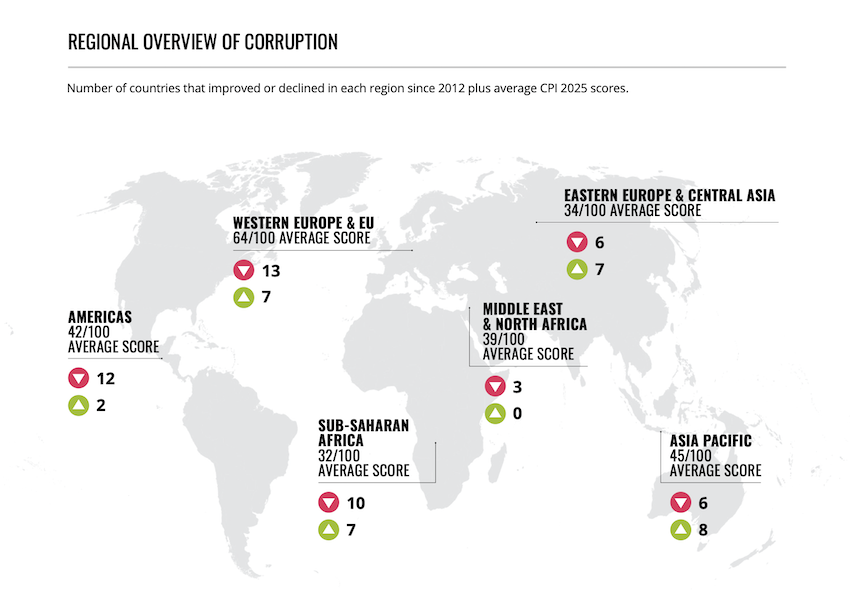
Transparency International said in its CPI report that the political climate in the United States “has been deteriorating for more than a decade,” and noted that the country’s CPI score was its lowest ever.
“The use of public office to target and restrict independent voices such as NGOs and journalists, the normalization of conflicted and transactional politics, the politicization of prosecutorial decision making, and actions that undermine judicial independence, among many others, all send a dangerous signal that corrupt practices are acceptable,” the organization said in reference to the U.S.
In equal last place on the 2025 CPI are Somalia and South Sudan, with scores of just nine. They are just behind Venezuela, whose index score was 10.
Global CPI average drops for first time in over a decade
Transparency International said that the global CPI average dropped in 2025 “for the first time in more than a decade to just 42 out of 100.”
“The vast majority of countries are failing to keep corruption under control: 122 out of 182 score under 50 in the index,” TI said.
“At the same time, the number of countries scoring above 80 has shrunk from 12 a decade ago to just five this year,” the organization said.
“In particular, there is a worrying trend of democracies seeing worsening perceived corruption — from the United States (64), Canada (75) and New Zealand (81), to various parts of Europe, like the United Kingdom (70), France (66) and Sweden (80),” TI said.
With reports from El Economista and Expansión
