
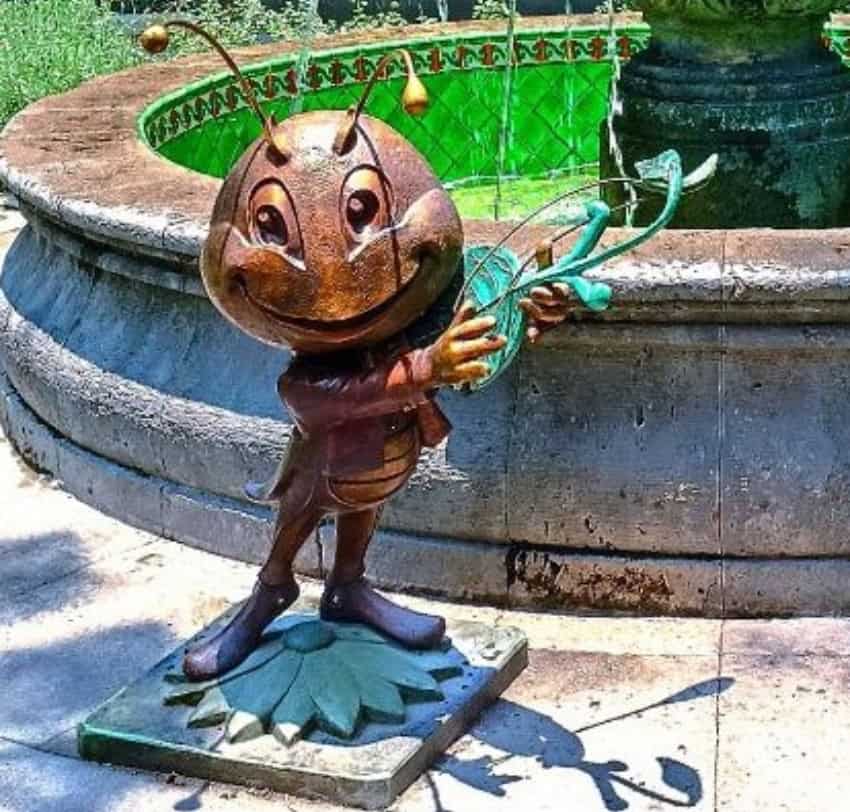
For generations of Mexican-raised families, there’s a name that inevitably evokes the purest childlike joy and unfiltered excitement: Cri-Cri. A fictional cricket musician and beloved icon — who is widely believed in Mexico to have inspired the creation of Disney’s Jiminy Cricket character for the 1940 film “Pinocchio” — Cri-Cri has sung his songs, pranced around and delighted the Mexican imagination for nearly a century.
Debuting in 1934, the tiny anthropomorphic figure, also known throughout Mexico as “El Grillito Cantor“ (“The Little Singing Cricket”), wore a red tuxedo, played the violin made from twigs and leaves and would appear on the radio, albums, in children’s books and eventually on television. Nowadays, Cri-Cri even has a museum and a park in his honor located in Orizaba, Veracruz, where the original creator and songwriter, Francisco Gabilondo Soler, was born and raised. It’s a testament to Gabilondo Soler’s legacy as being the Walt Disney of sorts for Mexico. In his prime, he even declined to work for Disney, according to Gabilondo Soler’s grandson.
Ask a Mexican of any age, and they’ll most likely be able to sing one of Cri-Cri’s songs word for word. Though Soler’s characters have certainly lost ground globally in an age of digital overload and media oversaturation, he’s still a legend in Mexico. Here’s what made him such a sought-after generational talent and creative engine of his time.
From amateur astronomer to national music icon
Born in 1907 in Orizaba to the children of Spanish immigrants, Gabilondo Soler reportedly taught himself how to play the pianola as a teenager by asking permission to use a public self-playing piano as his informal schooling. In 1928, he would go on to study astronomy at the National Observatory of Mexico in Baja California but was unable to finish his degree, though he retained his interest in astronomy. A man of limited resources, he dabbled in other professional fields, including linotyping, before returning to his creative passion and dedicating himself to becoming a full-time musician.
He played in public areas and was in an opportune position to share his music with larger audiences when radio began to grow in popularity — a technology that had only existed in Mexico since 1921. He slowly and naturally transitioned into being on air, with his initial radio persona being dubbed “El Guasón del Teclado” (The Joker of the Keyboard), known for his humor and witty social commentary.
In 1934, everything changed. Gabilondo Soler performed his first children’s songs: “El Chorrito,” “Bombón I” and “El Ropero” on Mexico City’s renowned radio station, XEW. For a 15-minute segment, he began to sing fantasy children’s songs he had been writing on the side. It became a regular radio segment that lasted for 27 years and led to his eventual fame and renown.
But at the time, he was merely a hungry artist trying to make his mark. According to the official website for Cri-Cri, Gabilondo Soler’s initial recordings went largely unacknowledged; instead, he “had only his voice, a piano and a lot of imagination. Thus he continued, seemingly without success, with his nameless program and no character,” according to the site.

Though he was mostly unknown at the time, this was the year that Cri-Cri was born.
Cri-Cri: Mexico’s own Walt Disney
By the end of his career, Cri-Cri (the fictional moniker that Gabilondo Soler would become known for) composed a total of 210 songs.
Among his most well-known are “El Ratón Vaquero” (The Cowboy Mouse), “Cochinitos Dormilones” (Sleepy Piggies), “Caminito de la Escuela” (Little Road to School) and “Marcha de las Letras” (March of the Letters). At the museum in Orizaba, various songs are brought to life with papier-mache figures portraying the song’s lyrics.
Cri-Cri was especially heralded for his songs because they often focused on life lessons or educational values for young Mexicans, and to this day they are used as learning tools for infants, toddlers and grade-school children to learn about topics such as friendship, family, school and more.
His repute extended beyond Mexico, of course. When Walt Disney and a team of cartoonists and creatives visited Mexico and various regions around Latin America in 1941, they specifically had hoped to get Gabilondo Soler to work with them.
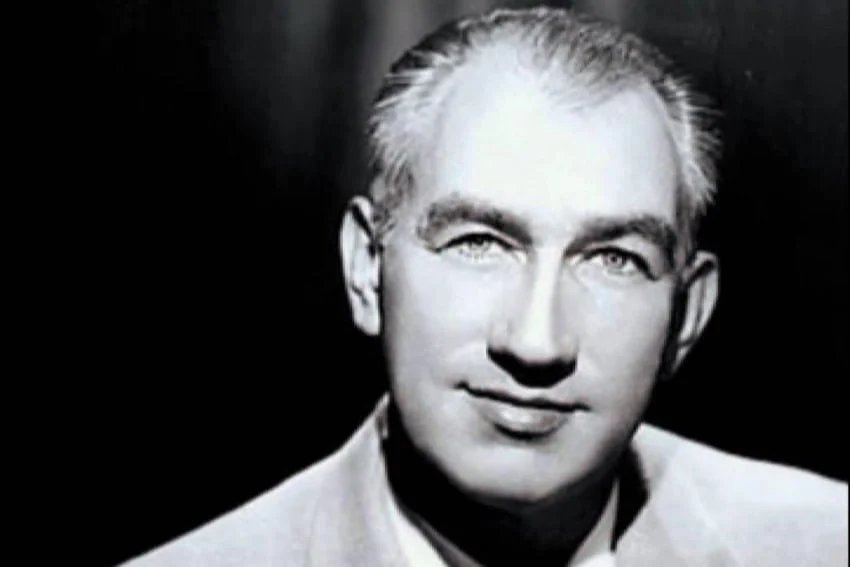
The times were complicated. World War II had broken out, and though the United States hadn’t yet actively entered the war, political factors fueled the U.S. government to fund the Disney Company’s trip — via the newly created Office of the Coordinator of Inter-American Affairs — in an effort to generate trust and leverage among Latin Americans through movies.
The trip would result in new Disney films and characters. In 1942 and 1944, respectively, Disney produced “Saludos Amigos” and “The Three Caballeros,” musical family films that were informed by the Disney’s team’s experiences in various Latin American countries, including Mexico.
Turning down Disney
In the 1940s, Walt Disney was working with the U.S. government, including the military. During this time, he visited Mexico as part of a U.S. government goodwill tour of Latin America. (Bettmann Archive via Getty Images)
While in Mexico, Walt Disney allegedly attempted to hire Gabilondo Soler to create original material that would speak directly to Latin Americans. But, it is said, Cri-Cri was opposed to taking his characters off the Mexican airwaves and placing them in a commercial market aimed at U.S. filmgoers, and so Gabilondo Soler declined the offer.
Decades later, in 2016, rumors about this alleged tête-à-tête were rehashed by Gabilondo Soler’s grandson, Francisco Sanz Polo, who confirmed on the Dante Night Show Disney’s efforts to purchase the rights to his grandfather’s material. After it was revealed that the Mexican songwriter had remained true to his roots and creative vision, his adoration among Mexican fans only increased.
The Cri-Cri catalogue never grew to become a massive corporation or money-making amusement park with international renown. But that’s largely because Gabilondo Soler — a proud Mexican musical icon who was raised in the mountains of Veracruz — wanted to keep it that way.
Alan Chazaro is the author of “These Spaceships Weren’t Built For Us” (Tia Chucha Press, 2026), “Notes from the Eastern Span of the Bay Bridge” (Ghost City Press, 2021), “Piñata Theory” (Black Lawrence Press, 2020), and “This Is Not a Frank Ocean Cover Album” (Black Lawrence Press, 2019). He is a graduate of June Jordan’s Poetry for the People program at UC Berkeley and was selected as a Lawrence Ferlinghetti Poetry Fellow at the University of San Francisco. His work can be found in NPR, The Guardian, SLAM, GQ, L.A. Times, and more. He is currently based in Veracruz.
