
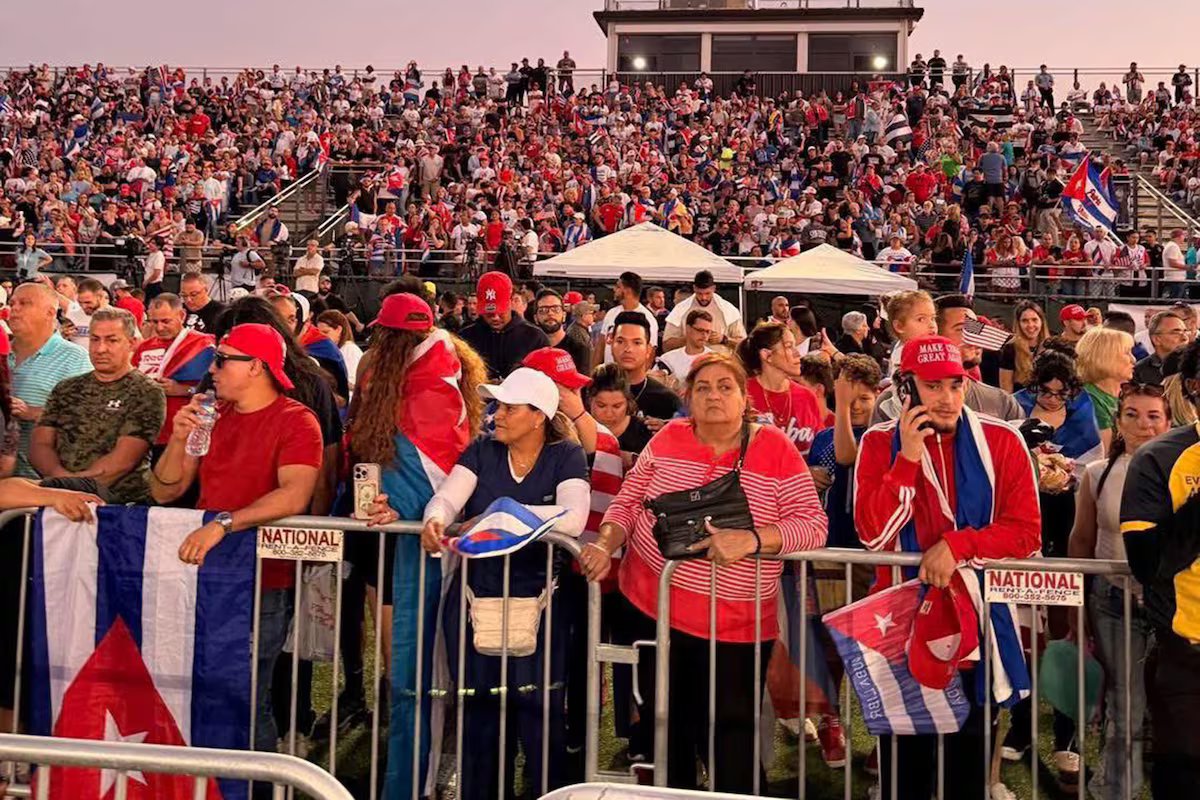
Thousands of people gathered Tuesday in a park in Hialeah, the quintessential Cuban-American neighborhood north of Miami, at a rally advocating for freedom in Cuba. While U.S. President Donald Trump appears to be precipitating a historic shift on the island—exactly what that shift will entail is unclear—through an energy chokehold and dialogue with the Castro regime, several generations of Cubans, opposition members, artists and local politicians shared the stage in Florida to advocate for regime change, yes, but also to reject dialogue with the communist regime.
“We are very happy because we see the freedom of Cuba getting closer and closer. Thanks to this president, Donald Trump, and to [State Secretary] Marco Rubio. I have never seen it as close as it is now,” says Miroslava Romero, 56, originally from Havana but a resident of the U.S. for 14 years. “We have spent our whole lives dreaming of seeing Cuba free. We came here to express our support for that, for freedom for Cuba.”
But she has no faith in dialogue. “We don’t believe in this talk. You can’t negotiate with that government in any way. They must be removed by force. I don’t know if Donald Trump will decide to intervene the way they did with Maduro. We don’t believe in dialogue, in conversations,” she explains.
President Donald Trump’s repeated pronouncements that the Havana regime’s days are numbered have reignited hopes within the diaspora that the long-awaited change of government on the communist island may be closer than ever. Exile opposition groups, organizations, and leaders in South Florida have mobilized, seeking to influence both the narrative and the decisions surrounding a potential transition.
On Tuesday night, many wore “Make America Great Again” hats, as well as “Make Cuba Great Again” hats. The Cuban-American vote in the last election clearly favored Trump. This support was largely driven by his hardline policy toward Cuba, in addition to economic concerns. The community considers itself an important bloc within the Republican Party and, historically, has used this position to make its voice heard in the halls of power in Washington.
“The purpose is to send a direct message to the highest levels of this government, to be very clear and very firm that we want a free Cuba. And a free Cuba for us means a complete change from the Castros, from [Miguel] Díaz-Canel, from all the communists, to bringing democracy and freedom to Cuba. We have never been as close as we are now, but we don’t want a half-measure. We want to see a complete political change,” Hialeah Mayor Bryan Calvo, who organized the event, told EL PAÍS.
“This is a clear message to the Administration that the majority of Cuban Americans don’t want negotiations with the regime. We don’t want talks. We want action, not words. Cuba has to be next on the list because the Cuban people have endured 67 years of communist misery and death. It’s time to act,” adds Cuban-American influencer and opposition figure Alexander Otaola of the Cuban Anticommunist Foundation, another of the event organizers.
Following the capture of Nicolás Maduro in Venezuela, the main ally and economic backer of the Cuban government, the U.S. has tightened sanctions against the island and, crucially, cut off all its oil supplies. Since then, Trump has repeatedly stated that the Cuban regime is about to fall at any moment.
Last month, reports began circulating that Marco Rubio and U.S. government officials had held discreet, unofficial contacts with Raúl Guillermo Rodríguez Castro, Raúl Castro’s grandson, on the sidelines of a Caribbean summit in St. Kitts and Nevis. Rubio did not confirm any meeting. But in early March, new reports pointed to a broader U.S. effort to establish channels of communication with figures close to power on the island. And on March 13, Cuban President Díaz-Canel acknowledged that talks had taken place between Havana and Washington, without providing further details.
The revelations provoked immediate reactions within the diaspora. Sectors of the exile community harshly criticized any contact with members of the Castro family and the regime, arguing that this contradicts the historical stance they have maintained and promoted since the beginning of the Revolution.
This is the voice that was spoken this Tuesday afternoon in Hialeah, one of the most densely populated areas of Miami-Dade County, and the epicenter of the Cuban-American community in the U.S., where approximately 75% of the population traces its origins to the island and many still have ties with and relatives in Cuba.
Before the gates of Milander Park on Palm Avenue opened, nearly a hundred people had already gathered near a makeshift stand selling Cuban flags of various sizes, caps, and T-shirts. Shortly after 7:00 p.m. local time, the crowd completely filled the bleachers, and many more continued to arrive. Some posed for photos wrapped in flags next to a monument of a fist with a broken chain that adorns the park’s green space, while songs by Willy Chirino and Albita Rodríguez, some of the most iconic exile artists banned on the island, or the classic “Guantanamera,” played in the background.
Lucía Lorenzo, 76, who arrived in the U.S. 46 years ago during the Mariel boatlift and attended the event with her daughter-in-law and granddaughter, shares the same opinion as everyone else. “I hope this ends once and for all, that Trump finally does something. If he doesn’t do it now, he’ll never do it,” she says, opening her arms and letting go of her walker, which she uses to navigate the grass. When the Castros came to power, she was seven years old: “And look where I still am. But I don’t want dialogue,” she adds, “just bullets flying everywhere.”
At the beginning of the month, the main exile organizations signed a “liberation agreement” that would serve as a roadmap for an eventual transition to democracy on the island. Rosa María Payá, leader of the Pasos de Cambio coalition, and Orlando Gutiérrez Boronat, of the Cuban Resistance Assembly, signed the document, which they described as “a historic alliance,” in a highly symbolic ceremony at the Ermita de la Caridad del Cobre, a shrine to Our Lady of Charity, a representation of the Virgin Mary that is venerated in Cuba.
Payá, daughter of the late human rights activist Oswaldo Payá and founder a decade ago of Cuba Decide, an initiative that calls for a plebiscite on the island, was invited by Miami Congresswoman María Elvira Salazar to the State of the Union address, to represent “the millions of Cubans who refuse to give up their right to live in freedom.”
“We are on the threshold of change, and it is we Cubans who must lead this urgent transformation on the island,” Payá said Tuesday in Hialeah. “Cubans on the island and in exile are one people, and as such, we are acting. The nights in Cuba are filled with people banging pots and pans and shouting for freedom and the end of the dictatorship; in exile, we are equally mobilized for systemic change. Tonight in Hialeah, and the nights to come around the world, are to tell our brothers and sisters on the island that they are not alone; to tell the United States that we appreciate the pressure and want them to continue acting so that the dictators have to submit to the will of the people and leave; and to tell the world that Cubans have a plan, we are ready for change, and we hope they will side with the people, not with their oppressors.”
Sign up for our weekly newsletter to get more English-language news coverage from EL PAÍS USA Edition
