
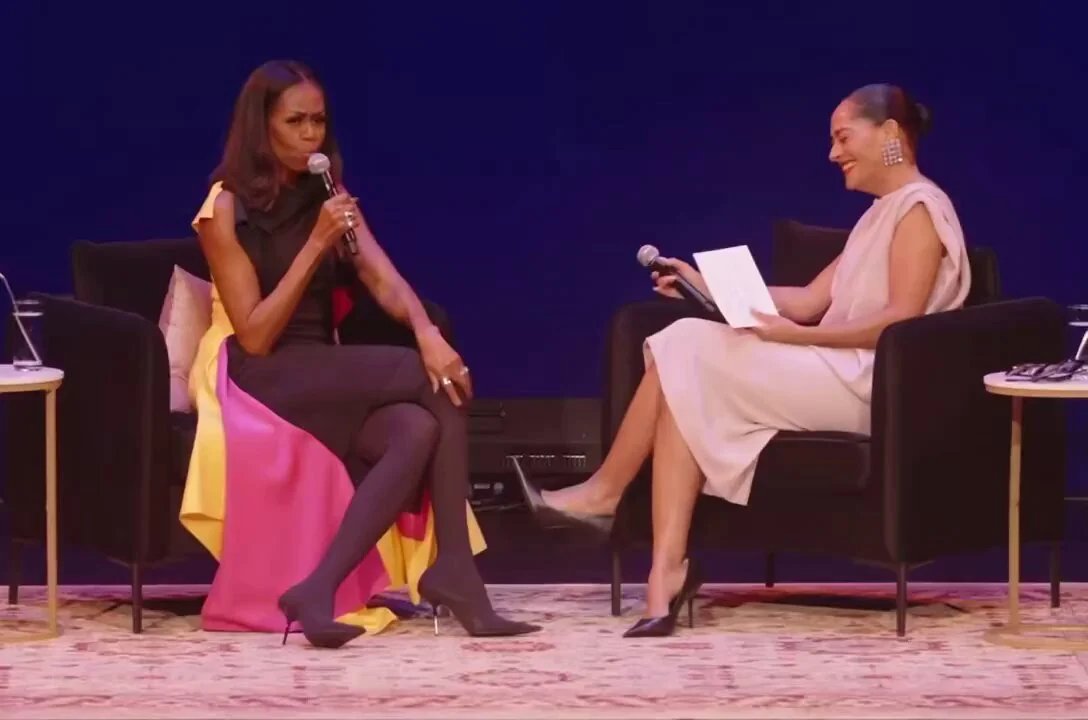
X/@Breaking911
Michelle Obama has sparked a fresh debate by attributing the avoidance of swimming and exercising among Black people to Eurocentric beauty standards. The former First Lady’s statement has gone viral along with the video where she indicates that money and health are the two main factors in keeping straightened hair and that a lot of people are going to the gym only because their hair is going to be back in its natural texture.
Advertisement
One of the clips shows Michelle Obama with a very convincing talk. She explains that Black hair tends to grow in a curly and coily manner. By getting their hair straightened to follow what she calls ‘white people hair standards’ Black people actually become ‘trapped by the straightness,’ she claims. This she calls one of the reasons ‘so many of us can’t swim’ and ‘run away from the water.’ For her, even fitness is an issue as she puts it, ‘People won’t go to the gym because we’re trying to keep our hair straight for y’all.’ Giving an analogy, Obama compared the situation to being ‘exhausting,’ so expensive,’ and a huge waste of time. She finished her statement with a powerful order, ‘Don’t tell me how to style my hair. Don’t ask about it. Don’t touch it. Just don’t.’
The online community’s response to her remarks was swift and largely divided. A great number of people were users who completely rejected her reasoning. One person called the assertion ‘the most absurd nonsense I have ever heard,’ and underlined that the term ‘barrier’ concerning swimming was not convincing when the barrier was personal grooming options. Another user maintained that Black people were being treated as if they had no choice but to rely on White people’s help—this, he said, was a racist attitude. Others indicated that the comments had an element of personal responsibility with a certain degree of naïveté and were therefore not credible.
One of the major criticisms that emerged was the suggestion that Michelle caused conflict within the races by her statements. One user branded Michelle as ‘the number one racist in the world,’ and another one wrote, ‘Race baiting is so deep-rooted in this woman that it is disgusting.’ Some postings implied that her viewing of racial issues was an obstacle rather than a support. A case in point is the following comment: ‘Nothing Michelle does is non-racial and she keeps saying that only some people can achieve what they want or that those with darker skin are less human. She is one of the most divisive persons and is actually holding her own people back.’
The discussion also veered off to a practical aspect of her assertions. An exercising enthusiast had a contrary observation and said, ‘At my gym, people of various ethnicities work out together. It’s really a melting pot.’ This individual’s testimony called into question the assumption that Black people are purposefully avoiding gyms. Another person’s comment was filled with sarcasm, ‘I would like to know what kind of hair she would wear when shopping at Kroger? Like it would be something like if she was looking to get into a fight with some of her girls in the veggie section or whatever.’
Notwithstanding the numerous criticisms, there were a few comments that ventured to point out the cultural beauty standards issue among which was one user who questioned the internal coherence of Obama’s assertion, ‘Why does she want to look white? Hasn’t she accepted that Black Is Beautiful? Women should do their hair as they wish. Don’t impose your fears on others. This remark reveals the intricacies involved in the often sensitive and complicated discussion of hair and identity in the Black community, a topic which former model Brenda has expressed her views on very openly in the past. Brenda’s remark has, however, put the matter in such a way that it was interpreted by many people as being accusatory and reductive.
Advertisement
The very strong responses indicate that the issues of race, beauty, and personal choice are still extremely lively subjects of debate. Michelle Obama has surely hit a raw nerve with her airing of such specific grievances, which has resulted in a bifurcated public discourse that reflects the presence of deeper societal strains. Even at this point, her comments are still being dissected and discussed on various platforms, exhibiting her ability to draw attention and provoke intense reactions long after leaving the White House. There is no denying that the debate over natural hair and the conditioning to accept others’ preferences is an age-old one, but the fact that the former First Lady’s high-profile intervention has highlighted it in the present cultural moment is what secures its place in the here and now. Her recent podcast appearance and her discussion about being labeled difficult are further examples of her continued public engagement.
