
The year was 1965. Military regimes dominated Latin America, and Bolivia was no exception. As one of the first measures of his de facto government, General René Barrientos ordered the takeover of mining camps, which were home to the largest militant forces of the leftist parties. One of the most important was the Milluni center in the highlands of La Paz, as it housed La Voz del Minero (The Miner’s Voice), a radio station and communication hub for mobilizations.
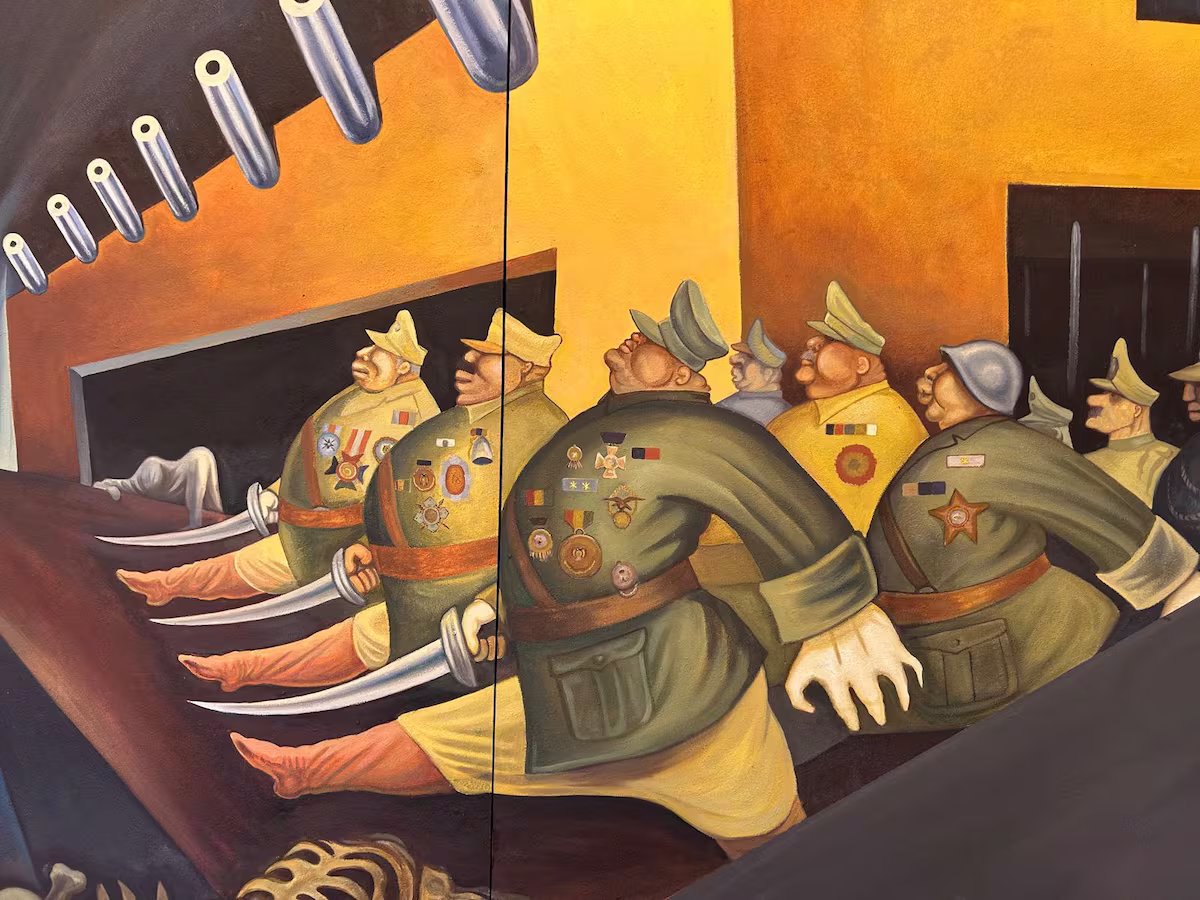
Soldiers stormed the camp and walked out with bodies, microphones, and radio control equipment. They did not realize, however, that the wall of the camp theater’s auditorium was fake: a mud-brick barrier built by the miners after they were warned of the attack, protecting a mural that told the story of their exploitation.
It is one of the 16 murals painted between 1953 and 1966 by visual artist Miguel Alandia Pantoja, a union leader and one of the foremost representatives of Bolivia’s leftist intellectuals. Considered an enemy of the dictatorship, Barrientos ordered the systematic destruction of his work displayed in public buildings.
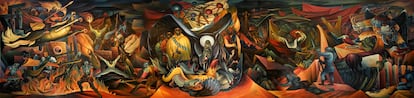
Not all of the murals survived like the one at Milluni; many no longer exist. A belated consolation comes now with the reconstruction — based on sketches and preparatory studies left by the artist — of one mural that had been removed and demolished from the Government Palace in 1964. It serves as the centerpiece of the new permanent gallery the National Museum of Art of Bolivia (MNA) has dedicated to Alandia.
“We have fulfilled a dream of the master, which one of his children shared with us: to restore the mural that once stood in the hall of the Government Palace,” says Claribel Arandia, director of the MNA.
The working class was not only the main subject of Alandia’s work but also the group of people that he felt closest to: he organized workers into unions and fought for labor rights that were not enacted in Bolivia until 1942. His art was never separate from his political activism, a coherent path shaped by living firsthand the social upheavals of the 20th century in the South American country.
Alandia was born in the main mining center of the Altiplano, Catavi (Potosí), a rocky land covered in silica. The son of a bread seller and a mining company accountant, he witnessed the so-called Uncía Massacre (1923) at a nearby camp when he was nine years old. The army opened fire indiscriminately on striking workers who had organized into a federation, demanding recognition and improved labor conditions. Nine people were killed, and from that moment on, death — often dramatized with dark tones and the Altiplano as a backdrop — became a recurring theme in his work, as seen in paintings such as Homenaje a los líderes mineros asesinados (Tribute to the Slain Mining Leaders) (1965).
Conditions in the mines at the time were deplorable: intensive exploitation without industrialization, with miners themselves transporting ore on foot for miles. Life expectancy was under 40 years. Silver, and later tin, were the nation’s economic backbone, yet production was controlled by a small group of entrepreneurs.
“The republican era [after Bolivia gained independence from Spain] continued the colonial order and did not overturn the economic and political privileges based on ethnic status […] The oligarchic sectors maintained their dominance based on the exploitation of Indigenous and working-class labor,” writes historian Daniela Franco in Two Perspectives on the Artist in Service of the Revolution (2024), co-authored with Javier del Carpio.
The social turmoil touched every part of Alandia’s life. At 18, he was called to join the army in the Chaco War (1932–1935) against Paraguay. It was a bloody conflict between two countries that had yet to develop economically compared to their neighbors, competing over a border region with alleged oil reserves. The painter left a graphic record of his experience as a prisoner of war, an ordeal that deepened his social consciousness: the front lines were composed of Altiplano Indigenous people thrust into a dry forest ecosystem, with little idea of what they were doing there.
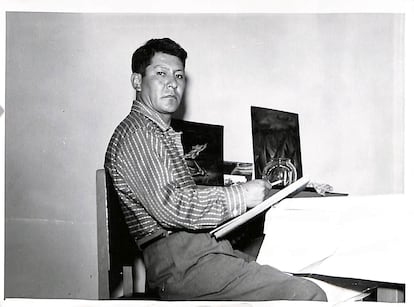
Alandia reached the height of his political activism upon returning from the Chaco War, which coincided with the outbreak of World War II. The demand for tin surged exponentially, along with the exploitation of miners.
“As a palliative measure to address the economic crisis that had been dragging on since the Chaco War, president Enrique Peñaranda accepted American financial aid, which was nothing more than monetary incentives in exchange for something far greater: mining production at absurdly low prices,” notes Javier del Carpio, co-author of the painter’s biography, who has studied Alandia’s life for 20 years. The rise in prices brought a windfall to mining companies that was never reflected in the workers’ wages.
Nearly 7,000 miners marched to the offices of a mining company in Catavi, where they were met by the army, which fired at point-blank range, leaving 19 dead. Alandia radicalized his political activity: he joined the Revolutionary Workers’ Party and founded, in 1947, the National Workers’ Center, which remains active today as the Bolivian Workers’ Center (COB). Meanwhile, on the artistic front — he was less prolific at the time due to the turbulent context — he channeled his feelings into the mural Dictadura capitalista: último acto (Capitalist Dictatorship: Last Act) (1945). At the top, above a cross, he painted caricatures of the leaders of the major powers of World War II, from Roosevelt to Hitler.
Below them, in a grim and Dantean scene, stands the Indigenous woman Marcela Barzola, one of the martyrs of the Catavi massacre, who is missing an arm. At her feet lie bodies, and behind them a massive protest unfolds with the banner: “We want bread…”
The struggle to overturn the economic and political order culminated in the armed revolution of 1952 — a movement inspired by earlier uprisings in Mexico and Cuba — in which Alandia took part, rifle and dynamite in hand. Victory went to the insurgents, and it seemed that a moment of peace had finally arrived for the artist. He temporarily left his party to focus on painting and was hired by the revolutionary government to create several murals.
“Muralism expresses the desire to bring a message of identity to the masses. It is above all a political movement rather than an artistic goal. It has a pedagogical purpose for aesthetic education,” Alandia said in an interview.
Diego Rivera, the leading figure of Mexican muralism, visited Bolivia in 1954, was impressed by his work, and intervened to have Alandia exhibit at the Palacio de Bellas Artes in Mexico City in 1957. This gave the Bolivian artist his international breakthrough: in the 1960s, Alandia exhibited in Russia, Czechoslovakia, Yugoslavia, Hungary, Austria, Chile, and Uruguay, among others.
At the height of this tour, seemingly at the peak of his career, the darkest news arrived: the conservatives were striking back with a coup in Bolivia. Barrientos not only ordered the destruction of his monumental work but also ransacked his home, taking documents and personal belongings. Alandia had to stay in Uruguay with his family, though he returned in 1971 to participate in a failed armed attempt to overthrow the government. He died in exile in Peru four years later, suffering from cancer.
Del Carpio describes him as an “unwavering man, very patient and humble, but with a fierce temperament when it came to defending his principles.” Del Carpio was the one who discovered the Milluni mural in 2017, which was at risk of disappearing because it had never been restored. After seeking help from public institutions to rescue it, the Ministry of Culture eventually began repairs. Then came the Covid pandemic, the ministry closed, and the project was left abandoned. In 2023, it was announced that the mural had been stolen.
Sign up for our weekly newsletter to get more English-language news coverage from EL PAÍS USA Edition
