
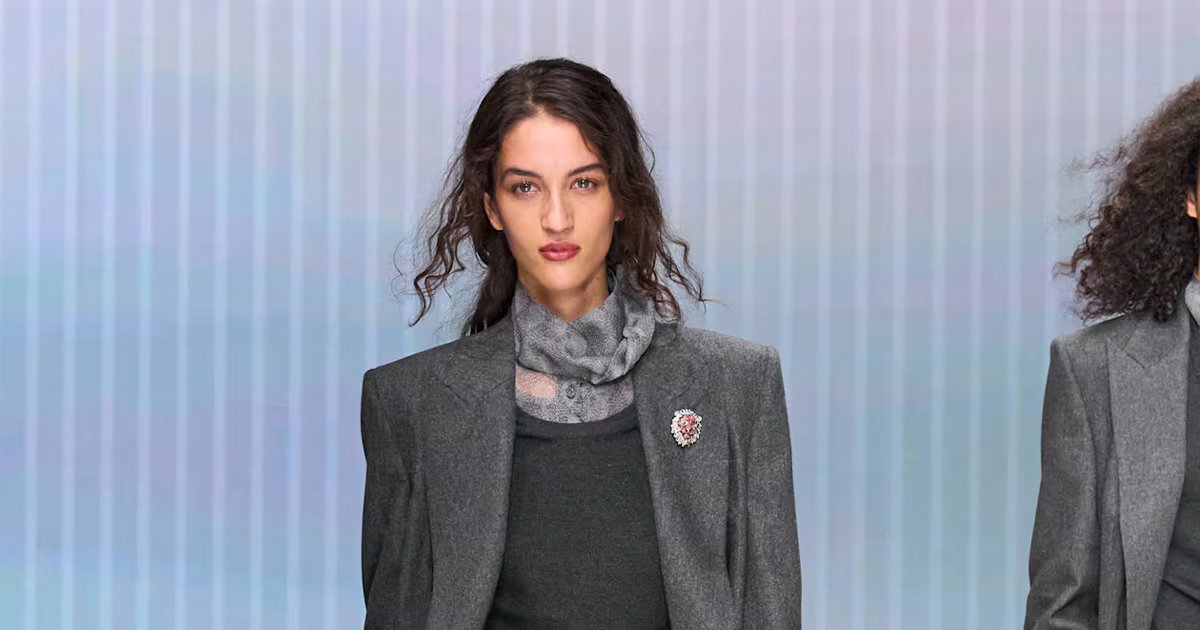
MILAN — Fashion week here ended on Sunday morning with Giorgio Armani: It’s been the same for several years now, and yet nothing is the same since the inimitable Giorgio left us. Silvana Armani has worked alongside her uncle for over 40 years, so her first ready-to-wear show as the womenswear creative director offered continuity, albeit with the lighter, more pragmatic, a fuss-free touch offered by a woman dressing women with a decidedly Milanese brand of effortlessness.
What was immediately apparent was how matte it all looked, the otherworldly but artificial sheen that Mr. Armani so fervently pushed of late finally and mercifully gone. The opening look set the new tone: a slouchy mannish suit in grey flannel worn over a grey silk shirt and a grey jumper. Grey, not greige. The second look was near-identical to the first, but the apparent perfection that preceded it gave way to welcome imperfections: The jumper was a little too short, the trousers a little too wide, and the model’s hair was flowing freely instead of being coiffed into a sleek hairdo.
Thereafter, the collection offered an ode to normality the Armani way: precious fabrics, somber hues, flowing volumes. The insistence on a catwalk proposal that’s viable for real life, not a far-flung fantasy, was the message. Even the trademark exotic hints were toned down: subtle kimono shapes for day, and tunic over pants at night.
It all made for something perhaps closer to the original Armani ethos, if the insistence on pragmatism looked at times a little too pragmatic. This is Armani after all, not Max Mara. One needs a dash of illusion this high up in the fashion stratosphere and that’s what Silvana Armani should focus on bringing to the equation in the coming seasons as she builds from this palate cleanser of a collection.
Elsewhere, Fila Milano, a special collection designed by creative director Alistair Carr for the revered Italian sports brand, made a convincing debut that was all about graphic tautness and a clean metropolitan spirit. Carr’s blue chip resume — which includes stints at Marni under Consuelo Castiglioni and Balenciaga under Nicolas Ghesquière — was evident in his angular sense of cut and taste for subtle embellishment. The only downside was that approaching sports from this perspective inevitably took the results dangerously close to Miu Miu and that was a faux pas.
