
MILAN — Identity — personal, collective, brand — is a key topic in this age of representation and self-staging, and there’s little doubt that clothes play a fundamental role in its construction and signalling. The third day of Milan fashion week offered food for thought on the matter.
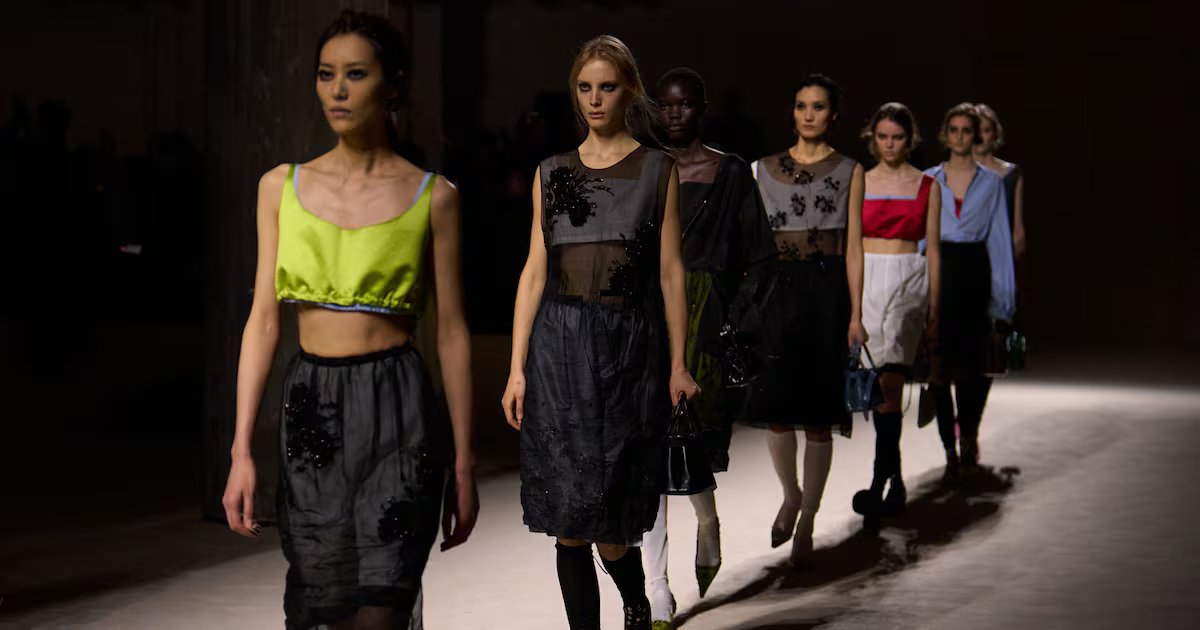
At Prada, Miuccia Prada and Raf Simons opted for concision, repetition and an easy but effective trick which looked brainy and perfectly on point within the world of Prada — context is everything, darling — but elsewhere would have been just bah! The show, in fact, was an act of undressing, a peeling away, a shedding of layers after layers, from extremely covered to barely there, and consisted of just fifteen outfits which passed four times along the runway, each one with something taken away.
As the show unfolded, we saw the multifaceted complexity of women’s identities, while large chunks of Prada’s own history — from minimalism to twisted bourgeoisie — were recapitulated to show how those identities are built rather than mere replica. Did it work? For sure it was surprising and entertaining, and it depicted the idea of the social self as a layering in quite an iconic way, but it came at the cost of needlessly heavy styling, which made it all feel a little fabricated and over-intellectualised. Sure, Mrs. Prada and Raf Simons were right in underscoring the emotional meaning pieces of clothing carry within the complexities of personal and social history, but sometimes acknowledging the mere pleasure of playing with fashion would be enough.
With the arrival of new designer Meryll Rogge, Marni is changing identity, going back to where it all started: the idiosyncratic mind of Consuelo Castiglioni, the inimitable founder, of whom Rogge has been an ardent fan since her teenage years. There was a strange mix of fangirling and gritty edge in Rogge’s debut, which needs to be read as such: a first act, the tentative laying of the foundations. Rogge opened sombrely for a reason: She discovered some very early Marni pictures — way before the brand started showing on the runway — on a hard drive and those collections were mostly black and grey. Fine. From there, Rogge pulled out a lot of archive references, without the same level of joy, and it looked like Marni through a gritty lens. She also brought out the many similarities Marni had with Prada back in the day — those nylons! — which felt like a misjudgment. All in all, it was a good start, but there’s fine-tuning to be done.
Continuity is how the Armani heirs — Silvana Armani and Leo Dell’Orco — are dealing with the matter of brand identity right now, and for the time being it works. The Emporio Armani collection, on which the two worked together and presented in co-ed mode, was an exercise in Armani-isms: androgyny, soft tailoring, bold outerwear, denim. It all looked very on brand, and yet a little different: The designers have a remarkable lightness that brought some welcome freshness without being disruptive.
Elsewhere, it was all about history and historical shapes. Over at Max Mara, the goings got medieval, much in a Romeo Gigli kind of way — extra-long coats, ultra-flat shoes — in a muddy palette of reassuring neutrals, but things felt repetitive early on. At Cavalli, Fausto Puglisi sang an ode to black, clashing robotic tailoring, languid slip dresses and mini crinolines that were more Atelier Versace than Marie Antoinette. It felt a little forced.
