
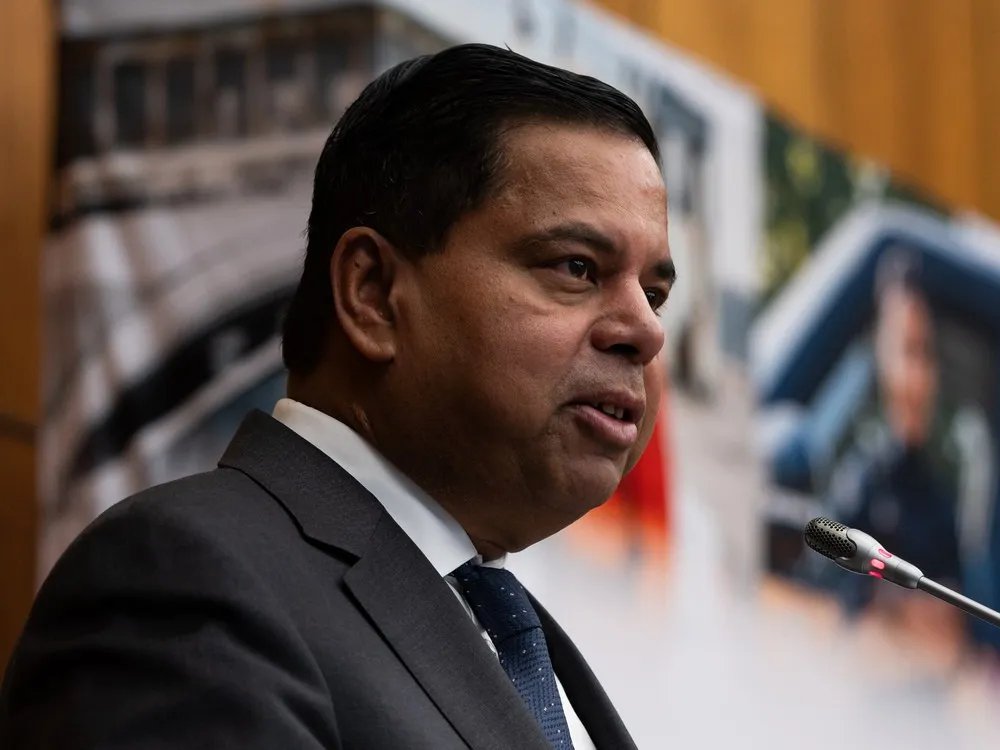
OTTAWA — Public Safety Minister Gary Anandasangaree said there are still “outstanding” security issues with India, the day after a senior government official stated that Indian agents are no longer linked to violent threats in Canada.
On Thursday morning, Anandasangaree refused to repeat the statement by the senior government official Wednesday, instead noting there is still “a lot more work to do” on the file of transnational repression linked to India.
The minister noted that while Canada and India are working on increasing bilateral economic and diplomatic ties, there are also at times “difficult conversations around safety and security of Canadians.”
“Of course, there are still outstanding issues that we’re going to work through,” Anandasangaree told reporters on the sidelines of a Thursday morning National Police Federation event on the need for lawful access reform in Canada.
“There’s still a lot more work to do, and we will do that work.”
On Wednesday, during a background briefing for reporters on Prime Minister Mark Carney’s upcoming visit to India, Australia and Japan, a senior government official stated that India is no longer interfering in Canadian affairs.
“We’re confident that that activity is not continuing,” the official said of previous allegations the agents of the government of India were linked to many violent crimes or threats in Canada, including the murder of B.C. Sikh-Canadian leader Hardeep Singh Nijjar in 2023.
“If we believed that the government of India was actively interfering in the Canadian democratic process, we probably wouldn’t taking this trip,” the official added.
The statement sparked the ire of the Canadian Sikh community, which has long accused the Indian government of trying to suppress criticism of Prime Minister Narendra Modi’s administration and treatment of Sikhs in the province of Punjab.
“I can say with complete conviction that the claim made by this senior government official is utterly false. It does not align with what Sikh Canadians are experiencing on the ground and what we are seeing firsthand,” said World Sikh Organization head Danish Singh in a statement.
It also raised the hackles of national security experts both within and outside of government, many of whom were stunned the official would make such a definitive statement after decades of suspected Indian government involvement in transnational repression in Canada.
The statement came just days after Global News reported that noted Modi critic and Khalistan separatism activist Moninder Singh had been warned by police of a credible threat to his life and family.
It was also a stark shift from a series of remarkable government and RCMP statements in 2024 linking the Indian government to both Nijjar’s murder and rash of violent crimes such as arson, extortion and murder, throughout Canada.
That led to a serious diplomatic row and the tit-for-tat expulsion of their respective diplomats, sparking months of frigid diplomatic relations between then prime minister Justin Trudeau and Indian Prime Minister Narendra Modi.
But Prime Minister Mark Carney aims to reset the relationship with the emerging economic giant as Canada’s rapport with the United States sours.
He invited Modi to attend the G7 meeting in Alberta last spring, spurring a diplomatic rapprochement that led to Carney’s travelling to India and meeting his counterpart on Monday.
But within the government’s security and intelligence community, there are still concerns about agents of the Indian government’s efforts to influence Canada’s democratic institutions and repress critics of Modi’s administration.
As recently as earlier this month, Canadian Security Intelligence Service (CSIS) Director Dan Rogers cited India as one of the countries the spy agency had previously linked to foreign interference and transnational repression efforts in Canada.
“We’ve called out publicly in the past, China, Russia, India and others,” Rogers said in response to a question about the most active perpetrators of foreign interference targeting Canada.
Jody Thomas, the former National Security and Intelligence Advisor (NSIA) to Trudeau who met with the Modi government after Nijjar’s murder, said that Rogers would not have cited India were it not still of concern to CSIS.
“I think that if they were no longer current, he would say that,” Thomas said in an interview. “If there were a radical change… he would not mention them as an ongoing concern.”
Thomas was also very skeptical of the government official’s suggestion that India was no longer linked to violent crimes in Canada, though she noted that she no longer has access to current intelligence.
“It would be such a radical change in behaviour, it would just surprise me,” Thomas said.
Martin Green, who headed the Privy Council Office’s Intelligence Assessment Secretariat until July 2024, was also skeptical of the statement, arguing that it’s impossible to say definitively that a foreign country has ceased certain behaviours.
“I find it counterintuitive. It’s not what one would say anytime about that. It would mark a significant shift,” said Green, now a senior advisor at Global Public Affairs.
“There could be a real decline in activities, but… even with that decline, you wouldn’t say anything that categoric about it,” he continued, adding that he also has not seen recent intelligence on the matter.
The RCMP and CSIS did not immediately respond to a request for comment.
National Post
cnardi@postmedia.com
Our website is the place for the latest breaking news, exclusive scoops, longreads and provocative commentary. Please bookmark nationalpost.com and sign up for our politics newsletter, First Reading, here.
