
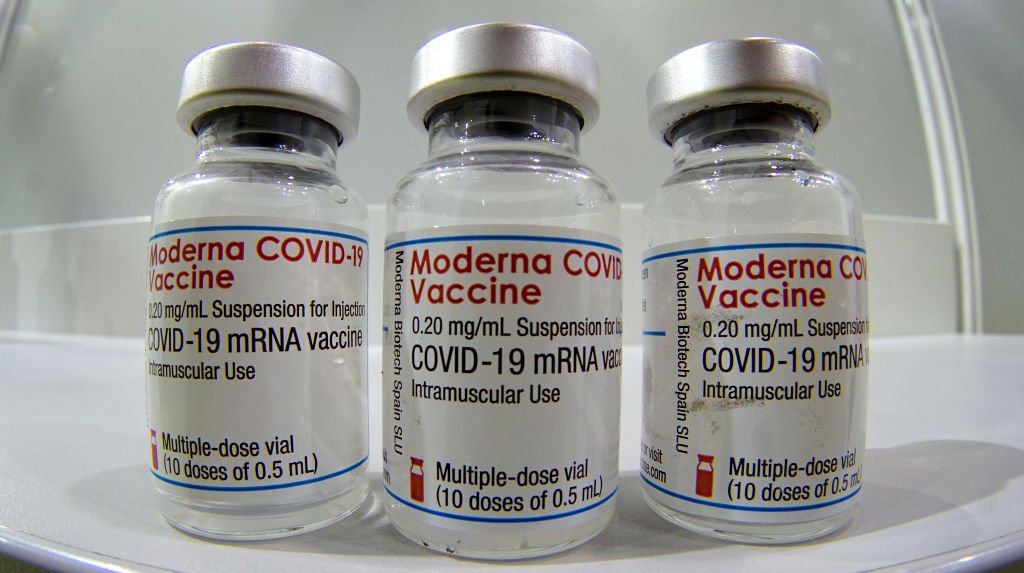
A patent dispute over technology key to messenger RNA Covid-19 vaccines is settling with Moderna agreeing to pay $950 million up front and potentially more than $1 billion later, a resolution that comes days before the expected trial start in litigation that has been brewing for years.
The cash will go to Arbutus Biopharma and Genevant Sciences, companies in which Roivant Sciences holds ownership stakes Moderna retains the right to appeal a narrow legal matter. But to Roivant CEO Matt Gline, the settlement announced after Tuesday’s market close is a victory for the companies as well as its scientists.
“Today represents the first real acknowledgement that team and those scientists have gotten that their technology was instrumental in Covid-19 vaccines, or at least the Moderna vaccine as we’re announcing today with this settlement,” Gline said in a Tuesday evening conference call.
The patent dispute focused on lipid nanoparticles (LNPs), tiny fat particles that encapsulate mRNA and protect it during its journey through the body to its cellular destination. Moderna’s mRNA vaccine for Covid-19 uses LNPs for delivery. In a joint complaint filed in 2022, Arbutus and Genevant contended this vaccine infringed their LNP delivery patents. Other parties have licensed this technology, and Arbutus and Genevant said Moderna needed to do so too.
Moderna contended its Covid-19 vaccine did not infringe any valid patents. But its defense focused on another argument: Arbutus and Genevant sued the wrong party. Moderna had said the companies should instead sue the U.S. government because the Covid-19 vaccine that became Spikevax was developed and brought to the market under a federal contract. Citing Section 1498 of the U.S. Code, Moderna said claims against a government-contracted supplier must proceed against the government and in the U.S. Court of Federal Claims.
In 2022, the court denied Moderna’s partial motion to dismiss under this federal law, which would have shifted liability to the government. In pretrial rulings earlier this year, the court denied this Moderna defense. The settlement announced Tuesday grants Moderna a non-exclusive global license to the Genevant/Arbutus LNP technology for mRNA vaccines for infectious diseases. Genevant and Arbutus agree not to not to sue Moderna for certain patents.
The settlement requires Moderna to make a $950 million lump sum payment by July 8. Moderna owes no royalty payments. The mRNA vaccine maker retains the right to appeal, but only on the question of whether the company or the government is liable for infringement regarding Moderna’s vaccine sales made under a federal contract. The company continues to argue that as a government contractor, its liability is limited. The additional payout of up to $1.3 billion hinges on a court decision affirming that Moderna is indeed liable in this matter.
In Moderna’s announcement of the settlement, the company said a court loss related to the pending Section 1498 appeal “is not probable,” so it expects no financial charge will be recorded. Moderna could appeal the case all the way up to the U.S. Supreme Court. If Moderna ultimately wins, Arbutus and Genevant must refund any payments plus interest. Gline said that all three times this issue has come up in court so far, judges have ruled in favor of Genevant and Arbutus.
“We expect to win on this issue and we believe we have the right side of the law here,” he said. “Whether the Supreme Court decides to hear a case like this is obviously up to them and difficult to predict.”
Leerink Partners analyst Main Foroohar, who covers Moderna, said in a research note that the investment bank viewed Moderna’s defense case as materially weaker. Leerink is surprised by the outcome, and the rise in Moderna shares reflects “relief for a successful dodged bullet,” Foroohar said. The manageable settlement terms do not push Moderna’s finances into distress or burden profit margins in the future with royalty payments — avoiding the two worst-case scenarios for the company.
Moderna investors expected the company to face as much as $5 billion in projected liability, making the settlement terms better than previously feared, William Blair analysts said in a research note. Acknowledging that Moderna believes it will win its appeal, the William Blair analysts noted that the U.S. District Court’s ruling for the government means Moderna’s government contractor argument under Section 1498 is not applicable for the vast majority of the company’s sold Covid vaccine doses. Still, the analysts see the settlement as removal of an overhang on Moderna, leaving the company with enough capital to deploy toward its other programs, including late-stage oncology vaccines with expected data readouts this year. These vaccines could become new long-term drivers of revenue growth for Moderna.
Roivant’s research into patent litigation found that the largest verdict from a biopharma case that went to trial is the $2.54 billion awarded to Idenix in 2016 for its suit against Gilead Sciences and its hepatitis C drugs. That verdict was later overturned and nothing was paid. The next largest biotech case was the $2.1 billion that Teva Pharmaceutical and Sun Pharma agreed to pay in 2013 to settle patent litigation regarding Pfizer’s stomach acid-reducing drug Protonix. Gline noted that the potential payout from Moderna falls between those cases, placing it among the largest disclosed patent settlements in industry history.
Roivant plans to apply the settlement proceeds toward development of its pipeline and potential product launches. But the company will also return some of that capital to stockholder, boosting a planned share buyback program from $500 million to $1 billion.
Roivant also has ongoing patent infringement litigation against partners Pfizer and BioNTech, which have a much larger share of the Covid-19 vaccine market with their mRNA shot, Comirnaty. Gline said this case is about a year behind the Moderna litigation and no trial date has been set.
Other patent suits over Covid-19 vaccine technologies have settled. Last year, BioNTech acquired mRNA company CureVac in a move analysts viewed as a way to resolve the patent dispute between the companies. BioNTech later reached a formal settlement that paid $740 million to CureVac and its mRNA R&D partner, GSK. This deal also requires BioNTech to pay those companies royalties on sales of its Covid-19 vaccine.
Photo: Michael Sohn — Pool, Getty Images
