
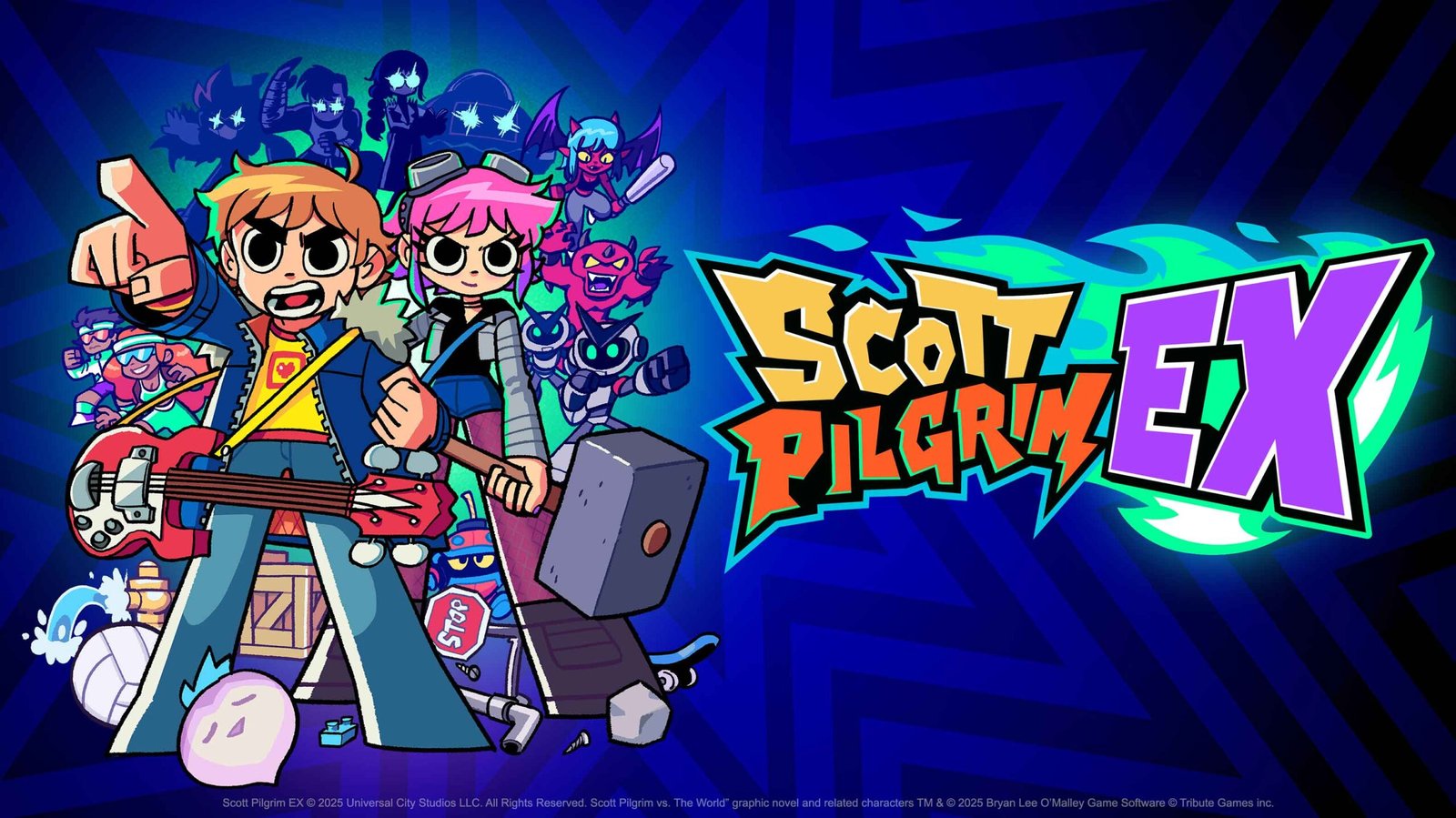
In 2010, Ubisoft Montreal and Chengdu released Scott Pilgrim vs. the World: The Game, a retro-inspired side-scrolling beat ’em up based on Canadian cartoonist Bryan Lee O’Malley’s popular graphic novel series.
Quickly, the game garnered strong praise for its charming presentation and rock-solid gameplay, and it helped pave the way for some of the key Montreal-based developers to spin off their own studio, Tribute Games. Under the new banner, the team has made a name for itself with other stellar beat ’em ups, like 2022’s TMNT: Shredder’s Revenge and last year’s Marvel Cosmic Invasion.
Now, Tribute is returning to its roots with Scott Pilgrim EX, a brand-new beat ’em up starring the titular Torontonian developed in close collaboration with O’Malley. Unlike the first Scott Pilgrim game, EX features an original story in which Scott, Ramona and the evil exes must travel through the fractured time and space of Toronto to stop the villainous Metal Scott. And as with other Tribute titles, EX supports solo play and up to four-player co-op.
To learn more about the prolific developer’s latest exciting project, MobileSyrup sat down with narrative director Yannick Belzil, who’s worked on all three of Tribute’s licensed titles. In a wide-ranging interview, he discusses his collaboration with O’Malley, what it’s like to work on Scott Pilgrim vs. Marvel and TMNT, what goes into designing each of the colourful playable characters, the series’ Canadiana and more.
I saw in a video from Tribute that a lot of the writing came from Bryan Lee O’Malley, but you were in charge of “setting things up.” Can you elaborate a bit on that? What did that collaboration look like between you two?
Yannick Belzil: The big thing when I came in on Scott Pilgrim EX was to help out with structure. The way the game is played and the way you progress through it usually starts from a huge document that is written by the game designer, Jonathan [Lavigne]. So at first, there was a huge walkthrough document, not unlike many video games online, in a .txt format that is just like, “Here’s the game, you go there, you have to take that item in this level, and this and that.” So there’s a big list, and I would first take that document and try to sort of rewrite it in not exactly a screenplay form, but something that felt more “narrative.” And then I would go like, “Oh, to get on that quest, you’d need a character to talk to us here and give us said quest, or ask us about it, and then when you go and interact with that event, it’d be good if there’s another character telling you about this event,” and then set it up with something funny or stuff like that.
So I did a whole bunch of that structure early on. When we started the game earlier, Bryan was not all the way in because he was touring for the 20th anniversary of Scott Pilgrim, so he was really busy with all that stuff. But we were just setting up the actual gameplay and making sure to figure out how the game works. So I would come up with premises and structures and stuff like that. And eventually, when he got to join us more on the bigger narrative side, it was him going through these quests and looking at the structure of it and the placeholder dialogue that I put in different places. “The player talks here to an NPC, let’s say young Neil or Envy, or whichever character,” and so we would go back and forth, and we would talk about sometimes changing sort of the situations so that it would feel better and more appropriate for the characters. And then he would write new dialogue for these exchanges. So I pretty much do a whole bunch of structure and set up things where he could rewrite or sometimes flesh out ideas that feel more appropriate for the world and the characters.
Something that’s really awesome about Tribute is you guys have made a name for yourselves for high-quality, licensed, retro beat ’em up games. Obviously, some of the co-founders worked on the original Scott Pilgrim game at Ubisoft, but then also TMNT and Marvel at Tribute. What’s it like to work on Scott Pilgrim versus these other properties? What goes into making a good Scott Pilgrim game versus a good Marvel game versus a good TMNT game?
Belzil: I would say the biggest difference when tackling these characters, because I was also the narrative designer on all these games and the main writer on all these games… As opposed to Scott Pilgrim, the Turtles and the Marvel characters, which are characters that I love, are made to carry on. They’re made to have many, many adventures forever. And therefore, there’s something that is accessible. They have a solid handle on them to write and create new adventures and create new dialogue about them. Whereas Scott Pilgrim, it’s really so specifically Bryan. I wouldn’t want to say it’s his soul, but it’s the way they are characters that he created when he was these characters’ age, and it’s the age that I met these characters as well. So his perspective on these characters has sort of morphed as he aged. Same thing for me.
And there’s something specific about these characters that I feel like, if it’s not Bryan writing them, or having a strong hand in how the narrative of these characters is created, then there’s something lacking. I remember I would write a lot of placeholder dialogue for these characters. I was like, “Oh, okay, this does sort of sound like how these characters would talk,” and then Bryan would come in and rewrite it like, “No this, this is how Scott talks” — a specific, endearing way that Brian has on lock. And that’s for the characteristics and the interplay between all these characters. It truly comes from him, and I feel like if you don’t have Bryan on board to write these characters and bring them to life, you’re going to be missing something, or you’ll get something wildly different, maybe.
Something that’s interesting with Scott Pilgrim, the property, is the Netflix anime [Scott Pilgrim Takes Off] came out and was really a surprise to everyone in terms of how subversive it was. Like, you think you’re getting a remake, and then it’s actually this meta sequel. So in that spirit, what are some of the ways that you’re trying to have fun with the larger world of Scott Pilgrim and do something a little familiar, but also different?
Belzil: For me, what I think is fun about Scott Pilgrim EX is that we create a Toronto that you can walk around and have beat ’em up, brawling adventures around. So it’s the possibility of having an adventure and then meeting a character that you like from that universe and interacting with them. So that, for me, felt like a really fun way that we can interact with the world. Something that really got to me when I was an early teenager, we went to MGM Studios with my family, and we walked on some sort of a main Hollywood street, a 1930s street. And I thought, “Oh, this reminds me of the Los Angeles in Who Framed Roger Rabbit,” and I looked up and I saw Eddie Valiant’s office window, and there was a Roger Rabbit-shaped hole in the window and the store blinds like in the movie.
And it had a really profound effect on me of, “Oh, I am walking in the fictional world that was created in the movie, but it’s real right now.” And that’s something that’s always stuck with me, and that’s something I always wanted interactive versions of fictional worlds to be like. I want to feel like I’m walking into something that feels connected to the original thing that it’s emulating or it’s creating. So that was something really important for us for EX. And so it was putting some lesser-known characters from the books are there as well, and you have all these details that remind you of the comics, of the animated series, of the movie. And it feels like it’s a world that you can walk [into]. Although compared to the anime, I don’t feel like we surprise people, narratively, all that much, but that’s because we want to just create a playground for people to have fun in there.
To that point of the whole “playground” element, I was really surprised as I’ve been playing through the game, that it does have a little bit more of an open structure in terms of the different little quests you can take on and different parts of Toronto to go to. It’s not necessarily purely linear, like other beat ’em up games. What inspired that particular direction, and once you knew that’s what you were going with, how did that inform your approach to narrative?
Yelzil: The idea of giving it that sort of playground aspect comes from the fact that we’re huge fans of River City Ransom, especially the original game. And if you look, especially in the early books of Scott Pilgrim — even the art style has that familiarity with Kunio-Kun [River City] and how it looks and the way the universe is constructed. So these just went hand in hand. And one of our co-founders and the game designer, Jonathan, he had an itch to make a River City Ransom-type of game. So when the opportunity came up for us to do Scott Pilgrim again, we were like, “Oh, well, let’s do that. They handshake really well.”
Narratively, for me, it was an occasion to think about how to properly construct a quest. So you know a quest at the end has some sort of boss, and the boss will be in some sort of zone or environment that has certain memorable qualities or character or a vibe. So it was always reverse-engineering, “How do we get to that point, and how do we set it up at the beginning of the quest, and how do we get there?” That quest is usually sort of locked behind a rift, so then it’s how to construct a narrative that will go along with the gameplay ideas. Because, again, every quest is motivated by using the game mechanics that we’re building in River City Ransom vocabulary.
So it’s really how to thread both together that was a big thing when I started to work on the game. And also, what’s the actual story? What are going to be the characters? What are going to be the ideas? Do we want to invent a lot of new original characters, or should we take into account that fans will want to see their favourite characters, or familiar characters in different surroundings? So we tried to do a mix of both as well.
To that point, something that’s really fun about the game is the whole time travel element. You can explore different ideas and versions of these characters. For instance, I love that you’re going through The Beaches and then you go through a rift, and then you’re fighting this prehistoric ancestor version of Roxie. How did you all come up with these different versions of these established characters? Were you and Brian just kind of sitting in a room spitballing? How did that all work?
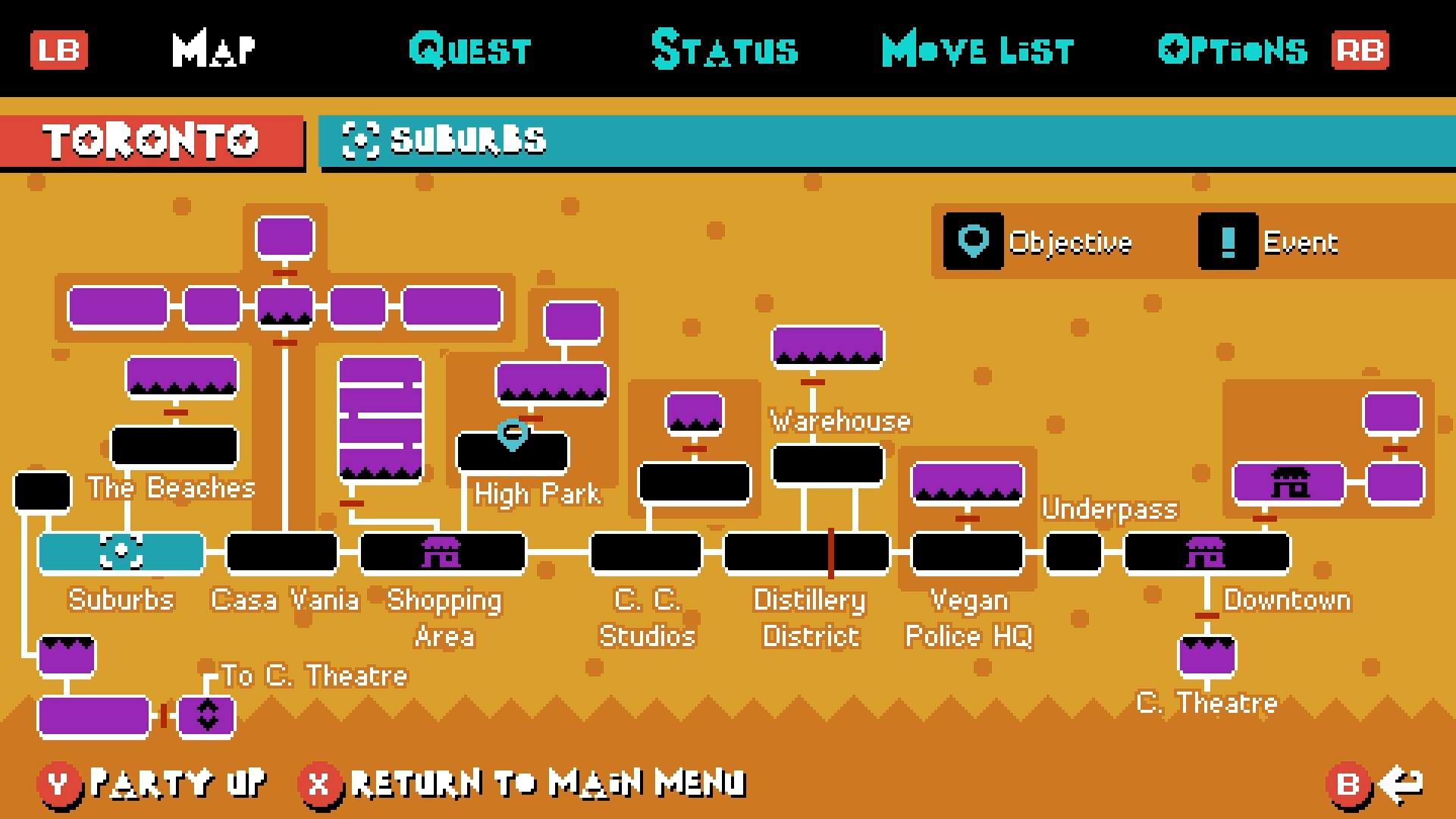
Belzil: When you create a game like this, you’re in a map, and the player will be walking all over this map and going back and forth through different places. So you’re thinking about how every zone has to be memorable so that the player can remember it. Even though I look at the map all the time, and probably most of us will look at the map, they have to remember, “Oh, there’s a prehistoric zone, and there’s sort of a Western train part, and then there’s a post-apocalyptic zone, but there’s also a beach, and there’s this and there’s that.” So we wanted to have really strong zones that would feel different.
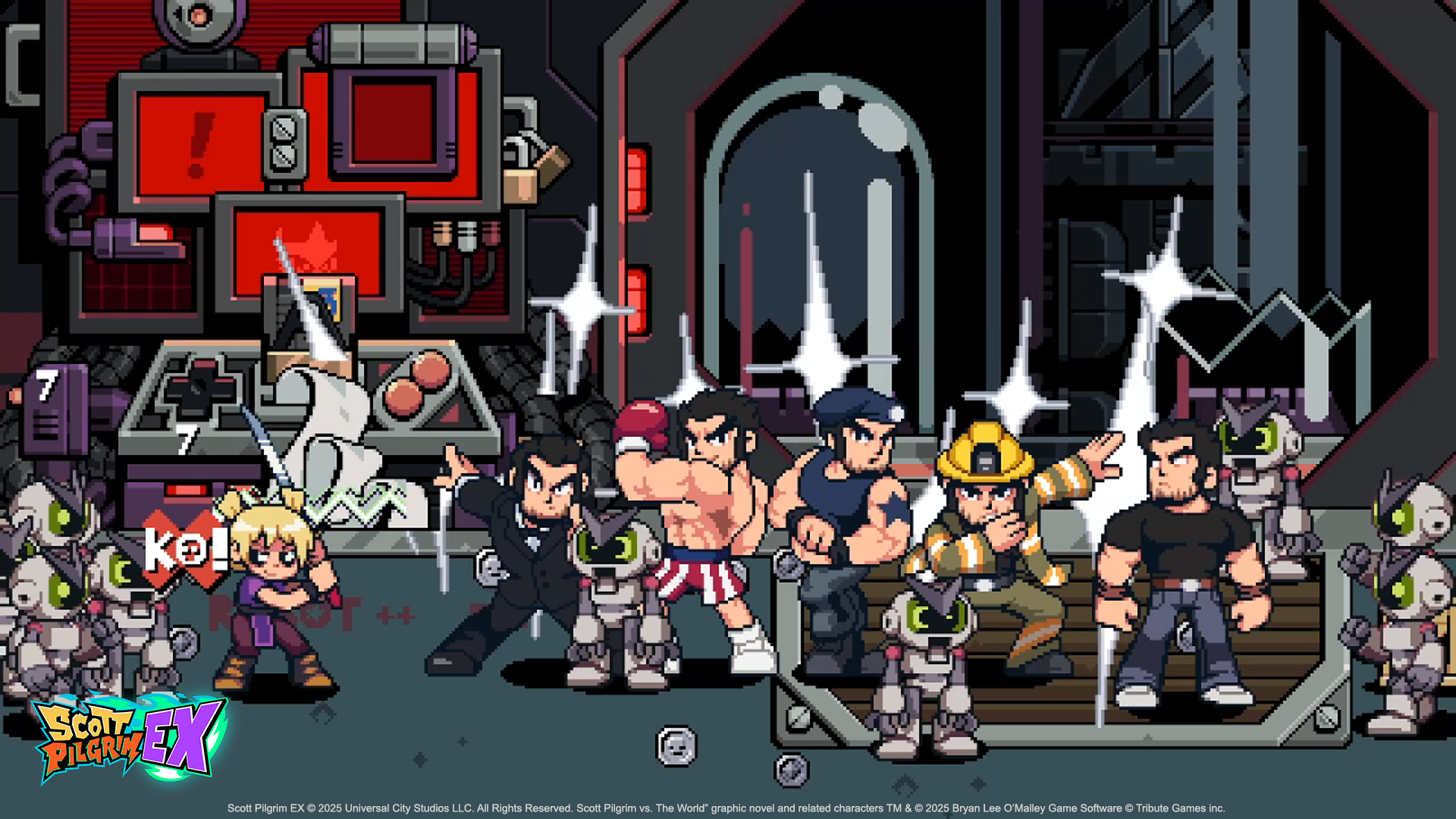
And then it was also talking with our amazing art director and background artist Stéphane [Boutin] — “What do you want to draw?” Because again, even though you can have a variety of urban environments that are memorable, it’s going to be even more memorable if there’s a Flintstones-esque B.C. period, and there’s going to be a certain high school that really looks like 8-bit River City Ransom. So we would come up with wacky environments, and then that’s how we figured out that, “Okay, so there’s some sort of element of time travel or dimension travel happening here, and because these zones will have strong visual identities, a boss that is matched to that identity would be really interesting.”
So then it was like, “Oh, well, we can make Todd a dinosaur and Roxie a primal cavewoman.” We come up with ideas, and we use some sketches. We send those to Bryan, and then he either likes it or he doesn’t, or sometimes he’ll do another sketch, like, “Oh, I think Roxie should look like this, more cat-like, and less cavewoman-like,” and so on. And that’s how we eventually come up with the characters that you see in the game.
Something that you guys do really well at Tribute is that the characters are so colourful and you bring out a lot of their personality through the art direction and the gameplay and the narrative. They all feel distinct. When you’re designing all these characters, I’m curious the role that the narrative plays in that. When you play as Scott versus Ramona versus Matthew, you see their little sort of character personalities fleshed out, and then obviously there’s little bits of dialogue as well. So what does that dynamic look like between you on the narrative side and then the artists and the gameplay designers to come together and design these distinct characters?
Belzil: Yeah, that’s a big thing when making them — character is part of narrative as well, even though it’s not plot or necessarily what most people would consider a story. So I do research and I just push it across the table to the artists, and they can use it as they see fit. But in the case for, say, Scott. Again, the designer, Jonathan, knows how he’s going to fight. He’s going to have this more Ryu/Ken Shotokan karate type of fighting — a basic heroic fighting style. So when [Jonathan] does that, what I do is that I look through my favourite martial arts movies and I look up stuff about actual martial arts and what these martial arts are considered to be — heroic, straightforward and clean.
Luckily, because we were working both on Marvel and Scott Pilgrim at the same time, I saw how the 15 playable characters on Marvel would have different fighting styles. So I was like, “Ok, Scott should do bajiquan,” which is this really cool type of martial art with a lot of elbows and knees and straight punches, and then I find action scenes from certain movies, or just diagrams of these moves, of these martial arts. And I say, “Okay, well, here’s what I think Scott’s martial arts should be.” And so that adds a lot.
And also, again, with these characters, we have the anime, we have the books, where there’s a lot of characters in the original art. So I take captures of these panels and also add them to the document. We worked with [artist] Jonathan Kim, who drew a lot of the basic frames for the moves of the characters. So he has all that info, and he can use it to add certain flourishes or character bits to the moves. And that’s how we go for bosses, playable characters and references for stuff like that. I gather a whole bunch of stuff, and I leave it to our wonderful artists to pick what they like from it.
Obviously, Scott Pilgrim is so intrinsically Torontonian, and in the game, of course, you have a lot of recognizable landmarks — the CN Tower, versions of Honest Eds and Sneaky Dee’s and Pizza Pizza, High Park, the Distillery District, etc. Of course, Toronto is such a big city, and you guys are not a massive team and can’t include everything. So, how did you decide which parts of Toronto you wanted to include? Would you go to Toronto and scout? Would Bryan pitch things that had to be there? How did that all work?
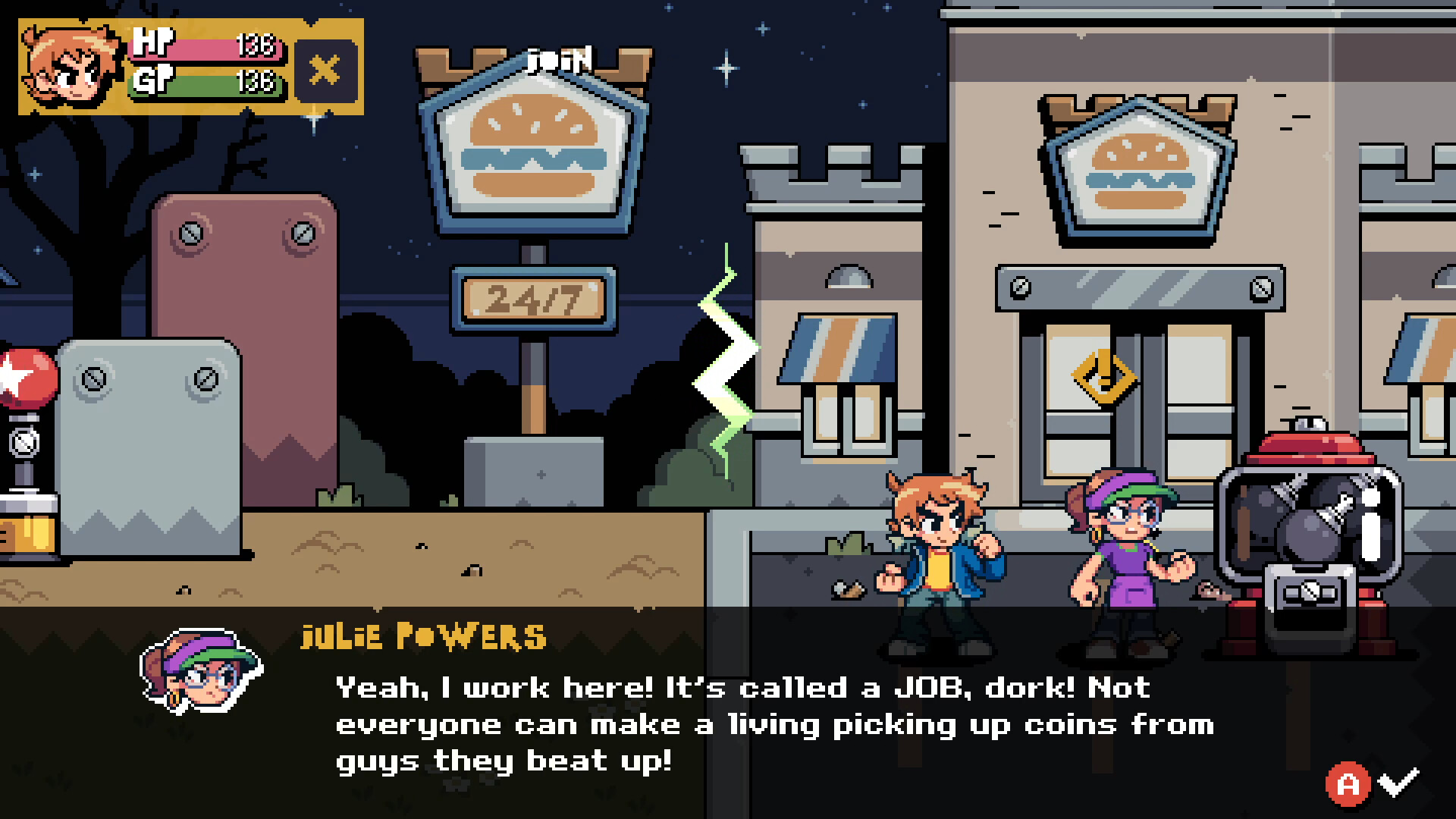
Belzil: It’s a mix of both. First, what can be there is what can fit through our sort of skewed, shoebox type of perspective of the game. So that’s why you only see the CN Tower from pretty far in the horizon, because that becomes a hard one to fit into the perspective. But yeah, there’s a lot of stuff like that. Like High Park, our art director, Stéphane had seen it on a trip to Toronto and he thought it was beautiful, and that’s why there is this sort of medieval type of era in the game. Because he saw High Park, he saw that a castle there, and he really liked it. And that’s how it became some sort of White Castle, Burger King-type of place with all that stuff — that’s how that fed together. And so that’s how we chose these places.
But other things, like, say, later on in the game — there’s the Vegan Police Department, which has a pan-up, and it’s sort of based on the Robarts Library Building. But that was something that Bryan suggested to us because we were like, “Oh, what kind of building would be good for the VPD? What has sort of that visual pizzazz?” And he suggested it to us because it has such an awesome brutalist shape — it looks like a building that OCP might build in Robocop. So we thought, “Oh, that would fit really well!” That’s how that made its way into the game. So it’s a mishmash of all that stuff you mentioned.
Sometimes there can be a bit of a friendly rivalry between Toronto and Montreal, Anglophone and Francophone. What was it like as Montrealers to work on something that’s so quintessentially Torontonian?
Belzil: It boils me. I am so angry about it. [laughs] No, it’s funny because our very first idea for the game, before we really got into it more with Bryan — one thing we suggested was, “Okay, Sex Bob-Omb are on tour, and they’re in Montreal, and as soon as they arrive in Montreal, their truck gets stolen, and they have to go across Montreal to find their stolen instruments once more.” And we were pretty excited about making a super cartoony version of Montreal, with all the stereotypes that we know to be based in some sort of truth. And we thought that, “Oh, well, that’s a fish out of water, it’s Scott Pilgrim in Montreal.” And eventually, that got pushed away, but it would have been pretty fun for us to do that.
But otherwise, no, it’s really cool because Toronto is the place that gets the bigger shows that sometimes don’t come to Montreal. [laughs] Which is why sometimes my lady and I go to Toronto. But it’s a really nice place, and there’s still a whole lot of stuff to make in a visual game with memorable locales. So it was really fun to put that in there, but also to sort of create and adapt the Toronto that Bryan created in his books. So when I get that question, I think, “Yeah, it is Toronto, but it’s sort of Bryan Lee O’Malley-drawn Toronto first, rather than the actual Toronto.” We try to have a bunch of real bits in there, or in the case of the Robarts library, somewhere that was not in the books. But otherwise, we think of it as a real but adapted location, rather than the real city, in a sense.
What is it like as Canadians to get to make this game set in Canada?
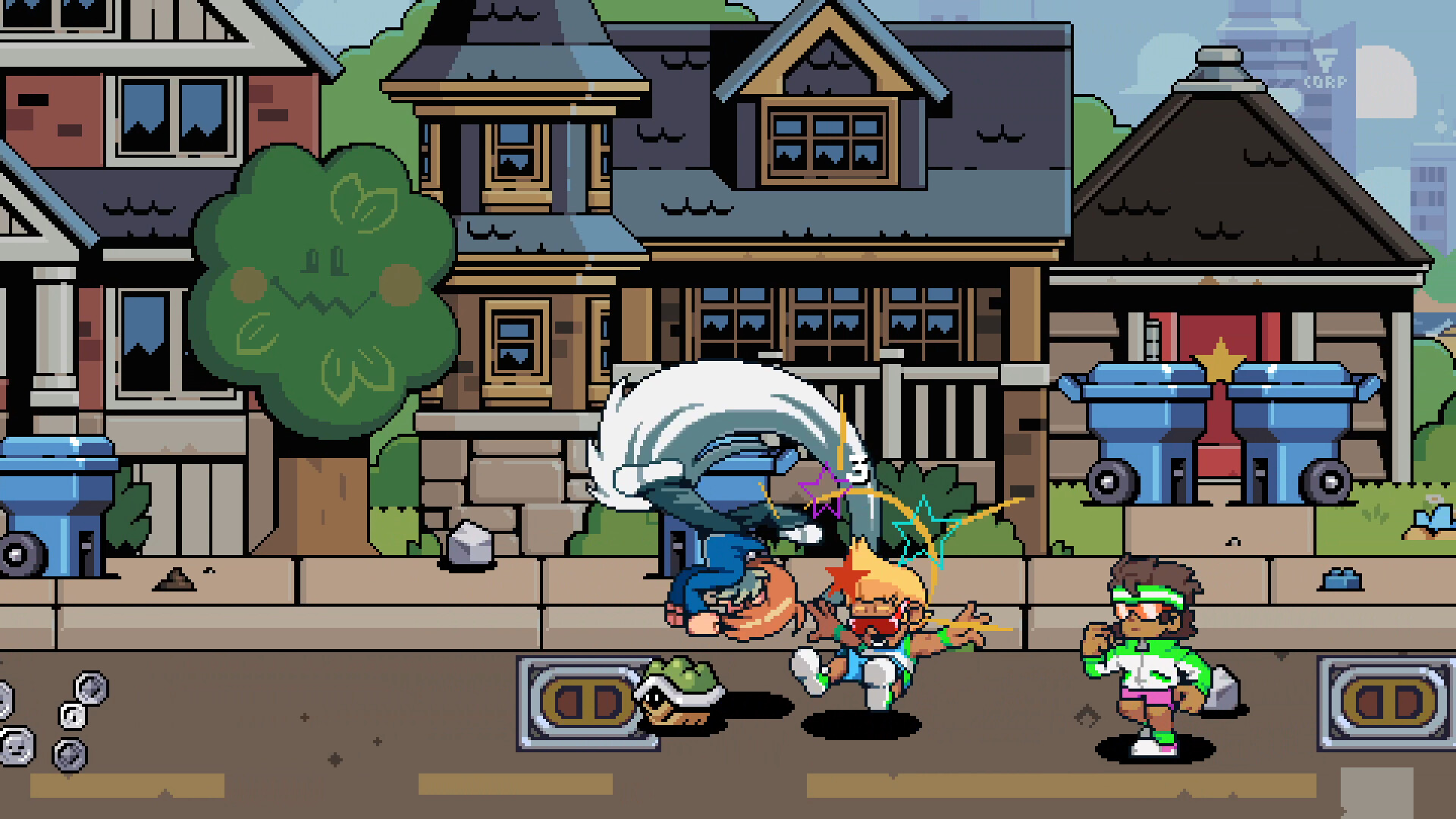
Belzil: Oh, it’s really fun. Just the fact that you beat up these bad guys, and you can pick up Canadian coins. We get something out of that — we relate to it a bit more. It’s really, really fun to be able to add that colour. Because again, we worked on TMNT, so you do the iconic cartoon New York that almost becomes somewhat of a default action-adventure setting. And we have some New York levels in Marvel Cosmic Invasion as well. We’ve done those, and they’re great, but sometimes you’re like, “Oh, it’d be fun to have a different cityscape that looks different.” And it could be from anywhere else in the world, but we’re really happy to have ours with recycling bins that are a different colour and with signage that feels more like the ones we grew up with. So that’s always a fun detail.
This interview was edited for language and clarity.
This interview has been edited for language and clarity.
Scott Pilgrim EX will launch on March 3 on PS4, PS5, Xbox One, Xbox Series X/S, Nintendo Switch and PC.
Image credit: Tribute Games
