
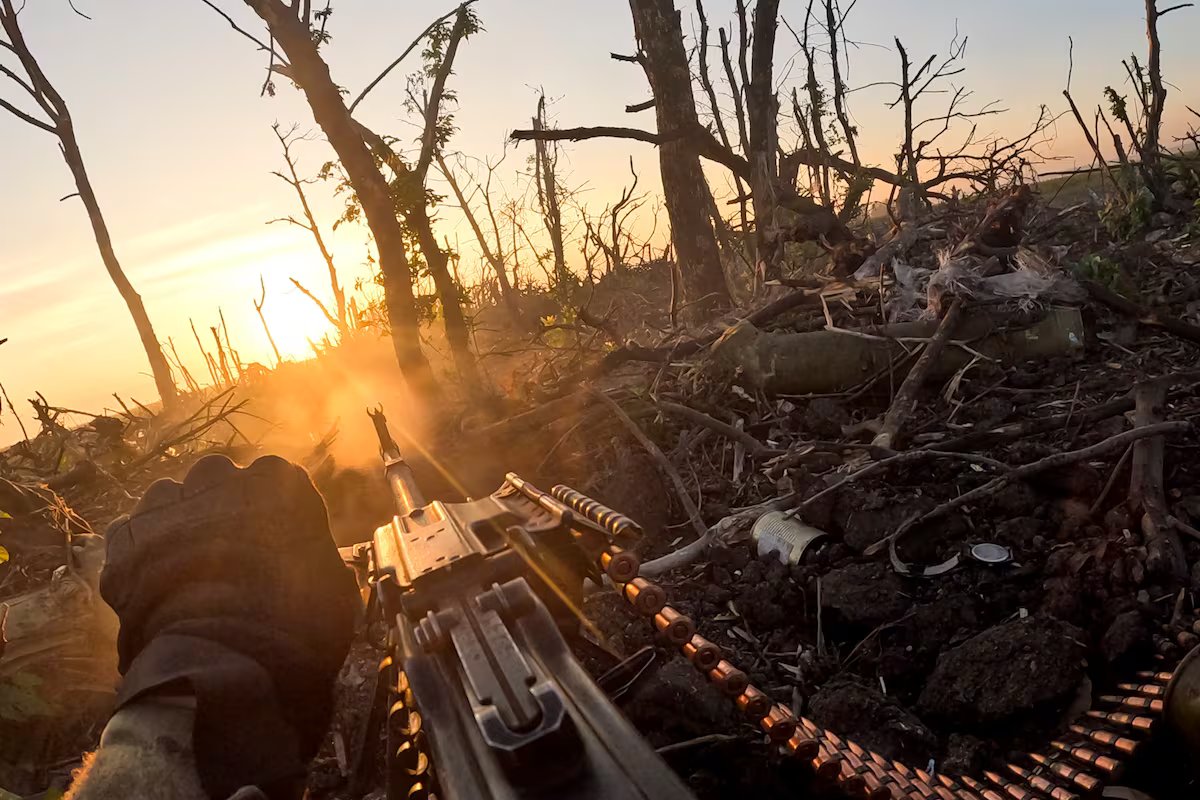
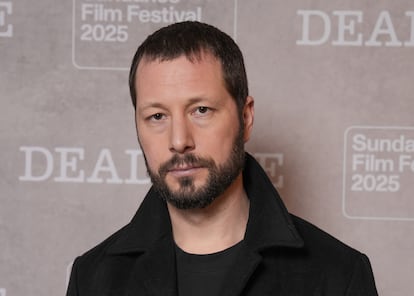
“It was like living in two worlds, and having to go from one to another in a dramatic way. From attending film festivals and walking down red carpets to crossing the Poland border and getting into the trenches,” recalls Ukrainian filmmaker Mstyslav Chernov (Kharkiv, 40 years old) of September 2023, when he was headed from screening to screening, kicking off the race to the Oscars that he would ultimately win with his documentary 20 Days in Mariupol. It was also then that he managed to get his country’s army to allow him to embed with a platoon. The moment in which that decision was handed down was not just any — with it, he was able to document the offensive that Ukraine launched to recover its land in Donbas, now considered the biggest counteroffensive in Europe since the Second World War. The result is 2000 Meters to Avdiivka, which can now be seen on Prime Video, and is itself an Oscar contender, after debuting at Sundance and being included on this year’s 15-film shortlist for best documentary.
Chernov is not just anyone in the world of photojournalism. In addition to reporting in his homeland on the 2013 Euromaidan protests and being the first to arrive at the remains of the Malyasia Airlines flight downed by Russia in 2014 on his third day working for the Associated Press, he would come to cover a range of martial and humanitarian conflicts with the agency. For his work in Mariupol, which told of his stay in the city while it was under seige by Russian forces, Chernov and three other AP colleagues won a Pulitzer. Afterwards, he had so much recorded material — around 30 hours — that he decided to put together the documentary that would win the Oscar. In his interviews, he barely takes a breath, or strays from his core message. Speaking with EL PAÍS last Wednesday via a WhatsApp call, he breaks slightly when he lets it slip that, “For me, it’s later. It’s midnight here.” He was not calling from London as previously announced, but most likely, from Ukraine. Where else? When asked if his family, including his two daughters, is OK, he says, “For security reasons, I cannot answer that.”
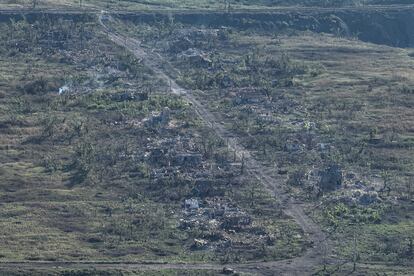
Those titular two kilometers of Chernov’s new documentary separated Ukrainian troops that September of 2023 from taking Avdiivka, a Donbas village that had been razed to the ground, but was key due to its geographical location. The only route was through a forest, whose only remaining greenery laid in piles of branches and bushes, and was full of Russian army trenches measuring 50 feet across, flanked by two gigantic minefields. The Ukrainian soldiers’ only option was to go through the forest. “I was looking for another story, not one of pain and victimhood like 20 Days, but one that showed our resistance, our unity in the face of adversity. And when the counteroffensive began, I felt that this was what I wanted to tell. This is a story of distances, not only the one that separates the army from the city, but also the one that separates peace and war.”
The film portrays a modern war, one that is completely digitalized. In addition to images from his camera and that of his colleague Alex Babenko, from when the two were embedded in the 3rd Assault Brigade, the movie also features recordings from cameras that are typically mounted on Ukrainian soldiers’ helmets. There are also aerial views from attack and surveillance drones, and shots from army headquarters, where every move is followed on screens and warnings as to Russian movements are sent out: “Brother, watch out there, there’s a bastard on your right.” “Brother” is used by Ukrainians to refer to each other. “Bastard” signals a Russian soldier. The two words are the ones most commonly used in the documentary.
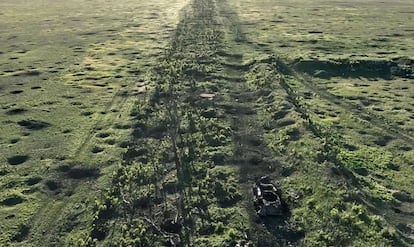
Chernov points out that the impressive similarity of the film to a video game is “because this training has been modelled with martial experiences”. He continues, saying, “This disgraceful reality is easily available due to current technological developments, because we can install cameras on the helmets, see what the drones see,” says the director. “We can bring the viewer an experience they’ve never had before. It could be that Saving Private Ryan, All Quiet on the Western Front or Apocalyse Now provoke a similar sensation. But here, everything is real. It’s the only, really the best, thing we can contribute through the documentary genre.”
Things have not gotten any better in 2026. “When the counteroffensive took place, 20% of Ukraine was under Russian control. Avdiivka was taken back, because it’s a symbol of our resistance, and it was lost again. That 20% continues to be under Russian control. The world has never been as dangerous as it is today. And I’m talking about the whole planet. There has never been this much militarization. With all that, there is a big difference between how the Ukrainian public and the Western world see this documentary. My colleagues have to defend their home and family, and the film also serves as a memory of those who have died. Careful, this is not a propagandist film. Westerners say, ‘The war is terrible! It’s horrifying!’ Of course, it’s unacceptable, and should never have begun. And it could be that they think that we are making a futile attempt, but it is not futile to defend your home and identity,” he says.
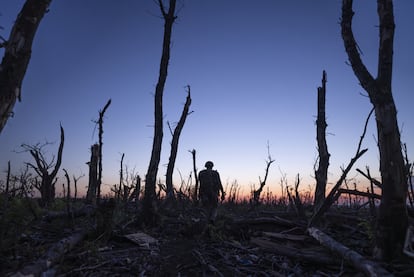
The bullets may whizz by, but neither in the fast-paced nor slower scenes do Chernov and Babenko’s images show the faces of the dead. And there are many. “We don’t hide the harshness of what’s happening, we’re not there to whitewash the war. However, we set out to respect the fallen and their families. We show the horror, but we want a lot of people to be able to watch this,” says the director.
In the spirit of that caution, Chernov speaks in a voiceover in the documentary to recount what has happened with the soldiers who were interviewed. Nearly all of them died in combat. One, a 46-year-old who could have been the father of the other members of the platoon, asks that they not portray him as a hero, that he only came to defend his country and family. “Because in war films, the most important moments are the ones that speak to us of humanity. At least, that’s how I understand it. I had to listen to them and understand that what was fundamental to them is their families, their universities, their community, the human connection,” says the filmmaker.
How does he see the future of Ukraine? Will there be an end to the Russian invasion? “Look, I’m not an optimist, like many of my colleagues, nor am I a pessimist, because if I were, I would give up. I’m a realist. In recent months, there have been a lot of conversations about peace and possible accords, and none of those words have helped stopped the Russians from bombing Ukrainian cities and killing civilians,” Chernov says. Is he working on a new film? “Yes, my projects are shifting again. I’m trying, again, another different perspective, one that is more political, and that at the same time reflects how citizens are affected by the in crescendo Russian bombings and violence. I only hope that it will be my last film about this barbaric invasion, and that it shows the end of the war.”
Sign up for our weekly newsletter to get more English-language news coverage from EL PAÍS USA Edition
