
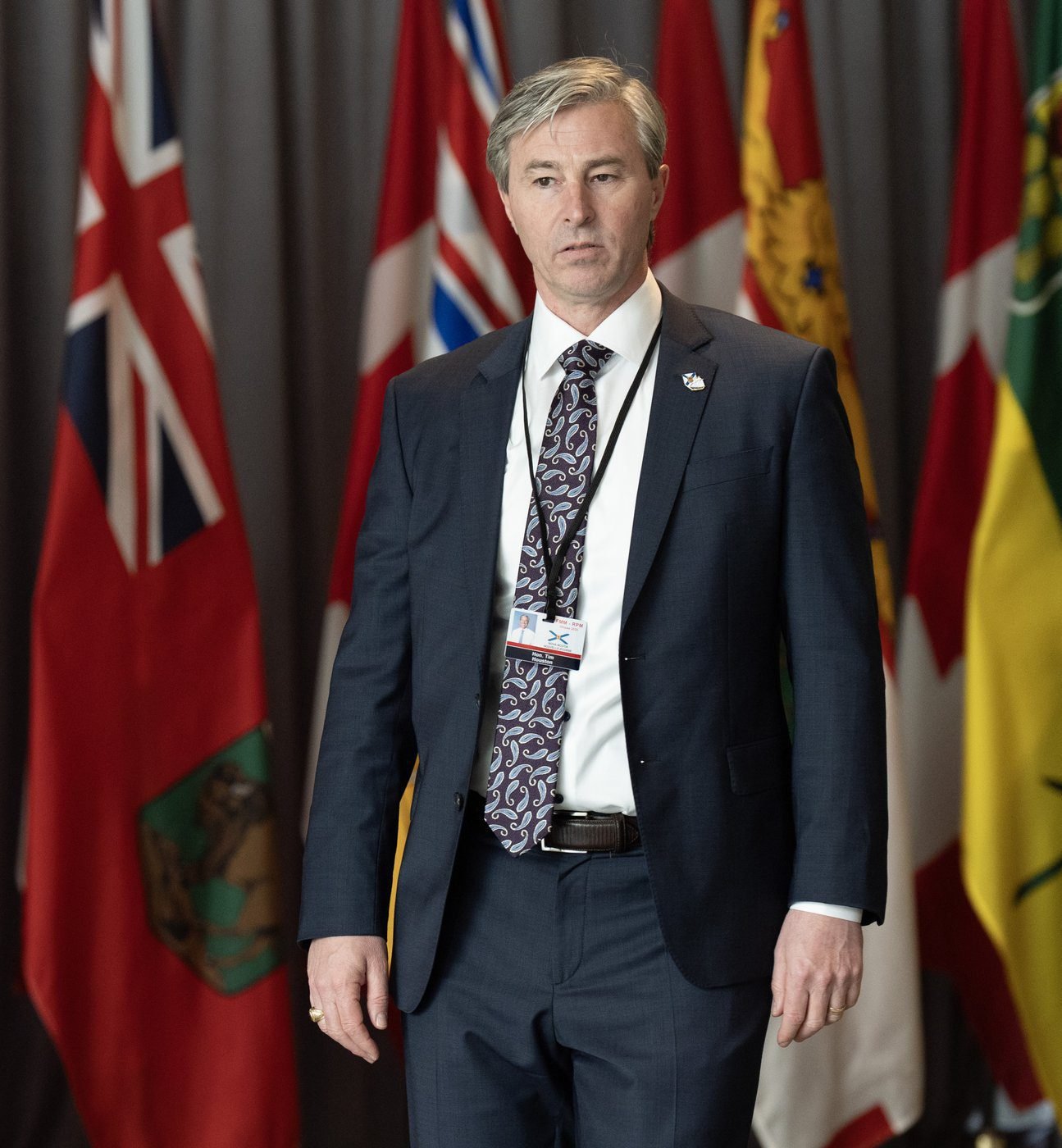
HALIFAX — The Nova Scotia premier’s popularity appears to have taken a significant hit following controversial budget cuts that he partially walked back amid public outcry and protests.
An Angus Reid poll released this week indicates that Tim Houston’s approval rating has dropped to 39 per cent, marking his lowest rating since he was elected premier in 2021.
The online survey conducted between March 11 and 17 found that Houston’s 11 point drop was the largest of any premier in the country.
Over the past few weeks, several boisterous protests have been held outside of the legislature over his government’s planned grant cuts and the premier has been booed at public events.
Alex Marland, a political scientist at Acadia University, said it made sense for the premier to change course on some cuts and apologize amid the backlash.
“Sometimes that (change of course) can actually work in your favour … could give you a lot of authenticity and credibility. In a democracy, having a leader listen to the public is a great thing,” he said in an interview.
“My sense (is), he waited a little too long.”
Houston’s ranked sixth out of the nine provincial premiers surveyed by Angus Reid. The poll suggested Quebec Premier François Legault was the least popular with a 26 per cent approval rating, while Manitoba’s Wab Kinew and Houston’s provincial neighbour, New Brunswick’s Susan Holt, had the highest and second-highest approval ratings.
The polling industry’s professional body, the Canadian Research Insights Council, says online surveys cannot be assigned a margin of error because they do not randomly sample the population.
The budget Houston’s finance minister tabled on Feb. 23 included $304.9 million in cuts, with a reduction in public service staff and a rollback of $130.4 million in funding for arts and culture, Mi’kmaq and African Nova Scotian programming and services for people with disabilities.
Responding to the initial public criticism, the premier told reporters on March 4 he couldn’t imagine making any changes to the budget.
But six days later, Houston apologized for making a mistake in cutting programs and services supporting vulnerable Nova Scotians and announced he would reinstate $53.6 million in funding.
“Because initially (Houston) said there weren’t going to be changes, and yet there were in the end, it gave the sense that rather than … having empathy, it was more him being backed into a corner,” Marland said.
The premier’s “ability to have his finger on the pulse of Nova Scotia was missing,” Marland said, “and I think the communication surrounding the budget was a bit of a train wreck.”
The political scientist said when the public is outraged and shocked by budget cuts, it may mean government has failed to communicate the bleak fiscal outlook that’s pushing them to reduce spending.
“They haven’t done a good job at making people understand that … there’s no money left and they need to do something here,” Marland said.
Claudia Chender, leader of the Opposition NDP, told reporters Friday that Houston’s government ought to scrap the budget altogether and present something new to Nova Scotians.
“The cruel cuts in this budget are mostly still intact, and ministers still mostly cannot explain them (cuts) or their impact,” she said.
The Assembly of Nova Scotia Mi’kmaw Chiefs has said the remaining cuts will result in the loss of Mi’kmaq programs that were built to address systemic racism.
Sidney Peters, chief of Glooscap First Nation and co-chair of the assembly, said only two of 21 Mi’kmaw specific programs affected by the cuts have been restored.
Peters added that this partial budget reversal “made one thing unmistakably clear: when the province said it was restoring $53.6 million to ‘protect some of the most vulnerable,’ they did not mean the Mi’kmaq.”
Chender said these programs and many others need to be restored.
“The cuts they have proposed in this budget confirm that even the most vulnerable Nova Scotians are on the chopping block,” she said, which include a range of community programs and funding for arts, culture, tourism and transit among others.
This report by The Canadian Press was first published March 21, 2026.
Lyndsay Armstrong, The Canadian Press
