
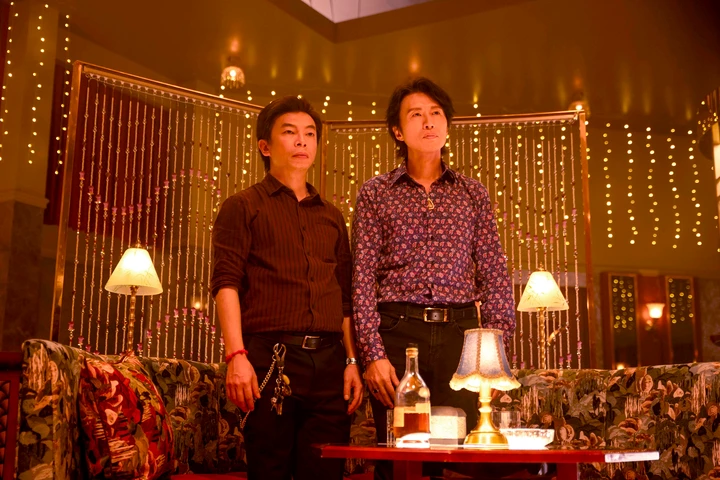
Host and hostess clubs are an inherently East Asian form of nightlife, with many Westerners only encountering them by travelling to the region or through the extensive hostess mini‑game featured in the extravagant Yakuza series. For the uninitiated, hostess clubs are establishments where men pay female staff (hostesses) to entertain them by serving drinks, lighting cigarettes, and engaging in conversation. It’s a form of fantasy wish‑fulfilment in which lavishly dressed women spend hours acting as your companion. This otherworldly nightlife is the key focus of Night King, the latest film by Jack Ng, which explores job insecurity, financial decline, and Loyalty in a luxurious and hyperkinetic comedy‑drama.
Set in Hong Kong’s Tsim Sha Tsui (TST) district, a neon-soaked playground in the ’90s, the film now finds the area in 2010, long after most of its famous clubs have closed. Club EJ is one of the few still standing, but it’s struggling to stay afloat. Manager Foon (Dayo Wong) is loyal to his girls and will do anything to keep them employed and the club alive. Everything changes when his ex-wife, Madame V (Sammi Cheng), begins negotiations to take over the club after the death of Foon’s godfather.
Just like heading out into the centre of town after a couple of drinks, there’s a chaotic sense of beauty to the lavish Club EJ; the titular venue becomes a character in its own right. We see it in the build-up before the doors open, when every light is blazing, and every detail is visible with such precision that it feels as though we’re watching the mechanics of a magic trick. But when the lights dim and the regulars drift through the doors, the club’s lavish beauty truly awakens. The chandelier becomes otherworldly, and seeing every table filled and bustling is striking.
Jack Ng does an impeccable job of capturing the beauty of the nightlife scene while grounding it in the harsh reality of a declining business. Much of this comes through in the film’s treatment of the women. Hostess clubs have long been criticised for objectifying women, centring their labour around pleasing men. Night King finds a balance: the women are allowed to flaunt their beauty without the intrusive male gaze that could push these moments toward sleaze. Foon, as a manager, anchors the nightlife world; he respects his staff and understands that if they lose their jobs, they have nowhere else to go.
We’ve seen this far too often in our current age: entire generations struggling to find work because they lack the required skill set. With the rapid rise of technology, even more people are finding it difficult to adapt to the modern work culture. Business decline is something every industry faces, cinemas included, and although Night King is set in 2010, its themes feel highly relevant today. We see so-called “more popular” or “timely” services skyrocket in visibility and profit, leaving others behind. It’s a harsh reality that hangs over Night King , grounding the film in something uncomfortable but undeniably true.
Loyalty is what holds all these grounded elements together. Foon is devoted to his staff; without them, he has no business. He’ll bend over backwards for them, whether that means offering interest-free loans or providing other forms of support. His staff, in turn, stand by Foon; without his guidance, they wouldn’t be able to keep roofs over their heads or afford necessities like medicine. This loyalty and unity keep every grounded moment synced and believable. You understand why the staff choose to work with Foon, and in a touching moment near the end, you see that this loyalty extends to their regular customers as well.
Despite the film’s grounded tone, it carries a great sense of humour. Whether it’s Foon and his colleague role‑playing how to deal with inappropriately flirtatious guests, Madame V suddenly and uninvitedly moving back in with Foon after selling her apartment to keep Club EJ afloat, or a waiter abruptly becoming a host simply because she can speak Japanese, Night King is filled with laugh‑out‑loud moments that had me wailing at the top of my lungs. Even in the third act, the film shifts tone once again, and while I won’t spoil it, this dynamic change is utterly gripping and feels like a natural payoff.
The film is inherently character-driven, and without its strong performances, it simply wouldn’t work as well as it does. Dayo Wong is charming as Foon, delivering a pitch-perfect turn that stands in stark contrast to his work in The Last Dance, blending comedic beats with the sincerity required of a manager. Sammi Cheng is just as fierce as Madame V, delivering a commanding performance as both a successful club owner and Foon’s ex. We understand immediately why Madame V thrives in her own right. The supporting cast is equally impressive, each performer matching the film’s tone and direction with ease.
On a technical level, Night King is incredibly visually striking, from its lavish and hypnotic opening credits to the lush cinematography that features stunning nighttime bokeh and moments designed to look as though they were shot through glass, creating a kaleidoscopic effect. Despite being set primarily in one location, the film never feels visually repetitive. The soundtrack is equally brilliant, perfectly accompanying every scene it appears in, and the pacing is immaculate thanks to the stellar editing. Even at over two hours long, the film feels as though it lasts barely an hour.
Night King is a marvellous and thrilling comedy‑drama, unlike anything I’ve seen. Equally hilarious, poignant, and heartfelt, Hong Kong nightlife has never looked this good. Filled to the brim with loyalty and tenderness, I couldn’t help but fall in love with this film, and I already can’t wait to see it again. Night King is phenomenal.
★★★★1/2
In UK Cinemas from 16th Feburary 2026 / Dayo Wong, Sammi Cheng, Louise Wong, Fish Liew, Wai Lun Yeung / Dir: Jack Ng / Trinity CineAsia / 12a
Related
Discover more from
Subscribe to get the latest posts sent to your email.
