
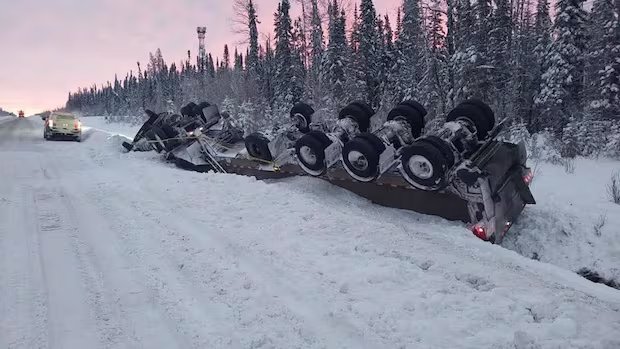
Northern Ontario politicians are urgently appealing to the federal government for help during one of the deadliest winters on record along 2,000 kilometres of highway between Nipigon, Sudbury and North Bay.
In a letter to Prime Minister Mark Carney, the Northwestern Ontario Municipalities Association (NOMA) is urging the government to designate the stretch of the Trans-Canada Highway — both Highway 11 and Highway 17 — as dual-use national infrastructure.
That would tap into the federal government’s plan to spend more on defence-related infrastructure while fulfilling a years-old request from northwestern Ontarians to shore up the sole land connector between Eastern and Western Canada.
“We need to get the attention of the federal government to say: listen, we need you to invest,” said Rick Dumas, the mayor of Marathon, Ont., and president of the Northwestern Ontario Municipalities Association (NOMA).
He said investing in the corridor would improve the movement of both civilians and troops and “connect Canada in a safe and modern way.”
All ground cross-Canada transportation and trade has to travel along Highway 11 or 17 and pass over the Nipigon River Bridge, northeast of Thunder Bay. When that bridge last failed, it severed the country for 18 hours.
“The reality is that the bridge is the only connecting point of Canada,” Dumas said.
“So when you talk about national defence and security of our country, there’s a link that if anything happens … we’re literally split in half.”
Highways 11 and 17 merge just east of the bridge. That stretch of highway, between Nipigon and Thunder Bay, has recently undergone a massive twinning project.
The highway is now divided, with two lanes on each side.
“I’m not 100 per cent sure if, when we talk to the MPs in Ottawa, if they all realize the importance of that critical link in Northwestern Ontario,” Dumas said.
He said NOMA is calling for Highway 11 from Nipigon to North Bay and Highway 17 from Nipigon to Sault Ste. Marie to either be twinned or given a two-plus-one system — a three-lane highway configuration where the middle lane changes direction every two to five kilometres for passing.
Designating the corridor as critical dual-use infrastructure would allow the federal government to tap into the newly announced $82-billion defence industrial strategy and and count toward Canada’s NATO defence spending target.

“The idea is … if you’ve got forest fires, if you’re doing a military defence exercise — then instead of regular civilians maybe you’ve got trucks, tanks, etc. using that facility,” said Charles Cirtwill, president and CEO of the Northern Policy Institute.
Recently, the federal government announced planned upgrades to roads and airports in the North by designating them as dual-use infrastructure — serving both the military and civilians.
“Asking for that dual-use label to come just a little bit south and fill in what remains the biggest infrastructure gap in the Trans-Canada Highway system is a very logical step,” Cirtwill said.
Dumas said the group has also called for an in-person meeting with the prime minister and key federal ministers to talk about their proposal.
‘3 times more likely to die’
NOMA represents 37 municipalities across northwestern Ontario, many of which have seen the toll that road fatalities have taken on their communities.
At least 11 deaths have been recorded on northern highways during the winter of 2026.
The Northern Policy Institute looked at the province’s highway fatality data from the last decade.
“If you get in an accident in northern Ontario, you’re three times more likely to die than if you get in an accident in southern Ontario,” Cirtwill said. “And in some stretches of the highway, you’re nine times more likely to die. So this is a real issue that needs to be addressed.”
Cirtwill said that data doesn’t include this past year, which has been one of the deadliest on record.
According to the Ontario Provincial Police, 10,661 collisions were reported on Highway 11 and 8,960 incidents on Highway 17 between 2020 and 2025.
In that period, 116 people died on Highway 11 and 123 on Highway 17, according to the OPP.

“We still have Trans-Canada level traffic on two-lane highways,” Cirtwill said.
“Many people don’t really understand the scope and scale of northern Ontario, and a lot of people probably don’t appreciate the fact that our Trans-Canada Highway looks like it did in 1945.
“It is not the Trans-Canada Highway that you see in Alberta or you see in New Brunswick. So the question of safety is absolutely critical.”
Single bridge ‘problematic’
All of this comes at a time when the prime minister is calling for more cross-Canada trade. But experts warn that can’t happen if the highway isn’t improved.
“There’s no question that having a single route that’s tied to a single bridge, having the nation’s trade tied to a single bridge, is really problematic,” said Cirtwill.
In the three-month period leading up to Feb. 6, 2026, there were at least 148 hours of closures along highways 11 and 17 between Kenora and Sault Ste. Marie, forcing Canadian trade to either stop and wait or go through the U.S.
“We’re talking 400-, 500-, even an 800-kilometre detour,” Cirtwill said. “It’s not as simple as turning around and figuring out another way to go.”

“Honestly, there has to be an option,” Dumas said. “The only option we have is through the United States of America. And that’s a big detour. But not only that, it means everybody has to travel with their passport in their car.”
As a second part of its proposal, NOMA is also asking the federal governments to begin exploring the development of a secondary east-west highway connection north of Lake Nipigon.
NOMA wants the federal government to work with the province of Ontario, municipalities and First Nations to modernize and strengthen the highway system through what they call co-ordinated planning and sustained investment.
“There’s not going to be a magic ball drop down and say, OK, we’re going to have twin highways,” Dumas said.
“But the reality is you start a plan, get a commitment from the federal government to work with the provincial government and start construction.”
In a statement, Minister of Transport Steven MacKinnon said the government sees safe highway travel as a top priority.
“We understand that highways 11 and 17 play an essential role in connecting northern Ontario communities and supporting economic activity across the region,” the statement said.
“Our government remains committed to ensure Canada’s transportation networks stay safe, resilient and reliable.”
The statement said questions about maintenance or modernization of the highways should go to the government of Ontario.
The Ontario government has previously told CBC News that it is investing hundreds of millions of dollars in making northern roadways safer.
