
O Tempora! O Mores! In the great scheme of things, the fact a United Conservative Party cabinet minister referred to one of her constituents in a private conversation with an office staffer as a “motherfucker” is of nearly total insignificance.
Public discourse in Alberta, and generally throughout North America in the age of Donald Trump, Jason Kenney, and four-letter black flags, is far too debased for us to get our knickers in a twist if a politician uses a creative variation of the F-word to describe a constituent, especially when the constituent in question is nowhere to be seen.
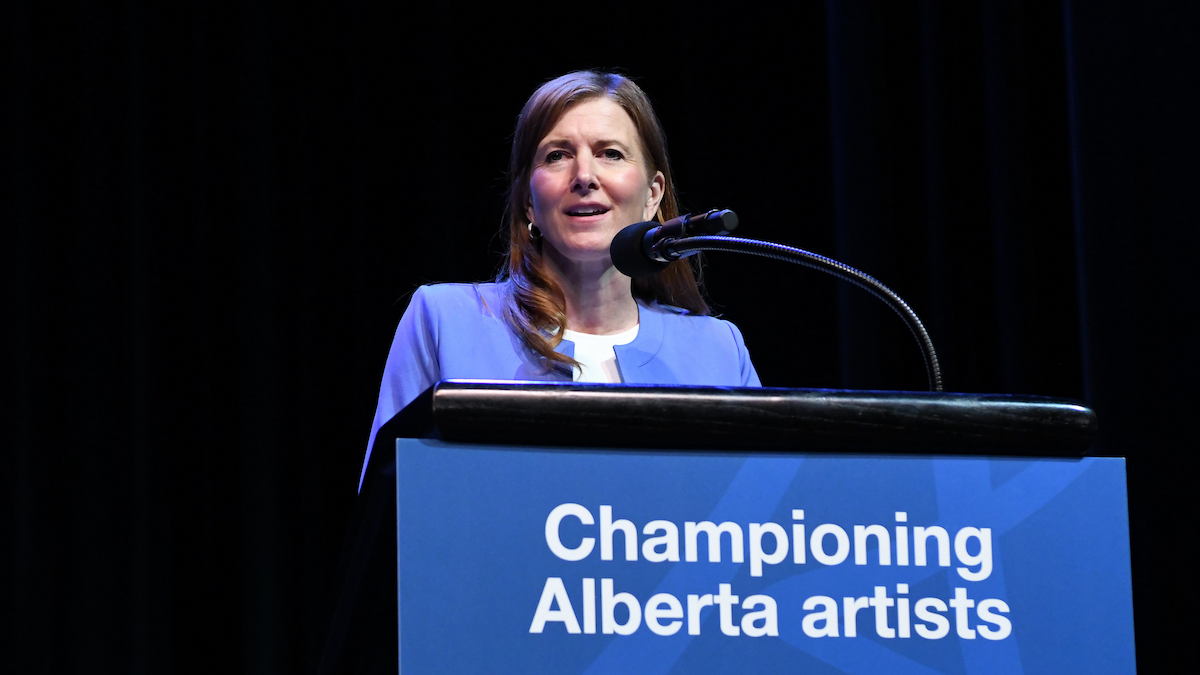
So on its own the undeniable fact that Calgary-Peigan MLA Tanya Fir – who is unironically Alberta’s minister of arts, culture and status of women – used that crude but familiar compound noun to describe someone who phoned to complain about the UCP’s use of the Constitution’s Notwithstanding Clause to suspend fundamental rights of unionized schoolteachers means little.
A recording of Ms. Fir’s pithy conversation came to light when she somehow failed to hang up her phone on a constituent for whom she had just left a more professional sounding message promising to make Premier Danielle Smith’s cabinet and the UCP caucus aware of the caller’s concern.
As the recorder continued to operate, however, Ms. Fir and her assistant discussed the message just left and then moved on to their next order of business.
“Alright,” Ms. Fir concluded. “Going on to this next motherfucker. …” Thereafter, she named the subject of her assessment and his telephone number, including them in the phone message to the previous caller. Whoops!

The subject of the epithet, as it turned out, was former Calgary Herald editorial writer Doug Firby, who nowadays publishes a blog on Substack. The person who had received Ms. Fir’s recorded message, which included Mr. Firby’s name and number, passed the recording on to Mr. Firby.
Mr. Firby, as any of us ex-journos would have, couldn’t resist the temptation to publish a story about the recording. He took a forgiving view – although a little self-righteous, in my opinion, seeing as he decided notwithstanding to publicize Ms. Fir’s blunder.
Be that as it may, he wrote in his Substack that Ms. Fir had quickly apologized to him. “She assured me the profanity was not intended for me and told me she only used it because she was overwhelmed by obscene messages she had to listen to.” Mr. Firby said Ms. Fir played him three, all crude, misogynistic and disturbing.
A little less insignificant, though, is that Ms. Fir left the impression, with me anyhow when I listened to the portion of the message posted on social media, that her unpleasant assessment not only applied to the next caller on her list, but to anyone who was upset about the UCP’s decision to use the Notwithstanding Clause to suspend the constitutional rights of 51,000 citizens who happened to have been on a legal strike when the government passed legislation not only sending them back to work but suspending their right to advocate for continued labour action.
For that she should have been asked to explain herself, as she did to Mr. Firby, in the Legislature.

Likewise, other UCP ministers who have been around for a while might have been asked why they were so tolerant of the same kind of intimidating attacks when they were directed at, for example, former premier Rachel Notley.
So where was the NDP Opposition on this? Apparently nowhere to be seen or heard.
This, I would argue, is political malpractice more serious than accidentally leaving a recorder running when you thought you’d hung up on an unhappy constituent.
The NDP’s lack of killer instinct is a serious shortcoming that may well impair the ability of Albertans to get rid of this terrible UCP Government. Surely it’s time for Opposition MLAs to sharpen their attacks.
Some thoughts on the use of profanity in reporting
Readers may wonder why I spelled out the offensive word in question instead of engaging in silly circumlocutions that made the word obvious to all readers but with a few letters blanked out or replaced by typographers’ dingbats as if that softened the message. Here are some passages from a textbook I wrote a few years ago for journalism students at a Christian College on this very topic:
“In determining whether the use of profanity in a news story is appropriate, context is everything. Specifically, the context of whether the use of profane language reflects on the fitness of a person to hold an office or position.
“If a robber uses profanity in the course of holding up a convenience store, this is not newsworthy. The is no news value whatsoever in informing readers that low-class characters who hold up stores late at night use the F-word as part of their ordinary discourse. We would simply expect such commentary from villains. There is no language test for the suitability of a candidate for armed robbery. In this and like circumstances, the profanity should not be included in the story.
“Some might argue that use of profanity in such a story will paint a dramatic picture of the events. Save such colour for your novel. It’s not news.
“On the other hand, if the bishop of a large church or a senior politician uses similar language in a sermon or a Parliamentary debate, arguably this is newsworthy. Either they have carefully pondered the implications of making such a statement, or they have not and have provided us with an unexpected glimpse into their innermost thoughts. Either way, their use of such language both emphasizes the point they are trying to make and reflects on their fitness to hold office.
“In this and like circumstances, the profanity should be included in the story.
“It’s best to use profanity very rarely. Judged critically, it is seldom newsworthy. When it is, it should be spelled out and stated clearly.”
Former ATA president Larry Booi on this year’s teachers’ strike
Speaking of Substack, and the recent teachers’ labour dispute ended by the UCP’s so-called Back to School Act, former Alberta Teachers Association president Larry Booi has published a sharply critical essay about the union’s strategy under the heading “Valiant Membership; Failure of Leadership.”

The “most fateful decision,” Mr. Booi wrote, “was to not take the single action that was key to the eventual success of the (ATA’s) 2002 strike: to ask teachers to withdraw their voluntary services.”
“When the ATA dealt with Bill 12 in 2002, they were faced with a very similar blunt force threat now used in Bill 2. All strike action of any kind was prohibited, with similar substantial penalties for defiance. ‘Work to rule’ was also prohibited, with a statement that teachers must resume the duties of their employment ‘without slowdown or diminution.’”
But in 2002, he wrote, the union risked using “the only weapon that could actually make a difference: asking teachers to withdraw their voluntary services.”
“The government did not levy fines or arrest anyone,” he noted. “The withdrawal of services was a huge success, and the fact that teachers had obeyed the law by staying in their schools was also very helpful. Public pressure on government mounted, they asked for talks, and an acceptable agreement was signed in April.”
