
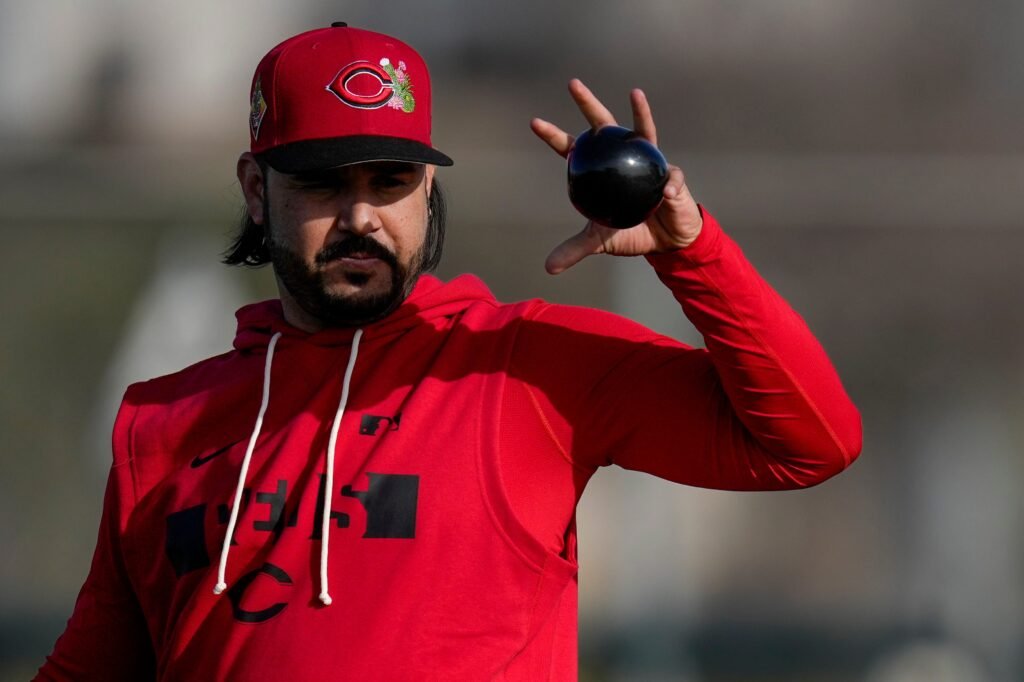
Eugenio Suarez‘s power bat is returning to the Queen City, but is that enough to bolster an inconsistent lineup?
Major League Signings
- Emilio Pagan, RHP: Two years, $20MM (Pagan can opt out after 2026 season)
- Eugenio Suarez, 1B/3B: One year, $15MM (plus $16MM mutual option for 2027)
- Pierce Johnson, RHP: One year, $6.5MM (plus mutual option for 2027)
- Caleb Ferguson, LHP: One year, $4.5MM
- JJ Bleday, OF: One year, $1.4MM
2026 spending: $37.4MM
Total spending: $47.4MM
Trades And Claims
Option Decisions
Notable Minor League Signings
- Nathaniel Lowe, Garrett Hampson, Josh Staumont, Michael Toglia, Michael Chavis, Anthony Misiewicz, Yunior Marte, Tejay Antone, Carson Spiers, Davis Daniel, Darren McCaughan, Will Banfield, Hagen Danner, P.J. Higgins, Brandon Leibrandt
Extensions
Notable Losses
- Hays, Barlow, Suter, Lux, Vilade, Zulueta, Nick Martinez, Santiago Espinal, Miguel Andujar, Reiver Sanmartin, Zack Littell (still unsigned), Wade Miley (still unsigned)
Kyle Schwarber grew up in Middletown, an Ohio city just a short drive away from Cincinnati. The idea of adding both a local product and a top-tier bat in Schwarber inspired the Reds to go beyond their usual financial zone in free agency, as the team reportedly made Schwarber an offer in the range of five years and $125MM. As was widely expected going into the offseason, however, Schwarber ended up re-signing with the Phillies (for five years and $150MM), leaving the Reds and Schwarber’s many other suitors looking for a backup plan.
Instead of adding a 56-homer slugger in Schwarber, the Reds brought in a 49-homer slugger who also had some ties to Cincinnati, as Suarez returned for his second stint with the organization. After bashing 189 homers for the Reds from 2015-21, Suarez went yard 132 more times in four subsequent seasons with the Mariners and Diamondbacks, including 49 home runs in 2025.
Though there were plenty of similarities between Schwarber and Suarez’s 2025 campaigns, there’s a reason Suarez was available at the relative bargain price of one year and $15MM. Schwarber is entering his age-33 seasons while Suarez turns 35 in July, Suarez’s walk rates over the last two seasons have been below average while Schwarber’s have been elite, and Suarez’s overall production has been inconsistent.
From the start of July 2024 to the end of July 2025, Suarez was arguably the hottest hitter in baseball in batting 276/.336/.593 with 60 homers over 766 PA with Arizona. He struggled badly in the first half of the 2024 season, however, and then his bat drastically cooled again this past summer after the D-Backs sent Suarez to the Mariners at the trade deadline.
Between the up-and-down numbers, Suarez’s age, and his defensive drop at third base, it seemed like Suarez wasn’t getting the types of offers he was expecting after a 49-homer campaign. Suarez’s alternate strategy was a one-year deal in a familiar (and hitter-friendly) environment at Great American Ball Park, with the idea that he’ll have a better chance of landing a pricey multi-year deal after another big platform year. It’s not out of the question that the Reds could again reunite with Suarez next winter if the price is right, but for now, the club is happy to add some much-needed power to the lineup for at least 2026.
Hitting was the Reds’ chief need this winter, as Cincinnati’s run to a wild card berth came despite middling offensive numbers almost across the board. Bringing Suarez into the lineup (primarily as a DH, since Ke’Bryan Hayes has third base covered) should alone provide a lot of pop, though the Reds will again be relying on a lot of the same faces from 2025.
While the Reds were willing to go above and beyond spending-wise for a special case like Schwarber, their free agent spending was (as usual) limited for much of the winter. President of baseball operations Nick Krall said in early November that the team’s payroll would be largely unchanged from 2025, and that has proven to be the case. As per RosterResource‘s calculations, Cincinnati finished 2025 with a payroll of roughly $118.7MM, and they currently have around $126MM on the books for the coming season.
Uncertainty over the Reds’ broadcast contract with Main Street Sports contributed to the team’s modest spending. The Reds were one of the nine teams who walked away from their deals with MSS due to the company’s continued financial issues, and Cincinnati then joined five of those teams in signing on with Major League Baseball to handle its broadcasts for at least 2026. Staying with MLB will bring some short-term stability to the situation, though the lesser broadcast rights represents a significant hit to the Reds’ revenues.
With money at a premium, it isn’t surprising that most of the Reds’ offseason pursuits (particularly on the batting front) came on the trade market. Schwarber and old friend Miguel Andujar drew the team’s interest in free agency, but the Reds were linked to such names as Ketel Marte, Luis Robert Jr., Brandon Lowe, and Jake Meyers. Robert has long been on Cincinnati’s radar, but the White Sox ended up dealing the outfielder to the Mets. Lowe, meanwhile, landed on an NL Central rival, as the Rays dealt their longtime infielder to the Pirates.
Only Krall and his front office lieutenants know exactly why any of these trade pursuits didn’t materialize, but it is fair to guess that the roadblock might’ve been the Reds’ reluctance to deal from their rotation depth. There was plenty of speculation that the Reds could dangle one of their starters for a prominent bat, except there was never much chance that any of Hunter Greene, Nick Lodolo, Andrew Abbott, or Chase Burns were heading anywhere. If teams kept asking about that group (and not more palatable trade chips like Brady Singer, or maybe Chase Petty or Rhett Lowder), it isn’t surprising that the Reds couldn’t line up on a trade fit.
Since the rotation powered the Reds’ playoff chase, it is understandable that Krall wasn’t keen on moving any arms from his club’s biggest strength. Both the team’s rotation (and bullpen) took a hit via a free agent departure, when swingman Nick Martinez left to sign with the Rays. Deadline acquisition Zack Littell is also a free agent, and while he remains unsigned at the time of this post, Cincinnati is probably deep enough in starters that a reunion isn’t likely.
Between Martinez leaving, and the Reds’ decision to decline their club options on Brent Suter and Scott Barlow, some big holes needed to be filled in the relief corps. The Reds’ biggest free agent expenditure addressed the bullpen, as Emilio Pagan was brought back on a two-year, $20MM deal.
This new contract is pretty similar to the two-year, $16MM pact he signed with Cincinnati back in November 2023, as this new deal also allows the right-hander to opt out after the first season. Pagan passed on his previous opt-out chance in the wake of an injury-marred down year in 2024, but he rebounded in very impressive fashion to post a 2.88 ERA, 30% strikeout rate, and 8.1% walk rate across 68 2/3 innings last season, while converting 32 of 38 save opportunities.
Pagan’s extreme fly-ball tendencies always run the risk of variance in his performance, depending on how many of those fly balls stay in the park or sail over the outfield wall. He is also entering his age-35 season, so a decline simply based on age isn’t out of the question. Still, in somewhat similar fashion to the Suarez deal, the Reds were willing to invest on a player they already know and like, and who has a track record of success in the organization.
Barlow and Suter could’ve been retained for a total of $9.5MM via their club options. The Reds instead spent a bit more on another righty and lefty relief duo in Pierce Johnson (one year, $6.5MM) and Caleb Ferguson (one year, $4.5MM). The four pitchers are pretty comparable overall, though the newcomers perhaps bring a bit more upside and a bit more postseason experience to the pen.
Cincinnati’s most prominent swap of the winter saw the team part ways with a bat in order to land some more bullpen help. Gavin Lux delivered barely replacement-level production in his only season in southwest Ohio, so the Reds sent him to the Rays as part of a three-team trade with the Angels that brought Brock Burke into the relief corps. Burke is a solid left-hander who doesn’t miss many bats, but he has developed a knack for inducing grounders.
The Reds had some interest in re-signing Austin Hays after declining their club option, but Hays went to the White Sox in part because Chicago could offer him the type of regular playing time that wasn’t available in Cincinnati’s outfield mix. With Hays and Lux gone, a Reds outfield that was already something of a question mark heading into the offseason needed some more reinforcement, though the acquisitions of JJ Bleday and Dane Myers don’t really provide a clear answer to the outfield questions.
Bleday (the fourth overall pick of the 2019 draft) had a strong year with the A’s in 2024, but has posted exactly 0.0 fWAR over his other three Major League seasons. After Bleday followed up his seeming breakout year with more struggles in 2025, the A’s parted ways with the outfielder at the non-tender deadline. Myers is more of a glove-first fourth outfielder type, as he has batted only .245/.299/.354 over 511 career PA with the Marlins. The righty-hitting Myers has hit well with the platoon advantage and should get a decent amount of run against lefty pitching. Bleday wasn’t a huge expenditure at the cost of $1.4MM, and he is arbitration-controlled through 2028 while Myers is controlled through 2029.
Cincinnati’s most regular outfield alignment on paper will probably be Bleday in left, TJ Friedl in center field, and Noelvi Marte in right, with Spencer Steer or Myers likely starting over Bleday when a southpaw is on the mound. Will Benson provides added depth off the bench or in Triple-A.
How exactly the Reds will juggle their position players remains a topic of debate, though Terry Francona is as good as any manager at finding at-bats for everyone and riding the hot hand. The situation underlines the curious dichotomy about the Reds heading into 2026 — this is a team aiming to return to the playoffs and make a deeper run, yet the club is also not exactly sure of what it has with the majority of its position players.
Assuming Suarez is more like the version of himself who tore up pitching for the bulk of his D-Backs tenure, he’ll be a source of stability. Elly De La Cruz is already an All-Star with an even higher ceiling of greater potential. Hayes is a mediocre hitter but also perhaps the sport’s best defensive third baseman, so he at least brings huge value with his glove. Friedl is a decent hitter who is probably better suited as a platoon corner outfielder, rather than as a defensively-challenged center fielder slated to get the majority of the work up the middle.
Those players are, at it stands, the surer things. Marte’s midseason move to right field seemed to work just fine from a defensive perspective, but can he take the next step as a hitter to truly establish himself as a big league regular? Can Sal Stewart be a Rookie of the Year contender after his very promising numbers over 58 PA in 2025? Can any or all of Steer, Matt McLain, and Tyler Stephenson return to the form they showed at the plate earlier in their careers? In Steer’s case, can he also adjust in what might be a utility role, as Cincinnati intends to toggle Steer around between first and second base, the corner outfield slots, and the DH position?
Obtaining another true everyday player to insert into the lineup might’ve solved at least one of these questions, but Suarez was the one splash permitted for a front office working under budget constraints. The Reds’ swath of minor league signings provides some interesting depth possibilities, with Nathaniel Lowe standing out as the most intriguing bounce-back candidate, even if he’d add to an already crowded first-base picture.
Francona, Krall and company would happily welcome a problem of having multiple productive hitters for too few positions, given how the 2025 Reds often had trouble providing their excellent starters with suitable run support. The wild card berth represented great progress, and it’s easy to see how the Reds can contend again in 2026 since they still project to have one of the game’s better rotations. With the NL Central (let alone the NL wild card picture as a whole) becoming more competitive, the Reds are counting on Suarez and at least a couple of internal breakouts to allow the team to take another step forward.
How would you grade the Reds’ offseason?
