
Improving the offense (and in particular the outfield) was the key focus of the Royals’ offseason, and there was plenty of speculation that K.C. would again look to move an arm for a bat. Instead, the Royals hung onto their rotation depth and made some moves that still leave the lineup with a few question marks.
Major League Signings
2026 spending: $7.15MM
Total spending: $7.15MM
Trades And Claims
Option Decisions
Notable Minor League Signings
- Abraham Toro, Brandon Drury, Elias Diaz, Hector Neris, John Means, Josh Rojas, Jorge Alfaro, Luke Maile, Kevin Newman, Aaron Sanchez, Jose Cuas, Eli Morgan, Connor Kaiser
Extensions
Notable Losses
- Zerpa, Bowlan, Lorenzen, Grichuk, Mike Yastrzemski, Hunter Harvey, Adam Frazier, Taylor Clarke, MJ Melendez, Dairon Blanco, Sam Long, Kyle Wright
After reaching the playoffs in 2024, the Royals hoped to significantly upgrade their lineup last winter, except the trade that brought Jonathan India to Kansas City from Cincinnati (with Brady Singer going to the Reds) ended up being the Royals’ biggest offensive addition. General manager J.J. Picollo was open with his frustration, telling Jaylon Thompson of the Kansas City Star in February 2025 that “that’s probably the one area in the two years we haven’t been able to reach our goal of getting that [offensive bat]. It’s a little disappointing, but we can’t force teams to make trades they don’t want to make. We were active in the free-agent market; we just weren’t able to land the guys.”
Thirteen months and another offseason later, an argument can be made that the Royals have again had to settle for a half-measures approach. To be clear, the additions of Isaac Collins, Starling Marte, and Lane Thomas should help the outfield, although that’s in part because there was really nowhere to go but up. The Royals’ outfield combined for a dismal -1.7 bWAR in 2025, so even if Collins and Marte just replicate their combined 3.1 bWAR from last season, that’s already a substantial step forward.
That said, Royals fans were surely hoping that the team’s biggest free agent expenditure of the offseason would be on a player who didn’t also have a sub-replacement year. Thomas played in only 39 games with the Guardians due to a bone bruise in his right wrist, and then multiple IL stints due to plantar fasciitis that eventually led to foot surgery in late September. Over 142 plate appearances for Cleveland, Thomas hit only .160/.246/.272, translating to -0.6 bWAR and just a total wash of a year for the 30-year-old.
Thomas isn’t far removed from a 23-homer, 109 wRC+ 2023 season with the Nationals, and he was still hitting well before his bat cratered following a trade to the Guards at the 2024 deadline. It could be that a change of scenery to another AL Central team will help Thomas get his career on track, but he can’t be counted on as a sure thing for 2026. For a Royals club working within a limited budget, committing $5.25MM to Thomas carries some extra risk, especially since he might end up being just a part-time player.
Kyle Isbel will continue to get regular work in center field, as his excellent defense makes up for the lack of punch from his left-handed bat. Thomas (a right-handed hitter) could end up platooning with Isbel in center, or take platoon duties or even everyday duties in right field depending on Jac Caglianone‘s development. The Royals would like nothing more than to see Caglianone start to live up to his top-prospect potential, though his first 232 plate appearances in the majors resulted in a measly .157/.237/.295 slash line. Given Caglianone’s bigger-picture importance to the organization, the Royals would have no problem relegating Thomas to platoon duty if it means Caglianone has a sophomore breakout.
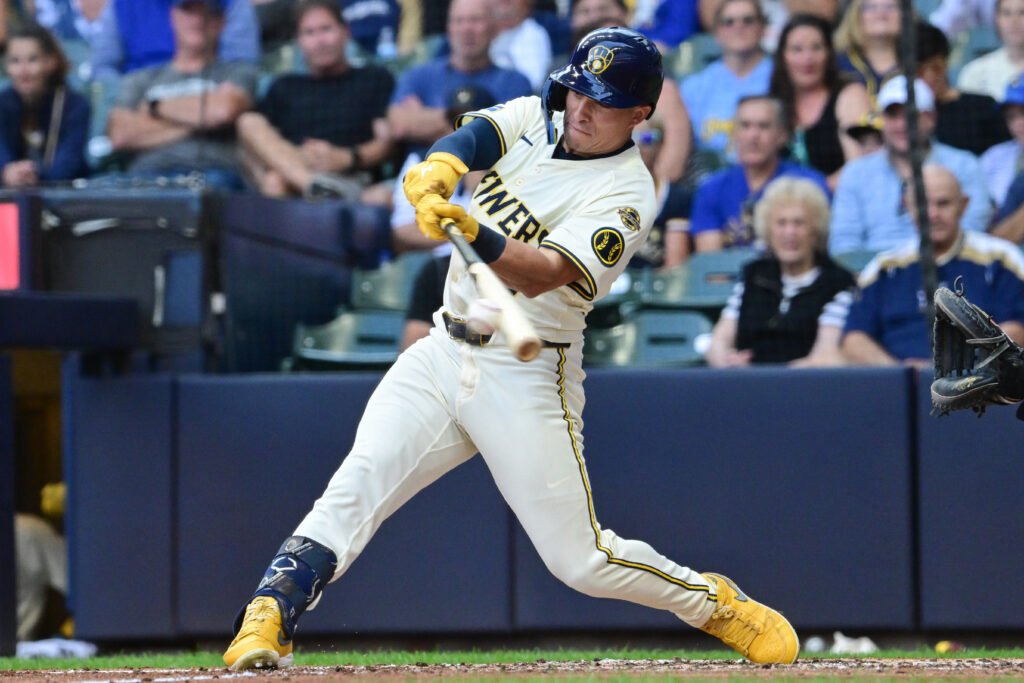
Collins is expected to hold down the everyday left field job in 2026 and potentially for years to come. Kansas City’s most notable trade of the winter saw Collins and righty reliever Nick Mears acquired from the Brewers in exchange for left-hander Angel Zerpa. Milwaukee may yet explore moving Zerpa back into a starting role, but on paper, the Royals were able to land a controllable (through 2030) outfielder as well as some more bullpen help without dealing from their rotation depth.
The trade made some sense for both teams, beyond just the Royals’ outfield need and the Brewers’ surplus on the grass. From the Brewers’ perspective, they may have felt they were selling high on a late bloomer (Collins turns 29 in July) who didn’t make much hard contact in 2025 and may have benefited from a .326 BABIP. Teams may have figured Collins out a bit, given how his numbers cooled off drastically over the season’s last six weeks. For the Royals, Collins brings a switch-hitting bat, good left field defense, very strong walk and chase rates, and room to grow after his fourth-place finish in NL Rookie of the Year voting. Milwaukee has plenty of outfield depth, and Zerpa has an extra year of control over Mears, who like Collins struggled down the stretch (5.89 ERA in his final 20 appearances).
Marte signed with K.C. two weeks into Spring Training, bringing another notable name into the position-player mix. Nobody expects Marte to return to his old All-Star form at age 37, and he’ll likely spend most of his time at DH with only a handful of outfield appearances. But, Marte hit a respectable .269/.331/.398 with 16 homers over 699 plate appearances for the Mets in 2024-25 working in this same part-time capacity. The Royals will happily take those numbers for the low cost of $1MM and some incentive bonuses.
Kameron Misner was also acquired from the Rays in an early-offseason trade. Between Misner, John Rave, Drew Waters, and utility types Tyler Tolbert and Michael Massey, the Royals have depth on hand as they try to finally establish some stability in their outfield mix.
Marte may end up sharing DH at-bats with either Salvador Perez or Carter Jensen. The Royals will want to try to give Jensen at-bats beyond just a backup catching role, and also give Perez a fair amount of rest days (which opens the door for Jensen to get more reps behind the plate). The rest of the infield picture is set, with Maikel Garcia at third base, Bobby Witt Jr. at shortstop, India at second base, and Vinnie Pasquantino at first base.
India’s return is the only surprising element of the otherwise stable K.C. infield. The Royals opted to give India another chance by signing him to an arbitration-avoiding one-year, $8MM contract, rather than simply non-tendering the veteran second baseman.
While it seems like the team simply believes India can bounce back in his second year in Kansas City, committing $8MM to this belief is another matter. Owner John Sherman indicated in October that the Royals would be spending at roughly the same levels as their $138MM payroll from last year, and as per RosterResource, K.C. has around $148.6MM on the books for 2026. India and Thomas combine for $13.5MM of that number, and one has to wonder whether the Royals could’ve done more with that money than investing in two players who simply weren’t productive in 2025.
Letting India go would’ve created another hole to address at second base, though since Collins has some experience there, the Royals could’ve still acquired him and toggled him between both the keystone and left field. Even after agreeing to India’s contract, the Royals were still linked to a couple of prominent infield trade targets. Kansas City was among the many teams who had interest in Brendan Donovan, though the utilityman might well have seen more time in the Royals’ outfield than the infield. The Royals’ interest in the Nationals’ CJ Abrams indicated a scenario of Abrams moving to second base (since Witt obviously wouldn’t be moved off shortstop) and India then perhaps dealt back to Washington or dealt elsewhere.
Abrams and Donovan were just two of the many players linked to the Royals in hot stove chatter. On the free agent front, K.C. had some interest in re-signing old friends Mike Yastrzemski and Adam Frazier, and other outfielders like Harrison Bader, Adolis Garcia, Austin Hays, and JJ Bleday were all reportedly on the radar. Most of this group ended up signing one-year deals on modest salaries, though Yaz (two years, $23MM from the Braves) and Bader (two years, $20.5MM from the Giants) might have been beyond Kansas City’s preferred price range.
Without much to spend in free agency, the Royals featured in several trade rumors over the winter. Apart from exploring MacKenzie Gore‘s availability as part of their talks with the Nats, most of the Royals’ reported targets were outfielders, including Boston’s Jarren Duran, Houston’s Jake Meyers, and the Dodgers’ Teoscar Hernandez.
Since there are still more than two weeks before Opening Day, we can’t entirely rule out the possibility of a late-spring swap involving any of the outfield trade candidates. Hernandez is the least-likely of the group due to his hefty remaining salary. Meyers is the most established player within the Astros’ own shaky outfield, so it could be tricky for Houston and Kansas City to line up on a deal that addresses both teams’ needs. The Red Sox and Royals, meanwhile, seemed like logical trade partners for most of the winter due to Boston’s outfield glut. No deal came together between the two sides, perhaps because the Royals weren’t interested in moving Cole Ragans.
It isn’t known exactly what players or offers were bandied about during all of these negotiations, but to return to Picollo’s words from last winter, “we can’t force teams to make trades they don’t want to make.” This naturally doesn’t absolve the front office of their responsibility to improve the team, but in relation to the 2025-26 offseason, perhaps the Royals’ rotation depth wasn’t quite as enticing as it seemed in terms of trade talks.
Seth Lugo and Michael Wacha weren’t going anywhere after being recently signed to extensions, so the trade speculations focused around the likes of Ragans, Kris Bubic, Noah Cameron, Ryan Bergert, and Stephen Kolek. There didn’t seem to be much chance that K.C. would move Ragans in the wake of an injury-shortened down year, which is only natural given that he looked like an ace when healthy in 2024.
Bubic showed some front-of-the-rotation ability in 2025 before a rotator cuff strain ended his season early, and while Bubic drew some trade buzz, the combination of his health status and his impending free agency after the 2026 season may have limited his trade value. For Cameron, Bergert, or Kolek, maybe the offers for any of these more back-end rotation types didn’t meet Kansas City’s expectations, if the plan was to bring back an everyday outfielder.
Again, it’s not out of the question that the Royals could still trade a starter in what remains of the offseason. Or, perhaps crucially, the Royals might be more open to moving a starter closer to the deadline, once the team has a better sense of its rotation mix. The 2025 rotation was hit with a number of injuries, so it makes sense that Kansas City wouldn’t want to trade away any starters unless the return was too good to ignore, or if the club was more confident in its starting pitching depth.
Turning to the relief corps, the Royals had to fill some gaps in the bullpen after Hunter Harvey signed with the Cubs, Taylor Clarke was non-tendered, and Zerpa was traded. Mears hasn’t shown much consistency over his six MLB seasons, but 2025 was his best year yet, with a 3.49 ERA and a 5.9% walk rate over 56 2/3 relief innings for Milwaukee. Alex Lange was another inexpensive free agent signing, with the Royals spending $900K to see what the righty can do after a lat surgery sidelined him for almost all of the 2024-25 seasons.
Zerpa’s role as the top southpaw relief option was filled by Matt Strahm, who broke into the majors with the Royals in 2016. Kansas City’s late-game trio of closer Carlos Estevez and set-up men Strahm and Lucas Erceg looks to be a strong group, as Strahm looks to continue his excellent recent track record as a workhorse reliever. He posted a 2.71 ERA, 30.5% strikeout rate, and a 6.2% walk rate over 212 2/3 innings for the Phillies during the 2023-25 seasons.
The Phillies were open to moving Strahm for a few reasons — some tension existed between Strahm and the coaching staff, and Philadelphia has other lefties in their pen, so the Royals’ offer of righty Jonathan Bowlan was a fit for both sides. Kansas City was also willing to absorb the $7.5MM owed to Strahm in the final year of his contract, which represents the Royals’ largest investment in new talent this offseason.
Three extensions represented the Royals’ biggest overall spends of the winter, including a deal with Pasquantino covering two of his arbitration-eligible years. The biggest investment was a long-term extension with Garcia that will pay the All-Star at least $57.5MM through 2030, with a club option for 2031. The Royals gain cost certainty through Garcia’s extended (as a Super Two player) arbitration years, and control over what would’ve been Garcia’s first two free agent-years. It’s a nice deal that reflects Garcia’s emergence as both an offensive and defensive force, and his breakout was of massive import to a team in need of hitting.
It was a foregone conclusion that the team was planning to at least exercise its $13.5MM club option on Perez for 2026, and the Royals took it a step further with a two-year, $25MM extension covering the 2026-27 seasons. The deal includes $12MM in deferred money, freeing up some shorter-term savings for the Royals and giving Perez a soft landing for what could potentially be the final two seasons of his big league career. Moving on from Perez and entrusting the catching job to Jensen and (further down the road) top prospect Blake Mitchell might’ve made sense from a pure logic standpoint, but there’s also obvious value for the Royals in retaining Perez, one of the most beloved players in franchise history.
Manager Matt Quatraro also got in on the extension action, as the skipper’s new contract keeps him in Kansas City through at least the 2029 campaign. The 2026 season was the final year of Quatraro’s previous deal, and there was little doubt the Royals were going to keep a skipper who has delivered consecutive winning seasons (and a playoff appearance in 2024) to bring the team out of a rebuild period.
Perhaps the most interesting wrinkle of the Royals’ offseason came not exactly off the field, but to Kauffman Stadium’s field itself. The team is slightly reducing the dimensions of the spacious outfield and lowering the wall from 10 feet to around 8.5 feet, all in the name of making the notoriously pitcher-friendly ballpark more conducive to power hitters. As Picollo told MLB.com’s Anne Rogers and other reporters, the aim is “a very fair ballpark. We don’t want it to turn into a bandbox and every ball up in the air turns into a home run. We just want hitters to be rewarded when they hit the ball well, particularly in the gaps.”
Maybe there’s a metaphor here for the Royals’ offseason, as the team is also hoping that some minor adjustments to its roster can yield larger results. After winning 82 games in 2025, a return to the playoffs certainly seems plausible if the Royals can get more offense and the pitching stays healthy. Kansas City’s chances are helped by playing in the relatively weak AL Central. Giving Witt and Garcia more established lineup support would’ve been helpful, but the Royals are hoping that Caglianone and/or Jensen can deliver as much or more than the new additions.
