
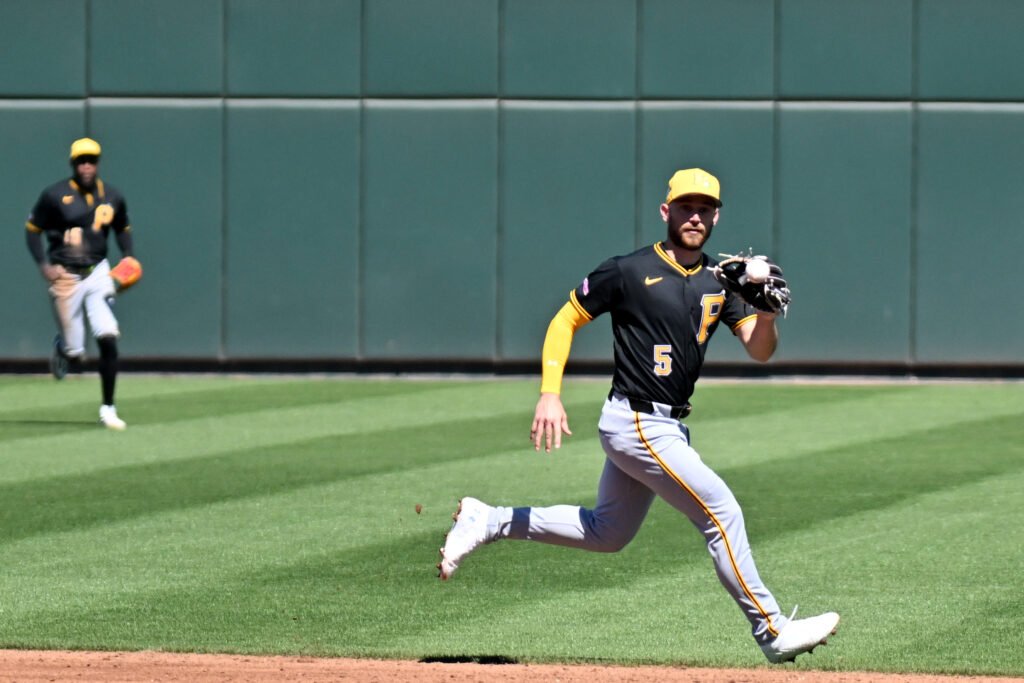
The Pirates went into the winter with a lot of pitching and almost no hitting. They spent the offseason smoothing out that imbalance and the team looks better going into 2026. Is it enough to get them back to the playoffs for first time in over a decade?
Major League Signings
2026 spending: $38.75MM
Total spending: $53.75MM
Trades and Claims
Option Decisions
Notable Minor League Signings
Extensions
Notable Losses
- Andrew McCutchen, Tommy Pham, Jack Little (waivers), Ji Hwan Bae (waivers), José Castillo (waivers), Liover Peguero, Cam Devanney (released and signed in Japan), Colin Holderman (non-tendered), Dauri Moreta (non-tendered, still unsigned), Alexander Canario (non-tendered and signed in Japan), Johan Oviedo, Mike Burrows, Chase Shugart, Jack Suwinski (waivers), Kyle Nicolas
The Bucs have been stuck in a rebuilding pattern for a while. They haven’t made the playoffs since 2015 and haven’t topped 82 wins in any season since then. They flirted with contention in recent seasons, though in the era of the expanded playoffs, that just means they floated near .500 for parts of the summer.
They have graduated a lot of exciting pitching prospects to the majors in recent years but have struggled to hit. The 2025 team scored 583 runs, lowest in the majors. The team had a combined .231/.305/.350 batting line, which translated to an 82 wRC+, indicating the squad was collectively 18% worse than league average. The only guy on the team with a wRC+ greater than 101 was Spencer Horwitz, who started the season on the injured list due to wrist surgery and did most of his damage in the second half.
Despite the clear deficiencies on the roster, there was a case for making a strong push this offseason. Paul Skenes has just four years of club control remaining and may not spend all of that in Pittsburgh. His salary will increase via arbitration in 2027 and he may not sign an extension, so he could be traded before reaching free agency, currently slated for the 2029-30 offseason. Konnor Griffin became the top prospect in baseball in 2025 and put himself in position to make a major league debut in 2026. If you’re not going to invest around these stars, then when?
The club has not been active in free agency historically. They have never given a free agent $40MM in franchise history. Since Ben Cherington took over as general manager in 2019, he had never signed a free agent to a multi-year deal or signed a one-year deal worth as much as $11MM. But in the early offseason, Cherington suggested they could add $30-40MM to the payroll. That wouldn’t be too exciting for a lot of clubs but would be an increase for the Bucs. There was also the trade market, as they appeared to have enough starting pitching that flipping some for offense seemed possible.
Given the weakness of the lineup, the Bucs had the freedom to target almost any bat, regardless of position. Quickly, it became clear that Cherington’s words weren’t completely hollow, as he went after some of the top available guys. It was reported in mid-November that the club had made a strong offer to Josh Naylor before he had re-signed with the Mariners and they were also in the mix for Kyle Schwarber. Signing either would have required shattering their $39MM franchise record for a free agent deal. They were also connected to guys like Kazuma Okamoto and Jorge Polanco in the early offseason.
Their first notable move wasn’t for a surefire lineup boost, but it did feature the pitching-for-hitting framework that was expected. There were five players in the deal but the headline was that the Bucs sent righty Johan Oviedo to the Red Sox for outfield prospect Jhostynxon García. Oviedo had shown some promise in 2023 when he posted a 4.31 earned run average over 32 starts. He missed 2024 due to surgery, returned in 2025 and put up a 3.57 ERA with more strikeouts but also more walks.
Oviedo has two years of club control remaining and may have some upside but the Pirates had enough starting pitching talent to part ways with him. By doing so, they added an intriguing but unproven outfielder to their roster. García has been on some top 100 prospect lists but has just five big league games under his belt. He should have a chance to earn some playing time but his path would eventually be crowded by the rest of Pittsburgh’s offseason moves.
The Schwarber dream died on December 9th, when he returned to the Phils on a five-year, $150MM deal. The Bucs reportedly offered him a four-year deal in the $120MM range. That obviously wasn’t enough but it signaled that there was indeed some change in the pocket.
On the same date that the Schwarber news dropped, the Bucs did get a deal done, but with a reliever. They agreed to a one-year deal with Gregory Soto worth $7.75MM. Soto had a 4.40 ERA over the past three years but with perhaps more interesting numbers under the hood. His 9.4% walk rate was around average for a reliever, while his 25.9% strikeout rate and 48.4% ground ball rate were a few ticks better than par. A .325 batting average on balls in play and 67.7% strand rate seemed to hurt him, which is why his 3.55 FIP and 3.55 SIERA were more optimistic. If his ERA trends closer to those other metrics, it could be a nice bit of business for the Pirates.
A little over a week later, the Pirates made their first surefire upgrade to the lineup. Like the Oviedo-García swap, this one would see the Bucs trading from their rotation depth. In a three-team trade, they sent Mike Burrows to the Astros in order to receive infielder Brandon Lowe, outfielder Jake Mangum and left-hander Mason Montgomery from the Rays. Burrows was a steep price to pay, as he has six years of club control remaining. But the Pirates had several such arms in their rotation mix and didn’t have room for all of them.
The biggest upgrade for 2026 is Lowe, though he is just a rental, since there is one year left on his contract. But he’s one of the top power bats at the second base position. He has 81 home runs over the past five years. Only four primary second baseman have more. The four guys ahead of him all played a larger sample of games in that span, which speaks to some injury trouble Lowe has had, which is the main knock against him. Though he doesn’t count as a free agent, the Bucs are taking on his contract and will pay him $11.5MM this year.
Mangum and Montgomery are more complementary pieces of the trade but still potentially impactful. Mangum’s first year in the big leagues saw him steal 27 bases and get strong grades for his glovework. His bat was a bit below par but he was still useful on the whole. He has five years of club control and a full slate of options. Even if he’s just a fourth outfielder type, he has value. If his bat finds a new gear, then that’s even better. Montgomery has huge strikeout stuff but poor control. He’s a project but one with upside if things break right. He also comes with five years of club control and has options.
The Bucs were clearly not content to stop after Lowe. In the coming days, they would be connected to guys like Eugenio Suárez and Yoán Moncada. Just before the holiday break, they pulled the trigger on a free agent addition, a two-year deal with Ryan O’Hearn worth $29MM. While a notch below the Schwarber/Naylor pursuits, it was still somewhat notable as the biggest free agent deal of Cherington’s tenure.
O’Hearn isn’t a superstar but has been solidly above average at the plate. Over the past three years, he has 46 home runs, a .277/.343/.445 line and 121 wRC+. He has some ability to play the outfield but is more of a first baseman. It initially seemed like he and Horwitz would share first base and the designated hitter spot, but this would change in the coming months.
The Pirates were still hunting for more offense, getting connected to various bats throughout January. They also showed some interest in Framber Valdez as he lingered unsigned, though that seemed like an odd fit and he eventually landed with the Tigers.
They did apparently have room for one arm in the rotation after their recent trades, as they landed José Urquidy on a one-year deal worth $5MM. The Bucs usually sign a cheap left-hander late in the offseason. Since PNC Park is so tough on righty power, those lefties can usually outperform their contracts. Urquidy is right-handed but is basically filling that role since he has reverse splits in his career.
There was one more clear lineup boost to come, as the Pirates signed Marcell Ozuna to a one-year, $12MM deal in February. It’s a bit risky since Ozuna is 35 years old and coming off a down year, by his standards. His season was weighed down by a summer slump which coincided with him battling a hip injury. Perhaps he can bounce back with a full season of health but that’s no guarantee at his age.
In addition to the risk, the addition also gummed up the lineup a little bit. Ozuna is just a designated hitter at this point in his career. He didn’t play the field at all in 2024 or 2025 and was in the outfield for just 14 innings in 2023. If he’s in the DH spot most days, Lowe is at second and Horwitz is at first, that means O’Hearn will have to be in the outfield almost every day. He’s never started more than 23 games on the grass in any season of his career, so that will be new for him, but it seems the Bucs are willing to make that compromise as they try to add as much thump to the lineup as possible.
In addition to displacing O’Hearn, there are other ripple effects. With Bryan Reynolds and Oneil Cruz in the other two outfield spots, guys like García and Mangum will be pushed to fourth outfielder roles or maybe even the minors. It also effectively closed off any chance of another reunion with Andrew McCutchen. He seemed frustrated by the situation but eventually moved on, signing a minor league deal with the Rangers.
The Bucs added one more guy into the depth picture with a spring trade. They sent reliever Kyle Nicolas to the Reds in exchange for infielder/outfielder Tyler Callihan. Nicolas is almost like a righty version of Montgomery, with big stuff but poor control. If he puts it together in Cincinnati, this one could sting, but it’s also possible that doesn’t happen. Callihan has just four big league games under his belt but strong minor league numbers. He played first base, second base and left field last year, so he provides depth in a few spots.
It was a busy offseason and it feels like there’s more optimism surrounding the Pirates than there has been for quite some time. When combining free agents and the money they took on in the Lowe deal, they added roughly $50MM to the 2026 payroll.
Despite trading away several arms, they project to have a rotation including Skenes, Mitch Keller, Braxton Ashcraft, Bubba Chandler and Urquidy. Jared Jones will return from his surgery rehab at some point, perhaps as early as late May. Prospects Thomas Harrington and Hunter Barco will be lurking in Triple-A.
The lineup will need incumbent guys like Reynolds and Cruz to bounce back but the Bucs have added Lowe, O’Hearn and Ozuna as three everyday upgrades. Guys like Garcia, Mangum and Callihan will be pushing for jobs over time. The left side of the infield feels like a weak spot but Griffin should be up to take over shortstop at some point, maybe as soon as Opening Day. That would leave guys like Jared Triolo, Nick Gonzales and others fighting over third base.
Is this enough to get them over the hump? The National League Central is in fairly healthy shape. The Cardinals are rebuilding but the Brewers, Cubs and Reds all made the playoffs last year. Did the Pirates add enough to leapfrog someone?
How would you grade the Pirates’ offseason?
Photo courtesy of Jonathan Dyer, Imagn Images
