
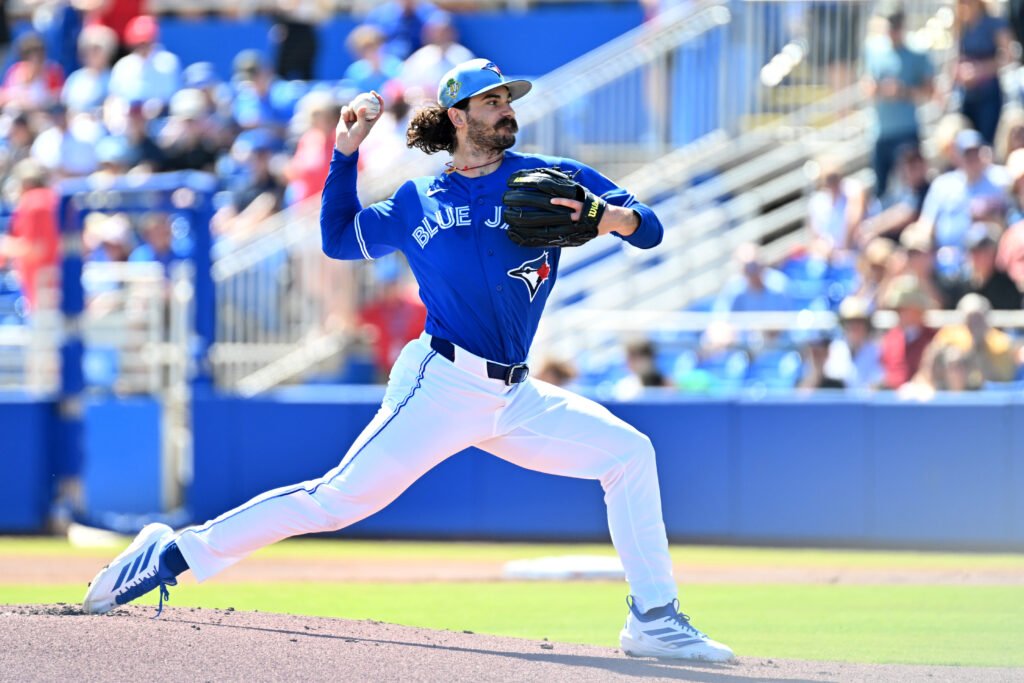
The Blue Jays reinforced their rotation, said goodbye to longtime shortstop Bo Bichette, and (again) lost a major free agent bidding war to the Dodgers.
Major League Signings
- Dylan Cease, RHP: Seven years, $210MM ($64MM deferred)
- Kazuma Okamoto, 3B/OF: Four years, $60MM (Blue Jays also paid $10.875MM posting fee to the Yomiuri Giants)
- Tyler Rogers, RHP: Three years, $37MM (includes $1MM buyout of 2029 club/vesting option)
- Cody Ponce, RHP: Three years, $30MM
- Max Scherzer, RHP: One year, $3MM
2026 spending: $70MM
Total spending: $340MM
Trades And Claims
Option Decisions
Notable Minor League Signings
- Eloy Jimenez, Juan Yepez, Jorge Alcala, Josh Winckowski, Joe Mantiply, Nic Enright, Jesse Hahn, Connor Seabold, Josh Fleming, CJ Stubbs, Caleb Freeman, Michael Plassmeyer
Extensions
Notable Losses
- Loperfido, Bo Bichette, Chris Bassitt, Seranthony Dominguez, Ty France, Isiah Kiner-Falefa, Nick Sandlin, Paxton Schultz, Ryan Borucki, Easton Lucas, Ryan Burr, Dillon Tate
The usual “Toronto is interested in everyone” rumors barely got a chance to get rolling before the Blue Jays made the early strike of signing Dylan Cease before the end of November. Even with some deferred money involved, Cease’s seven-year, $210MM pact is the largest free agent signing in Jays history, and it was the first indication that the Jays would again be shopping at the top of the market.
The durable Cease has logged 942 1/3 innings since the start of the 2020 season, and he has never been on the big league injured list apart from a brief stint on the COVID-19 IL in 2021. Beyond this ability to stay on the mound, Cease misses a lot of bats (29.7% strikeout rate over the last five years), and he is a hard thrower with some of the best fastball spin rates in the league. The down side is that Cease has below-average control and he has been prone to giving up hard contact, which is why Cease’s ERAs (like his 4.55 mark with the Padres in 2025) can be higher than his peripheral numbers would reflect.
It is certainly possible the Jays think pitching coach Pete Walker and the team’s development staff can help Cease find more consistency, and ideally get him back to his 2022 AL Cy Young runner-up form. Even the current version of Cease, however, is a pitcher the Blue Jays view as capable of starting playoff games come October.
Cody Ponce’s three-year, $30MM deal was another intriguing investment in the rotation. Ponce’s MLB resume consists of a 5.86 ERA over 55 1/3 innings with the 2020-21 Pirates, but the right-hander then went overseas, spending three seasons in Japan before heading to the KBO League’s Hanwha Eagles in 2025. The result was a sparkling 1.89 ERA, 36.2% K%, and six percent walk rate over 180 2/3 innings, and Ponce earned both KBO MVP and the Dong-Won Choi Award (the equivalent of the Cy Young) while helping lead the Eagles to a berth in the Korean Series.
The Blue Jays obviously wouldn’t mind if Ponce continues this form in his return to the majors, but more realistically, Ponce becoming a decent mid-range starter would still make his contract a relative bargain, when compared to the broader starting pitching market as a whole. Ponce will be used as a starter, and if that role doesn’t work out, his skillset could perhaps translate well to relief work, so the Jays could still some return on their investment.
Cease and Ponce are the newcomers joining a pair of familiar faces returning to the Jays rotation. Max Scherzer waited until early March to decide on his next team, and he opted for a return engagement in Toronto on a one-year, $3MM guarantee that includes up to $10MM in innings-based bonuses. Shane Bieber was the first pitching domino to fall in the Jays offseason when he eschewed free agency altogether, passing on a opt-out clause to instead remain in his contract on a $16MM salary for 2026.
Bieber’s decision was a surprise at the time, though reports emerged in December that Bieber pitched through some forearm fatigue during the end of the 2025 season. To that end, the Blue Jays will place Bieber on the 15-day IL to begin the coming season so that he can fully ramp up, since he has yet to start throwing off a mound this spring.
The Jays’ knowledge of Bieber’s situation surely informed their contract with Scherzer, which added to a rotation picture is overcrowded on paper. If everyone is healthy, there technically won’t be enough starts to go around between Kevin Gausman, Trey Yesavage, Jose Berrios, Cease, Ponce, Scherzer, Bieber, and swingman Eric Lauer.
As is often the way in baseball, there’s no such thing as “too much” pitching. Beyond Bieber, Berrios is also dealing with elbow inflammation and could be an IL candidate. The Jays are giving Yesavage a gradual build as they manage his innings heading into the postseason hero’s first full Major League season. Ponce is an unproven commodity in MLB action, and Scherzer is 41 with a checkered injury history. Even beyond the names set for the 26-man roster, depth starter Bowden Francis will miss the season due to Tommy John surgery, and former top prospect Ricky Tiedemann dealt with some elbow soreness this spring as he continues his own return from a TJ procedure.
Even if Berrios had some hard feelings about the end of his 2025 season or Lauer would’ve preferred a clear-cut starting job, there should be enough starts to go around for everyone. Since the Blue Jays are intent on winning the World Series, the team is building a pitching staff for a seven-month run, not just a six-month regular season.
This plan extends to the bullpen, which is why Tyler Rogers received a hefty three-year, $37MM contract on the open market. Though Rogers is entering his age-35 season, the veteran right-hander has been the picture of durability, as well as having some of the best command of any pitcher in the sport. An old-school outlier in today’s velocity-centric game, Rogers’ sinker doesn’t even reach the mid-80s, but he is a master at inducing grounders and soft contact.
Rogers is the only real new face within a bullpen that lost Seranthony Dominguez in free agency, and won’t have Yimi Garcia available at the start of the year. Trade acquisition Chase Lee could become a part of the picture as the season develops, and Rule 5 selections Angel Bastardo and Spencer Miles (selected in the last two R5s) will have trouble fitting onto the roster or staying in the Jays organization.
A minor league signing like Connor Seabold or Joe Mantiply could stand out, and a southpaw like Mantiply could benefit from the unsettled nature of the pen’s left-handed corps. Brendon Little and Mason Fluharty struggled down the stretch and in the playoffs, and Lauer isn’t really a fit in a true left-handed specialist sense since he’ll be kept stretched out for at least multi-inning work if the Jays ever need to quickly call on him for a start.
Left-handed bullpen help could therefore be on Toronto’s radar come the trade deadline, and a more high-profile move for a closer also shouldn’t be ruled out. Jeff Hoffman will return as the Blue Jays’ ninth-inning man, even though GM Ross Atkins suggested back in November that Hoffman was fine with moving into a set-up role if necessary. The team’s explorations into the bullpen market bore out its interest in a new closer, as the Jays reportedly had interest in such free agents as Edwin Diaz, Robert Suarez, Raisel Iglesias, Pete Fairbanks, and Ryan Helsley.
Other pitchers on Toronto’s radar included relievers like Luke Weaver, Phil Maton, and Brad Keller, while such free agent starters as Framber Valdez, Michael King, and former Blue Jay Chris Bassitt drew at least some interest. There was some speculation that the Jays could make a late push for Valdez after he lingered on the market into February, but the left-hander instead signed with the Tigers, and Toronto pivoted to Scherzer a month later.
Moving into the position-player ranks, Alex Bregman, Ketel Marte, Cody Bellinger, Munetaka Murakami, and Yoan Moncada were all linked to the Blue Jays at various points this winter. These players were primarily viewed as backup plans for the Jays, however, as Kyle Tucker and Bo Bichette were seen as Toronto’s biggest targets. As the offseason continued and the markets for both players remained unclear, there was some thought that the Jays could even sign both Tucker and Bichette, if the team wanted to go all out with its spending.
As it turned out, both Tucker and Bichette will be playing elsewhere in 2026. In Tucker’s case, the Blue Jays were reportedly the only suitor who made a major long-term offer, in the form of a ten-year, $350MM deal. The Mets offered Tucker a four-year, $220MM contract with multiple opt-outs, and the Dodgers a slightly larger four-year, $240MM pact (also with opt-outs) that Tucker ended up signing. Tucker could conceivably return to free agency as early as the 2027-28 offseason, but for the next two years, he’ll be joining the Dodgers’ push for more rings.
Bichette could be a free agent again next winter, if he triggers the first of the two opt-outs in his three-year, $126MM deal with the Mets, as New York quickly moved on from Tucker to sign another multi-time All-Star to a similar contract structure. In Bichette’s case, it was the Phillies who offered a longer-term (seven years and between $190-$200MM) deal, and president of baseball operations Dave Dombrowski felt “we were very close to having a deal done,” before Bichette chose New York over Philadelphia.
It isn’t known what the Blue Jays offered Bichette, or if the team necessarily even put a concrete offer on the table to its longtime infielder. While re-signing Bichette seemed like a more realistic scenario for Toronto than pursuing a Bregman or a Bellinger, it always somewhat felt like Toronto was expecting Bichette to leave — even dating back to last winter, when Andres Gimenez was acquired from the Guardians as an unofficial shortstop-in-waiting.
The Kazuma Okamoto signing also cast more doubt on a Bichette return. With Bichette, Tucker, and plenty of other position players still available, the Jays instead pivoted to sign the Japanese star to a four-year, $60MM deal. Given how the Blue Jays like to move players around the diamond, Okamoto might see some time in left field or playing first base if Vladimir Guerrero Jr. is getting a DH day, but Okamoto is expected to settle in as the regular third baseman.
As with all high-profile NPB signings, there’s risk in committing such a significant amount of money to a player with no experience in North American baseball. There’s good reason to believe Okamoto’s high-contact approach can translate well to the Show, however, and Okamoto hit so well in Japan (.277/.361/.521 with 248 homers over 4494 plate appearances) that it was clear why he was drawing interest from multiple Major League teams before the Blue Jays won the bidding.
With Okamoto now at the hot corner, the rest of Toronto’s lineup consists of Gimenez at shortstop, Ernie Clement at second base, Guerrero at first base, Alejandro Kirk catching, George Springer at DH, and a starting outfield of Addison Barger, Daulton Varsho, and Jesus Sanchez. The left-handed hitting Sanchez is expected to platoon with Davis Schneider in left field, and the presence of Nathan Lukes and Myles Straw as outfield depth could allow Barger to get some time back at third base if Okamoto needs an off-day, or has some difficulty adjusting to big league pitching.
Shoulder surgery will keep Anthony Santander out of this mix until at least July, as the slugger is already looking at what might be a second lost season in a row. Santander was limited to 54 games in 2025 due to shoulder problems, and he hit only .175/.271/.294 over 221 PA. The hope was that a healthy Santander could rebound and start providing some return in the second season of his five-year, $92.5MM contract, yet he’ll now again be sidelined until the second half.
Shortly after word broke about Santander’s surgery, the Jays landed Sanchez from the Astros in exchange for Joey Loperfido, another left-handed hitting outfielder with less MLB experience. Sanchez has six seasons under his belt with the Marlins and Astros, and poor numbers against southpaws have kept the outfielder from thriving as a true regular. As noted, the Jays only need him to be the strong side of a platoon with Schneider, and the team is hoping Sanchez can at least match his .253/.324/.450 career slash line against right-handed pitching.
Looking at the position-player depth chart as a whole, it isn’t much different from the offense that was one of the league’s best in 2025. That said, replacing Bichette with Okamoto is an obvious downgrade for now based on Major League track record, even if the Jays will get a defensive boost by installing Gimenez at shortstop. Counting on Barger or Clement to be regular starters also carries some risk, as their huge playoff performances came after much more ordinary production over the regular season.
After a 2024 campaign that saw almost the entire lineup struggle at the plate, the 2025 Blue Jays enjoyed a dream year that saw pretty much every batter significantly improve. The question now facing the Jays is whether the truth about their position players falls somewhere in between, or if 2025 was just the start of an offensive awakening under hitting coach David Popkins. Tucker, Bichette, or another proven veteran bat would’ve helped solidify the lineup quite a bit, and depending on how the season progresses, adding such a hitter might well be on Atkins’ shopping list at the trade deadline.
Aggressive moves and aggressive spending have become the calling card for the organization. This winter’s investments have again brought the payroll to new levels — as per RosterResource‘s estimates, the Blue Jays have a $289MM payroll, and a whopping $318.1MM luxury tax number. The latter figure puts the Jays well over the highest luxury tax penalization tier of $304MM, which means they’ll face a 90% surcharge on any dollar spent above the $304MM mark.
It is safe to say at this point that the front office doesn’t care about the short-term tax implications, or details like giving up two draft picks and $1MM in international bonus money to sign Cease (a qualifying offer-rejecting free agent). Last year’s playoff run and the near-miss in the World Series galvanized support for the Blue Jays all across Canada, creating both a ton of extra revenue for the Rogers Communications ownership group and a greater desire to finish the story with a championship in 2026. The Jays will face tough competition just to retain their AL East crown, yet Toronto figures to be contenders again come October.
