

Thick clouds covered the unusually lush, green lands of San Luis Potosí as campesinos and their Wixárika guardians gathered at the edge of the barbed wire. Back home in their adobe kitchens, women prepared huge skillets of scrambled eggs, steaming pots of beans and warm, fresh tortillas. Those savory flavors of the Wirikuta region would be loaded onto the back of a pickup truck and carried down rocky roads to feed about 200 who had come from near and far to stand in solidarity and witness history.
For three years, members of the Ejido Las Margaritas — located in the sacred desert known as Wirikuta — had resisted efforts to parcel and privatize their communal lands, known in Mexico as ejidos. In 2023, the government of former president Andrés Manuel López Obrador issued a decree that recognized and gave federal protection to all the sacred places and sites of the Wixárika, Náayeri, Odam or Audam and Mexikan peoples.
Recently, on Sept. 26, members of Ejido Las Margaritas took a decisive step: dismantling an illegally erected fence that threatened to fragment not only their territory but also a protected natural area and the Wixarika pilgrimage route through the desert, recognized just weeks ago by UNESCO as part of humanity’s world heritage. The fence had been put up by a group of ejido members who sought to subdivide and privatize part of the communal lands — a move others feared could open the door to agribusiness or mining interests rapidly expanding across the region.
With federal agrarian officials and human rights observers standing by, the men began loosening posts, rolling up the metal strands and carrying them off in measured bundles. But what unfolded that day was more than the removal of barbed wire. For the first time in Mexico, Article 59 of the Agrarian Law was invoked to defend ejido lands as a forest ecosystem, thanks to a scientific study recognizing desert plants like peyote, mezquites, nopales and creosote bush — known locally as gobernadora — as protected forest cover.
This unprecedented legal articulation — combining agrarian law, environmental law and Indigenous rights — set a national precedent.
As Jonathan Noyola, head of Mexico’s Agrarian Attorney’s Office, put it, “It is not an act of confrontation. It is the restoration of legality.”
The symbolism was potent.
“Taking down the fence is taking down the barbs that divide us,” said Marina Meza of Sincronía Wirikuta, a collective of activists from around the country working in defense of the sacred site. “So the deer can run, the rabbit can leap, the rattlesnake can pass — and so we can all walk in balance and peace.”
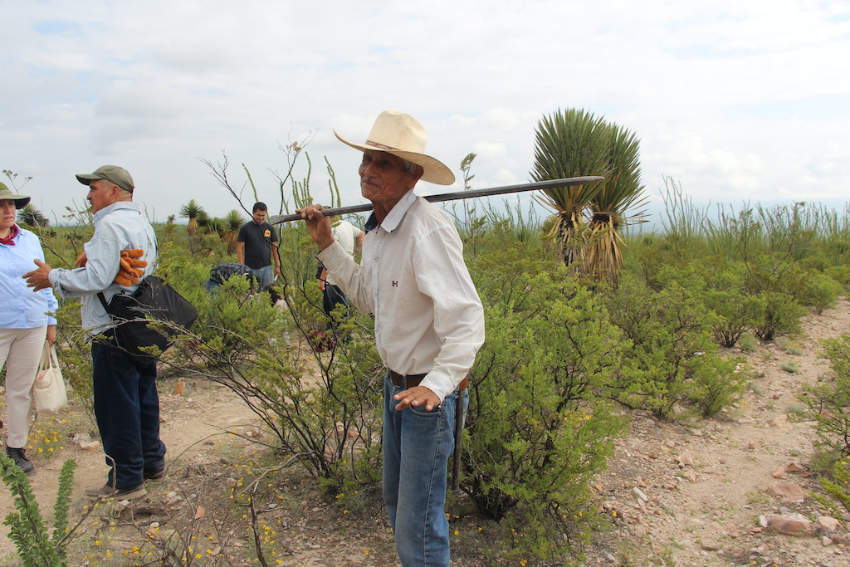
The act of de-fencing
The people began to gather just after sunrise, in the golden light of the high desert, at the Casa Ejidal, a complex of adobe buildings in the center of the ejido. Coffee, pan dulce, gloves and wire cutters were shared, and gradually people gathered around the kiva-style amphitheater at the center.
Daniel Giménez Cacho, the award-winning Mexican actor who has advocated for the defense of Wirikuta for more than a decade, opened the circle, invoking God, the Sun and Kayumarie, the blue deer deity that guides the steps of the pilgrims who come to these lands in search of spiritual guidance. His presence underscored the gravity of what was to come.
The round of introductions made clear the breadth of the gathering, which included:
- Wixárika delegations from at least three communities in the high Sierra of Jalisco and Durango, for whom these desert plains are a sacred pilgrimage destination far from home.
- Members of far-flung ejidos, some of whom had traveled for hours and slept on the bus to stand in solidarity, each with their own territorial struggles to share.
- Land defenders from a collective called Guardians of the Sierra.
- Officials from Mexico’s Agrarian Attorney’s Office — led by Noyola and accompanied by Dra. Beatriz Vera Castillo, who oversees the agency’s nationwide network of regional offices.
- Representatives from the Interior Ministry (SEGOB), the National Institute of Indigenous Peoples (INPI), the Ministry of the Environment and Natural Resources (SEMARNAT), and the National Human Rights Commission (CNDH).
- Delegates from the San Luis Potosí state government, the government of Catorce, a municipality that encompasses Las Magaritas and other ejidos in the area, and a pair of deputies from Mexico’s National Congress who had come to observe the proceedings.
- Mauricio Guzmán, an environmental anthropologist from the Colegio de San Luis who brought his students, offering them a living lesson in Mexican democracy.
- A team of diversely skilled organizers, documentarians and other professionals from Sincronía Wirikuta.
Then came the logistics. Tunuari Chávez, legal advisor for the ejidatarios (communal land owners) and Sincronía Wirikuta, laid out the action plan: The 5-kilometer fence, once dismantled, would be turned over to the municipal government. Roughly 60 ejidatarios and supporters would do the physical labor, while others would provide backup and document the process.
There was always the possibility of provocateurs showing up at the behest of those who had erected the barrier, but the plan was clear: De-escalate conflict and keep working. Such provocation had been made much less likely by the arrival of 11 Mexican National Guard units — about 66 soldiers in all — sent by the federal government to keep the peace.
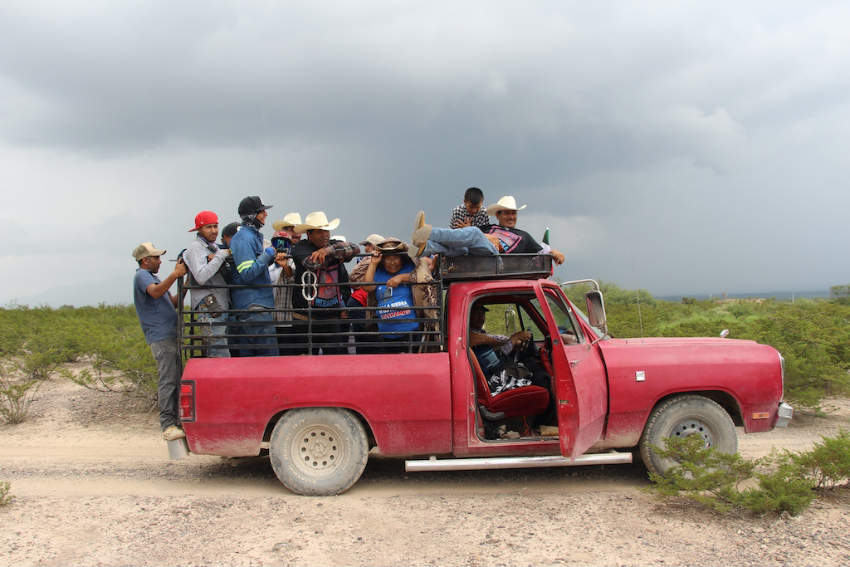
By the time the convoy of pickup trucks rolled out toward the disputed fields, the strategy was in place. A line of campesinos moved steadily along the wire, some prying posts from the rocky soil, others coiling the four rows of barbed strands, one by one, into neat bundles. It was the kind of work they had done all their lives — but this time, they weren’t just clearing land. They were reclaiming it.
By lunchtime, the wire and posts lay in orderly piles. Observers had seen no conflict. The work was carried out with discipline and restraint. As Chávez summed it up later: “We didn’t just take down a fence. We took down the walls between us.”
The legal breakthrough
The events in Las Margaritas represented far more than a local dispute resolved in the field. They signaled a new phase in Mexico’s approach to agrarian justice — one in which institutions, campesinos, and Indigenous peoples work side by side to restore legality to communal lands that have long been under pressure from privatization.
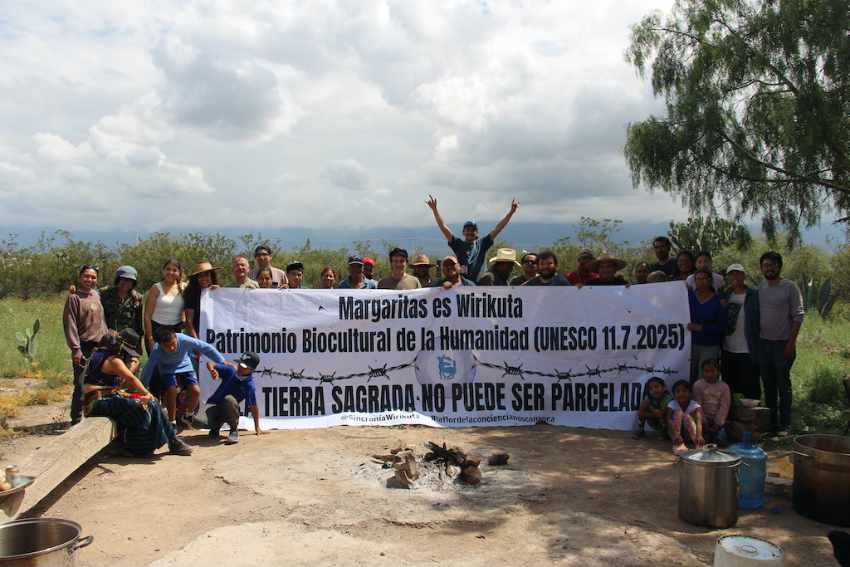
“Most social movements,” Noyola explained, “are movements of resistance — they resist the economic forces that seek to take their land, their water, their environment. But here, the resistance itself went on the offensive. The Ejido Committee of Las Margaritas, supported by Wixárika communities, campesinos from other regions and environmental movements — and under the protection and accompaniment of the federal authorities — carried out an act of territorial reclamation. That happens very rarely, if ever.”
Beatriz Vera Castillo, who coordinates the agency’s national network of regional offices, described the action as a reaffirmation of Mexico’s communal property system.
“The ejidos and communal lands are the heart of the country,” she said. “More than half of Mexico’s territory is in their hands — that’s where our forests, biodiversity, and culture live. Preserving social property isn’t just important for those who live here, but for all Mexicans.”
For Chávez, who helped shape the legal strategy, the meaning was simpler.
“When the law and the heart walk on the same side, things change,” he said.
UNESCO, Indigenous rights, and an environmental siege
The victory at Las Margaritas resonated far beyond the ejido’s dusty boundaries. Just three months earlier, as UNESCO recognized the Wixárika pilgrimage route through Wirikuta as part of humanity’s world heritage — a symbolic safeguard for one of the most sacred and biodiverse deserts on Earth — threats were multiplying: industrial greenhouses, mining concessions, water extraction and fenced-off lands that cut through ceremonial and ecological corridors.
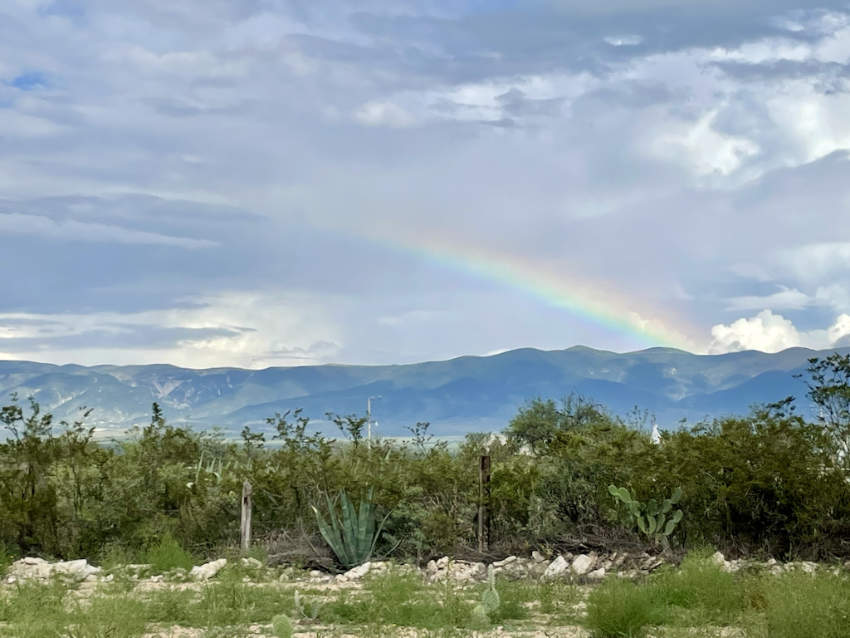
Guzmán said the struggle encapsulates a national dilemma between modernization and people’s right to exist.
“We could say that this case brings hope that the rights of both campesino and Indigenous communities will be respected and protected,” he said. “We’re not in an Indigenous community here, but the implications are broader — because modernization and development projects aren’t going to stop in this country. Quite the opposite: What we’re seeing are highways, railroads, all kinds of projects aimed at deeper territorial integration, and that will have an impact.
“The question is how to do this — what guarantees will there be? How can communities, even the smallest ranch or village, feel included in the decisions that affect them? Because that’s what’s at stake. I don’t think progress has to mean sacrificing these communities in the name of development.”
Giménez Cacho framed the day’s events as a glimpse of a different kind of civic and moral order — one in which public servants and citizens work together toward justice.
“I grew up in a culture where public officials were your adversaries,” he reflected. “… So today, to see public servants come here to uphold the law — it moved me deeply. A journalist asked me about utopias, and I told them, ‘In Mexico, for the law to be fulfilled — that’s the utopia.’”
The road ahead
By the closing circle on Sunday, tension had given way to quiet celebration. A core of allies and friends had stayed at the home of Eduardo “Lalo” Guzmán, ejidal treasurer, subsistence farmer and desert defender for decades, even though Guzmán was on a lecture tour in Europe, sharing the struggle of Wirikuta with more potential allies. Children played, women warmed the menudo and, finally, the group gathered as they had begun — around the fire in front of Lalo’s house.
All spoke with eloquence and passion, but Ricardo Peralta, the environmental educator and training coordinator who had been running the mobile kitchen with military precision, gave voice to the hopes of many.
“What we’ve witnessed these days — this synergy of people — is a clear message for all of Mexico. It’s proof of the beautiful things that can be achieved,” he said.
“For every Margaritas, may there be 10, 100, 1,000 more. May each one of them have that same strength, that same energy, that same love for the land — for life, for the people, for the animals, for the hills,” he added.
“What you achieved is historic,” Peralta said. “No one had ever managed to bring so many different actors together in one place — and you, the people of Margaritas, did it. Few have accomplished so much.”
Tracy L. Barnett is a freelance writer based in Guadalajara. She is the founder of The Esperanza Project, a bilingual magazine covering social change movements in the Americas.
