
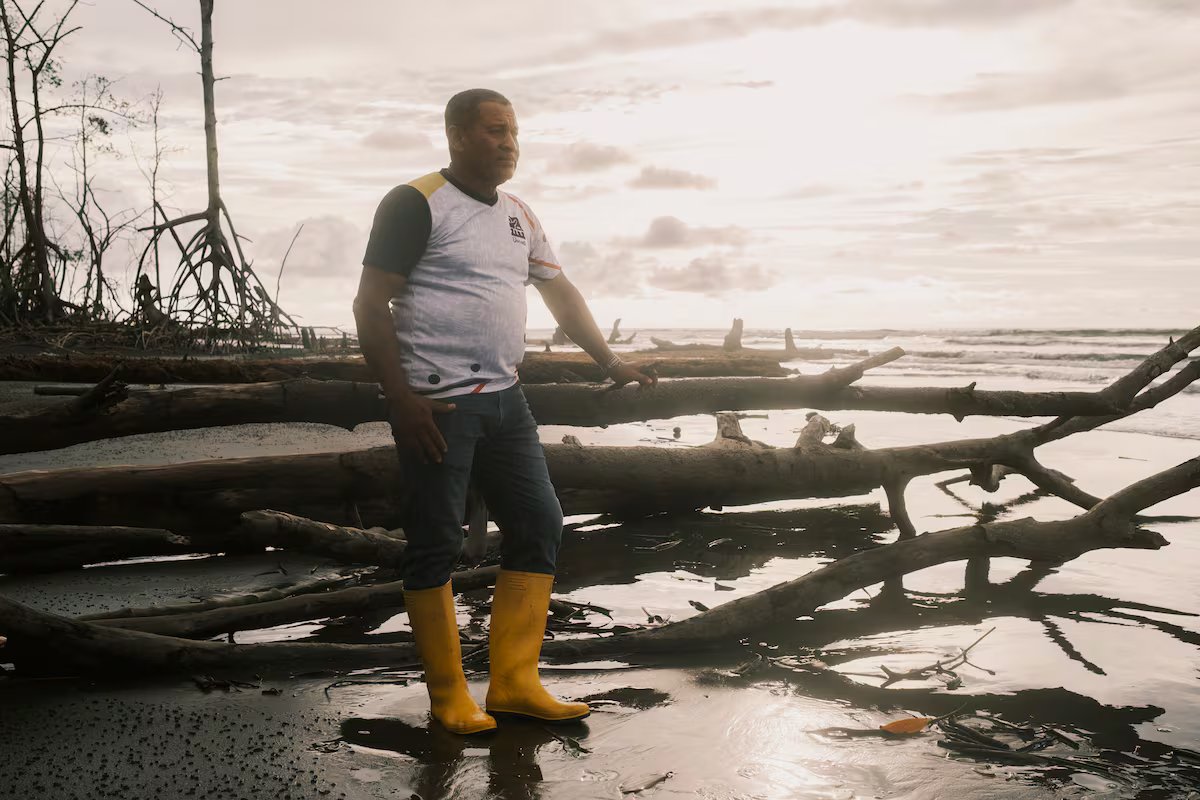
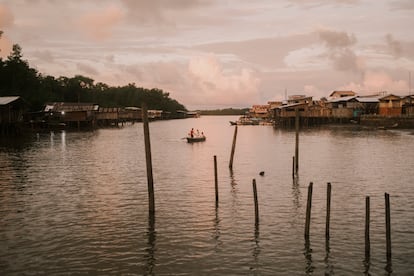
Rosendo Obando rarely answers the phone, because he usually doesn’t get reception. But the night he answered his former daughter-in-law’s call, he was in for a shock.
“Your son was bombed over there. Go look for him in Bogotá.”
“Over there” was the Caribbean, thousands of miles from home. From his village — built out of wooden planks on a mangrove swamp in southwestern Colombia — Obando wondered what had happened. The last time he’d heard from his son, a month-and-a-half earlier, he’d been fishing in Panama. He had no idea what his former daughter-in-law was talking about.
His 33-year-old son waited in an induced coma, intubated, at the airport in the Colombian capital. Swollen, with bloodshot eyes, he had just survived something that — until recently — was unthinkable for a poor fisherman on the Pacific coast: a bomb, dropped by Donald Trump.
Jonathan Obando — known to everyone as “Chiquitín” — is one of only two known survivors of the 41 deadly attacks that Washington has carried out since September 2, 2025, in a non-transparent campaign against drug trafficking. Authorities have confirmed more than 150 deaths in total, with no arrests or prosecutions in any of these cases.
The other survivor was Ecuadorian citizen Andrés Fernando Tufiño, who had a history of drug trafficking. He had completed his sentence in the United States and was released as soon as he set foot in Ecuador. Any potential evidence against him was destroyed in the bombing.
Obando and Tufiño were victims of the attack on October 16, 2025. After blowing up several boats, this was the first bombing of a semi-submersible vessel that — according to the United States — was transporting all kinds of drugs, including fentanyl. Images from that day show a submarine speeding along and three missiles being fired at it.
Until that moment, none of these attacks had left any survivors. There were others afterward, but they disappeared at sea, drowned, or reached land without anyone rescuing them. According to the Washington Office on Latin America (WOLA), there’s no record of them reaching any shore alive. The sea holds the secret of what happened to them.
Tufiño quickly vanished, while his sister — through the media — tried to dispel his image as a criminal. She said that Tufiño was a fisherman, which was true. Obando’s story, however, hadn’t been told out of fear. It is his father who shares it for the first time with EL PAÍS.
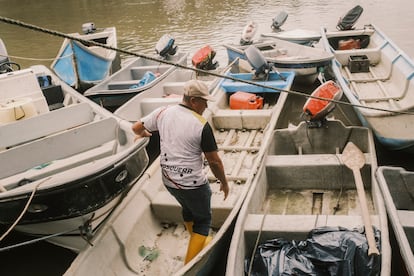
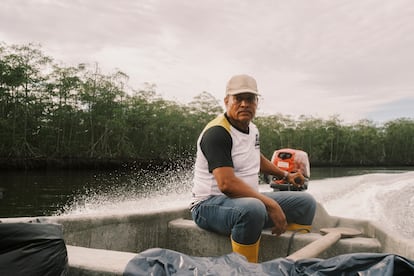
That hot October night when he received the call, Rosendo Obando — whom everyone calls “El Profe” (“the prof”) because he runs a small school an hour-and-a-half by boat from his home — grabbed his backpack and said goodbye to Margarita, his wife. He then went down to the wooden pier and got on a small boat. Starting out from the tiny fishing village where he lives, he made his way through a swampy sea, in search of the youngest (and quietest) of his four children.
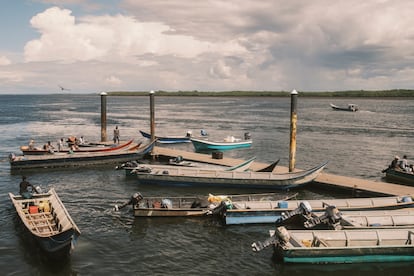
The journey to the nearest city on the mainland — two hours and 20 minutes total, with a 200-horsepower engine — reminds the inhabitants of these remote territories just how far removed they are from everything, and how forgotten they are by everyone.
Once in Tumaco — a port city, the so-called “Pearl of the Pacific” — he boarded the plane that would take him to Bogotá, where, many years ago, he had worked as a police officer.
When he saw his son, he was horrified.
“They left him there, practically dead, at the airport. He couldn’t even speak,” he recalls. Later, they took him to the hospital. It was reported that he had suffered a brain injury, but his father doesn’t know the exact diagnosis. He only remembers how swollen his son was, how red his eyes were, the bruises he had. “They kept him in a hallway without doing anything until I told them, ‘Get to work on him, I’ll take out a loan to pay for it.’ He was going to die.” Margarita, the young man’s mother, called her husband constantly. She wanted to know what was going on.
But he didn’t know much. “I thought there was [rule of] law here, or in the United States, that someone would explain to me what was happening,” El Profe remembers. “I demanded an explanation as to why they hadn’t given him proper first aid, because he’s a human being. Even if he had been transporting cocaine, he’s a human being. They should have caught him alive and tried him,” he says, without raising his voice.
El Profe spent eight days in the hospital room watching his son regain consciousness. U.S. Drug Enforcement Administration (DEA) agents and prosecutors would pass through. Trump — who called the survivors “terrorists” — promised that they would be prosecuted in their own countries. But Obando had no criminal record, nor was there any evidence against him.
Trump’s strategy against narcoterrorism is paradoxical: he justifies the extrajudicial killing of suspected drug traffickers, but those who survive go free, because there’s no evidence to charge them with. The evidence is destroyed before it can be collected. “They are trying to avoid having to defend their policies and standards in court,” a DEA official told The Washington Post.
Bringing them to trial might reveal the inconsistencies in the official White House narrative — the one that prevails — in several of these episodes that are almost never scrutinized. It would expose potential errors and perhaps call into question the effectiveness of eliminating the weakest link in the trafficking chain.
From his hospital bed, Chiquitín began to speak. The ringing in his ears — caused by the explosions — barely allowed him to think. The first thing he did was deny that he had been on the submarine.
According to what he told his father, there were several fishing boats around the vessel. The bombs, he said, threw them all into the air. “The sea was filled with blood and body parts,” he told him. He and Tufiño (it’s unclear whether they knew each other beforehand) climbed into an inflatable raft, waiting to be rescued. Another Ecuadorian man was with them and died after helping them get aboard.
The Americans subsequently took the two men aboard the amphibious assault ship USS Iwo Jima and gave them basic first aid. From there, they went to the Dominican Republic to board a military plane back to their respective home countries.
In the images released by U.S. authorities, no other boats are visible near the submarine, although the framing is closed. “The Colombian’s version can’t be completely ruled out, because the boats might be out of the picture,” says Adam Isacson, an analyst at WOLA, who compiles the known details of each of these episodes. “[The Trump administration] is a government that lies and keeps secrets.”
El Profe avoids speculating about the extreme coincidence that all those boats — including his son’s — were right in the vicinity of a semi-submersible right at the moment of the strike.
He believes what his son told him from his hospital bed. And, at the same time, he acknowledges that the line separating fishermen from crime can become blurred. Many — in addition to getting their catch of the day — act as lookouts, which is very different from being a trafficker or a narco-terrorist.
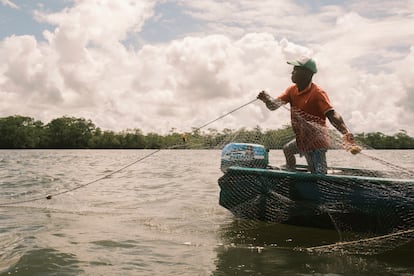
The fishermen of the Pacific and the Caribbean regions of Colombia are thousands of extra eyes on a sea that’s too vast for criminal organizations to fully grasp. Since they need to protect their drug routes, the traffickers hire them as lookouts. They’re the first to spot a rival’s plane, a patrol boat, or another vessel approaching. Reporting what they see provides them with an almost indispensable source of extra income when compared to salaries of barely 1.5 million Colombian pesos a month (about $400).
In places like this — without potable water and with frequent power outages — the guerrillas fill the gaps left by the state. Dissident groups from the now-defunct Revolutionary Armed Forces of Colombia (FARC) maintain a presence in the area and control illegal economies, such as drug trafficking. Violence fell when they got involved in the peace negotiations with the government of Colombian President Gustavo Petro, but in several of these villages built on stilts, the guerillas still dictate who comes and goes. They’re the ones who scrutinize visitors upon arrival and decide, with a simple gesture, whether they can stay. They’re the ones who, just a few years ago, sowed armed terror in the mangroves.
Many of the region’s fishermen end up collaborating with the traffickers out of economic necessity. Some may be striving to build a better house, while others may simply be pressured into cooperating.
“It was really hard for me, because I had to fight for my [livelihood] from a young age,” says Santiago, who got involved with one of these armed groups at the age of 14. “I grew up with my aunt in a house where, if we had breakfast, we didn’t have lunch. And, if we had lunch, we didn’t have dinner,” he recalls, speaking on the condition of anonymity. For years, he worked helping to produce cocaine and building the boats that send drugs north. In five months, he could earn 100 million Colombian pesos (about $26,500). “My life changed a lot despite being tainted by drug trafficking,” he says.
Santiago left this line of work when he was kidnapped, accused of being a traitor, and dug a grave in front of him. Today, he makes a living running errands for others.
“At least [some] have been able to return,” says Flor Vásquez, a community leader devoted to her neighbors. “There are many women here who have spent years gazing at the horizon, waiting for their sons or husbands to come back.”
“The sea is a grave without a headstone or a name. If it could speak, how many mothers could mourn their children?” she wonders.
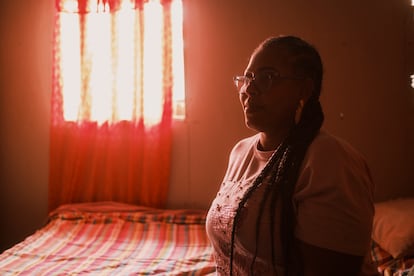
Chiquitín returned home after more than a week in the hospital. He went back to eating fried fish and working on the fiberglass boats that sustain all these communities that are connected to the Pacific Ocean. In the many small villages throughout the area, everyone has heard his story. “Trump sent a bomb after him,” they say. He reappeared wearing earpieces, because the impact of the explosions had ruptured his eardrums. He told everyone about it until, one day, he said to his father: “Dad, I can’t stand this anymore. I’d have been better off dead.” The constant ringing was driving him crazy.
Chiquitín left home again some time ago, without saying where he was going. He hasn’t been heard from since December. His parents think he went to Ecuador to fish. His mother, Margarita — worried sick — has moved heaven and earth asking about him, even friends and distant relatives. What tortures her is imagining him back at sea. And that he may have run out of luck.
Sign up for our weekly newsletter to get more English-language news coverage from EL PAÍS USA Edition
