
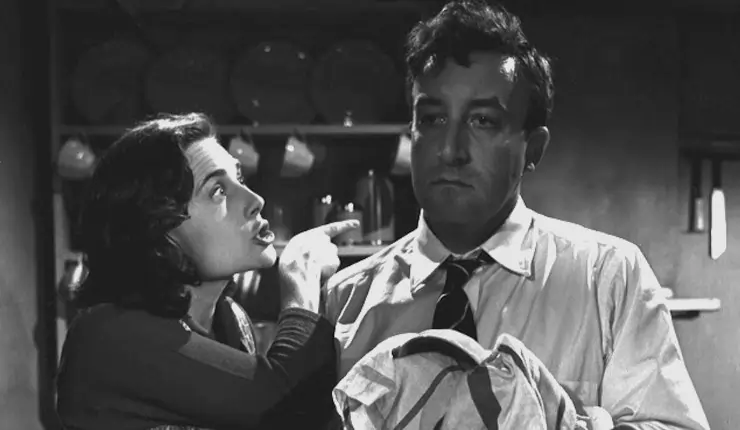
As far as the British Lion films starring Peter Sellers go, this latest pair of releases demonstrates his progression as an actor, even when the films themselves aren’t that great. An adaptation of Kingsley Amis’ That Uncertain Feeling, Only Two Can Play is one of the more frustrating films in the collection, with an uneven tone and unlikeable protagonist, but it’s one of Sellers’ most interesting performances, here playing against audience expectations as a sexually frustrated provincial librarian with delusions of grandeur.
It should have been a slam dunk considering the source material and the pedigree of talent behind the camera. If the Boulting brothers were the successors of Ealing comedies, you might say Sidney Gilliat and Frank Launder were among the studio’s most important antecedents. The scripts they wrote for Alfred Hitchcock and Carol Reed have the playfulness and wit you associate with the studio, while their more overtly comic efforts, like Green For Danger, The Green Man, and The Happiest Days Of Your Life, are all classics in their own right. Only Two Can Play is a curious one – they both produced the film, but only Gilliat directed, and the script was written by Bryan Forbes (before reportedly being punched up by Gilliat). There are a few satisfying quips – Sellers’ aside about “cleaning the brushes” is a particularly risque example – but by and large it lacks the charm of the pair’s best work.
The result is a tonal muddle: part kitchen-sink realism, part satirical attack on cultural pretension, part sex farce. At times, it plays like a pastiche of a John Osborne drama, filtered through the anxieties of late-1950s Britain. Sellers plays Welsh librarian John Lewis, who lusts after apparently every woman who enters his library. From the pre-credits sequence, it appears that Lewis will be a proto-Alfie lothario, but it’s quickly revealed that he is married with two small children, and his lascivious staring becomes a bit unpalatable. He finds a bit of escapism in an idealised affair with the glamorous wife of an influential local councillor (Mai Zetterling), who represents an escape from his apparently humdrum domestic life, and professional advancement, both at the library and on his side hustle as a theatrical critic for the local paper.
The problem is that Lewis is not merely flawed but actively unpleasant: he’s a snob, a lech, and a serial fantasist who treats his wife and children like an albatross around his neck. All of Sellers’ protagonists in this early period are flawed individuals, from the hopelessly naïve priest of Heavens Above! the charming rogue of Two Way Stretch, to the overt comic villainy of Carlton-Browne, but this is the only major pre-Hollywood Sellers role in which he is just plain unlikeable.
Sellers himself is still incredible, giving an early glimpse of the protean character work he would later refine in Lolita, subtly shifting accents and mannerisms depending on who he is trying to impress. In Kubrick’s film, this elusiveness suits Clare Quilty perfectly; here, where Lewis is nominally the protagonist, it creates a moral vacuum at the centre of the story. Any sympathy the character generates comes entirely from Sellers’ own charisma rather than the script. Added to which, it’s uncomfortable to watch today when Sellers’ own personal life is so well known – namely his volatile relationship with his first wife and children, and his well-documented crushes on his leading ladies. It’s difficult to separate the star from the role, and the parallels are a little uncomfortable.
Even at the end, when he makes his big decision to not cheat on his wife, it’s not due to a renewed sense of devotion, but simply because he envisages his future as a kept man with Zetterling. When he comes home and sees his wife trying to conceal her own affair, in a neat callback to his own actions earlier in the film, it’s maybe the most satisfying moment in the film – a rare bit of poetic justice that is unfortunately short-lived.
Virginia Maskell is a revelation as Lewis’ long-suffering wife, bringing strength and wry humour to a role that could easily have slipped into a meek, submissive character. Sellers apparently recognised how strong her performance was as he tried repeatedly to get her replaced – something he tended to do with actors he thought were stealing the limelight! He was proved right when Maskell was nominated for a BAFTA for her performance, while he was ignored. Mai Zetterling is similarly great as the capricious, manipulative object of Lewis’ desire, at once charming and unpredictable, revelling in the various men falling over themselves for her benefit. Of the supporting cast, Kenneth Griffith makes the biggest impression as Lewis’ mild-mannered coworker and rival for promotion. Griffith was previously seen as the fire-and-brimstone preacher in Heavens Above! and he gives a much gentler, understated performance here – there is a real pathos and melancholy to the deterioration of the pair’s working relationship. There’s also a fun cameo from Richard Attenborough as Lewis’ nemesis, a pretentious, bohemian playwright, complete with a goatee. The big scene between him and Sellers is brilliant, with both characters barely concealing their antipathy towards each other. Populating the rest of the film is the regular gallery of familiar British comedy faces, with John Le Mesurier particularly funny as a bemused councilman who encounters Lewis in a compromising position and then has to interview him for a job.
Only Two Can Play is not among Sellers’ best films, but it is an intriguing watch. On the plus side, it’s a lot more mature than other films of this era, confronting quite weighty issues about stagnating marriages and sexual frustration. But it’s very difficult to fully root for a character whose defining trait is leering at attractive women. Sellers himself is always watchable though, and today, the film serves as a testament to his versatility, showcasing his ability to give understated, realistic performances as well as the broad comic roles. As iconic as he is in Dr Strangelove and the Pink Panther series, it’s a shame his meteoric rise meant we didn’t get more grounded performances like this.
Special Features
As with the rest of the StudioCanal collection, there is a nice but modest package of extras here, including the now-usual appearance of Peter Lydon and Vic Pratt discussing Sellers’ career, and a behind the scenes featurette including interviews with Mai Zetterling, Bryan Forbes, Sidney Gilliat and Roy Boulting. It also includes an audio interview with Gilliat on the production, where he infamously refers to Sellers as “a monster.”
★★★
Only Two Can Play is released on 26th January from StudioCanal / Peter Sellers, Virginia Maskell, Mai Zetterling, Kenneth Griffith / Dir: Sidney Gilliat / British Lion / PG
Related
Discover more from
Subscribe to get the latest posts sent to your email.
