
Listen to this article
Estimated 4 minutes
The audio version of this article is generated by AI-based technology. Mispronunciations can occur. We are working with our partners to continually review and improve the results.
Students across the province are protesting recent changes to the Ontario Student Assistance Program (OSAP) — the post-secondary financial aid system will go from a majority grant structure to a majority loan structure in the new school year.
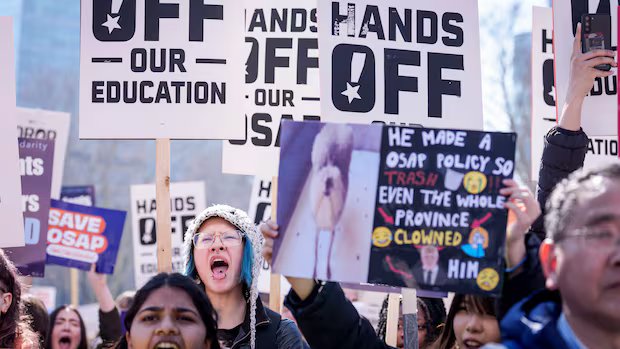
Hundreds of students rallied outside Queen’s Park in Toronto, while hundreds more walked out of class in Waterloo in protest. Earlier this week, high school students in Oshawa also led a walkout.
Toronto protesters chanted and banged drums in unison, calling for Premier Doug Ford and Colleges and University Minister Nolan Quinn to resign and take their “hands off” post-secondary education.
“No cuts, no fees, no corporate universities,” yelled Toronto demonstrators.
“We are distraught, but we are not willing to settle for the conditions that this government has manufactured,” said Omar Mousa with the Canadian Federation of Students–Ontario (CFS-Ontario) at the rally.
Education should not be another financial burden on students already facing insecurity with rising costs for food and rent, said Cyrielle Ngeleka with CFS-Ontario.
“Education should be a pathway out of precarity, not another bill students are expected to absorb,” she said, adding teachers, community workers and parents had also joined student protesters in Toronto.
Last month, Quinn announced a new $6.4-billion funding model over four years, which included an end to a years-long tuition freeze and the OSAP changes.

Students from over 20 schools across Durham Region held walkouts in protest of changes to the Ontario Student Assistance Program on Monday. CBC’s Christian D’Avino spoke to students who say the reductions to grant money put their futures in jeopardy.
Currently, students can receive a maximum of 85 per cent as grants — which do not have to be repaid — and a minimum of 15 per cent as loans that need to be paid back.
But in the new year, OSAP funding for eligible students will be reduced to a maximum of 25 per cent for grants, with funding for loans increased to a minimum of 75 per cent.
“Like so many young Ontario students, I feel disappointed and at a loss of control for what the Ford government has decided to do with OSAP,” University of Toronto student Naicey Portus told CBC Radio’s Metro Morning.
She said she’ll be among the crowds of students outside Queen’s Park at the “Hands Off Our Education!” protest.
On top of exams and assignments, Portus says she’ll now have to worry about money and working more to make up for the changes.
“This is affecting those who already have barriers that they’re facing, and so to make those walls even higher for those students is really disappointing to see,” she said.
CBC News reached out to the province for comment.

Students in ‘limbo’ due to OSAP uncertainty: professor
But the changes to OSAP aren’t that straight forward, said Danny Corral, assistant professor at the University of Toronto.
He said the program is funded by both the province and federal government, but the new cuts will only affect the provincial portion of OSAP.
Up to 60 per cent of OSAP funding comes from the federal government, according to Employment and Social Development Canada. That means OSAP changes will affect about 40 per cent of the funding that comes from the province.
“Students are really in a state of limbo, so to speak, in terms of really understanding how this is exactly going to impact them,” said Corral.
London Morning7:572 local university students explain how OSAP changes will affect them
Students are rallying against Ford’s changes to OSAP, including cuts to OSAP and a reduction of grants. Western University students Brooklin Begg and Amrithaa Logeswaran told London Morning how this will affect their budgets and choice to pursue post-secondary education.
He said the province has an aid estimator tool to help students see how much they might receive in grants versus loans, but that tool has yet to be updated since the announced changes.
The ministry of education has said that it will be updated sometime this spring.
“Hopefully these protests continue to demonstrate that students are stressed, students are angry … because of the real impact that these policy changes are going to have on their futures,” he said.
Corral encouraged students to keep pushing for answers and to stay on top of updates from the province in the months ahead.
