
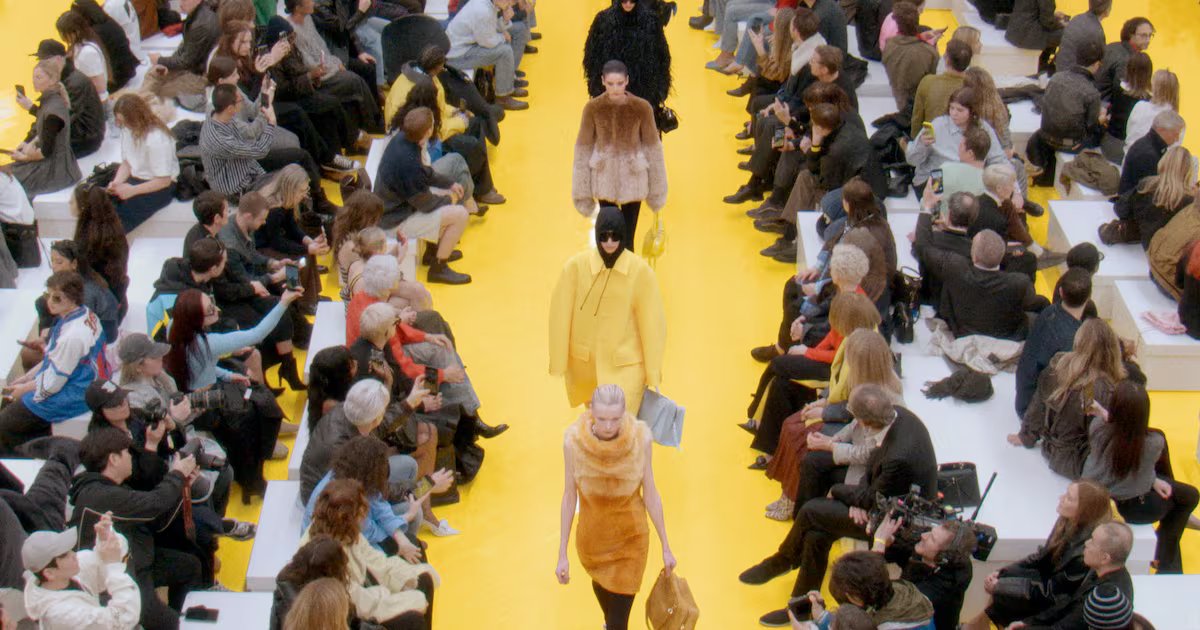
PARIS — The fifth day of Paris fashion week featured recently installed designers working to assert fresh identities (some more successfully than others) at the brands they helm and unbeatable masters that kept being themselves.
Givenchy
Now in her third season at Givenchy, Sarah Burton has really found her stride: while maintaining her signature sense of infinite variety, she has made the house her own, free from the urge to observe a strict code as was the case at McQueen. Today’s outing showed off the level of mastery of draping and construction befitting a couture house like Givenchy, and yet she steered away from any heavy references to the brand’s heritage. The multifaceted complexities of women’s lives are a recurring subject of rumination for Burton. And that made for an exploration of spontaneity and precision, strictness and sensual flow with a whiff of Gianfranco Ferré.
The painterly, Flemish Old Masters-inspired headwraps, conceived by Stephen Jones out of t-shirts, and yet rendered for the show in duchesse satin, set the mood: a rich visual composition that unfolded in such a way that sumptuous flavours were punctuated by palate cleansers in the form of suits. Multiplicity is the contemporary condition, but it’s hard to master. Burton did it — without losing the electricity of chaos.
Yohji Yamamoto
Just when one thinks an inveterate master like Yohji Yamamoto cannot top himself, here he comes with another masterpiece of a collection that’s a tattered, knotted, frayed, layered, decorated, délabré reminder that fashion can still evoke real feelings; that invention and the hand still matter; that beauty and poetry are balm for the soul and the eyes. For the first time in his career, Yohji-san fully tackled Japanese costume — kimonos, haoris, getas — in rural popular culture and mixed them up with an emotional vision of rag dolls maintaining their beauty in beaten times. What made it all the more compelling was the sensitive mix of earthy colours, maroons and shades of blue, that gave things depth. This was the first Yohji collection that wasn’t all black in a long time.
Loewe
Jack McCollough and Lazaro Hernandez’s Loewe vision is joyous, energetic, taut, with a step into sportswear — that is to say activewear, they’re American, after all — and a coating of arty coolness and a touch of childishness. The template was set last season with their debut show, which looked like a smart way to evolve the brand after more than a decade under predecessor Jonathan Anderson, holding onto what matters while shifting the aesthetic.
Their sophomore outing didn’t widen the scope but deepened it with the addition of an interesting techno-industrial take on craft. There was leather, of course, but also latex, silicone and inflatable puffers; there were visors and moulded diving shoes with kitten heels and skiing pants. It was all very futuristic. But there were also animalistic shearlings and teddy bear fur adding a touch of the organic and the demented.
It worked, not least because the exchange with bonkers Cologne artist Cosima Von Bonin, who created the set and inspired the mood of the collection, was a true dialogue, not one of those artist collaborations in which the work is splashed onto garments and accessories. All is all, it was an assured outing if a tad repetitive, leaving this already viewer wondering what’s next. Futurism can’t stand still.
Issey Miyake
Back on track after last season’s absurdist detour, Issey Miyake’s Satoshi Kondo offered a powerful essay on control and letting go, or as he put it, “creating and allowing.” In his latest outing, Kondo brought a sense of movement and the undone to Miyake’s signature shapes that barely touch the body with a hint to those the fibreglass bustiers à la Grace Jones in the early 1980s. At times things got a little too frumpy and needlessly complicated — those hats! — but when Kondo stuck to the mandate of purity falling apart, of pieces almost reverting back to their origins in rolls of fabric, his intent truly shone through and the results felt poetic, a tad raw, soothing.
Mugler
At Mugler, designer Miguel Castro Freitas made it quite clear what his vision for the house is, and it’s nothing predictably Mugler. At least, not at first reading. No showbiz, no sparkly glamour, no cheeky humour, no starlets. What he kept, instead, is the core ethos of the label: redesigning the body through clothing as a means of empowerment — because, in fact, the Mugler woman is powerful.
The show was a reflection on power, as epitomised by Mugler’s trademark inverted triangle silhouette — wide shoulders, nipped waist — spliced with militaristic, 1940s overtones. Considering the political moment we’re collectively living, the sense of militarism was slightly discombobulating, but that was a minor issue. What was way more challenging to digest was the image the collection projected, as if Mugler belonged in another section of the fashion sphere: edgy, avant-garde and redolent of the 1990s, which is where Castro Freitas’ stylistic roots originate. The designer, deep down, is an architect, a master of form: In the future it would be interesting to see his expression regain clarity, doing away with the styling tricks.
Lanvin
Over at Lanvin, Peter Copping finally found his stride, in what was his most convincing outing since the start of his tenure at the house: an exploration of the 1920s and modernism with a feminine edge à la Jeanne Lanvin that did not feel too literal or costume-y. It did not feel particularly modern either, but that’s another story. At least the house has regained its long-lost credibility. Coppings worked to a vertical silhouette, mixing strict tailoring and flou with a sensitive hand. And yet, what’s still missing is the spark of desirability, the next item on Copping’s agenda, one hopes.
Victoria Beckham
Victoria Beckham keeps using her runaway shows as edgy experiments in image-making, while selling something else entirely. Fine: Everybody does, too. But the image such shows project is practically that of another woman altogether. Amidst the sharp, distorted tailoring and the hints of flowy femininity, this collection felt less forced, but it’s certainly not moving the fashion conversation forward.
