
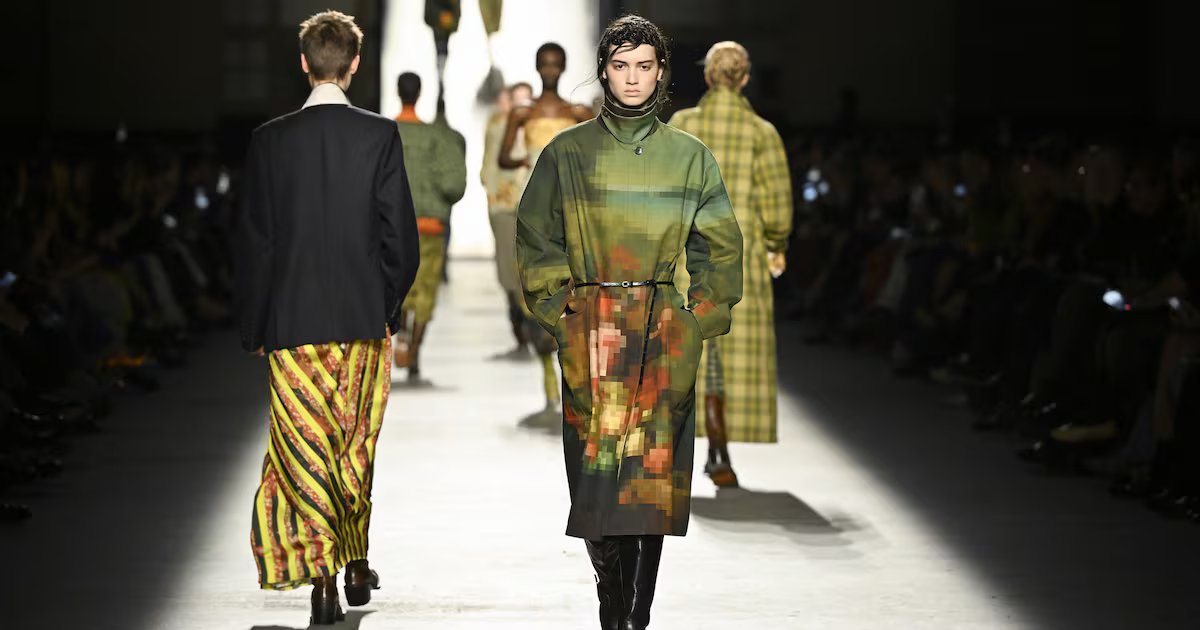
PARIS — The busiest day of Paris fashion week featured a hello at Balmain, a goodbye at Alaïa and variations on signature visions at Courrèges, The Row, Dries Van Noten and Tom Ford.
Dries Van Noten
At Dries Van Noten, Julian Klausner engaged on a detour around the most exotic and ineffable of topics: the building of identity at the end of youth, right before adulthood sets in and things solidify. He did so in a very Dries kind of way, taking things from here and there, mixing school uniforms, embellishment, mannish pieces, cozy knits and whiffs of other cultures, plus some grunge. We’ve seen this sort of thing on the Dries catwalk many times, but not quite in the same way. In fact, as much as Klausner’s language feels familiar, there is a raw edge, a fresh bluntness to it which is entirely his own and integral to how he is evolving Dries in such a convincing way. This season the proposal felt particularly tight and trembling: a poetic vision of the self as both personal and multicultural wandering, summed up in a killer silhouette that was narrow and vertical, grounded by stompy-heeled boots.
Tom Ford
The Tom Ford show closed to The Beloved’s Sweet Harmony on the soundtrack. Not a metaphor but a message, simple but urgent: “Surely now / We could move along / Make a better world? / No, it can’t be wrong.” That said, there is nothing simple or banal about the intoxicating vision Haider Ackermann is honing for the house: an electrifying masterpiece of strictness and abandon, perverse seduction and elegance. This season the outcome was particularly multidimensional: a variety of characters meandering in a glaring white space, each one at their own pace, each one with their own story captured in a sensational mix of sharp tailoring, leather, denim and Patrick Bateman-worthy clear PVC. “They all flirted with debauchery in their past, now they stand straight in life,” Ackermann explained backstage.
Courrèges
The ticking of a clock and the ringing of an alarm set Courrèges up for a reflection on time: that intangible entity which governs life, which flows so quickly that there’s never enough of it. Nicolas Di Felice was celebrating his fifth year at the brand. But the designer is not a romantic. His language is charged with a crude tension. Courrèges, moreover, is the temple of a modernism-futurism connected to the accelerated pace of the present. This is to say that the stylistic rumination on the passage of time was resolved in a series of clean, geometric pieces which were meant to be put on in a flash and taken off in a flash as well — the sexual charge in Di Felice’s work is always tangible — to respond to moments of the day. The show began with what looked to be white fabric draped over a sharp structure protruding from the hips, carried through sleek separates and ended with the opening look in black. The turn of a clock: easy!
Balmain
Blinders came up to let light flood the room behind muslin drapes, setting the scene for Antonin Tron’s debut as creative director at Balmain. Another easy metaphor: a reopening of the house, imagined as a dusty attic or a forgotten archive. This is where Tron, favouring evolution over revolution, began his path: looking at two archive pieces from the 1940s and bringing them into the now as if they were alive. And if it all looked very 1980s, it’s because the 1980s looked like the 1940s. That, however, did no good to the collection, which never quite shook off the dust, resembling things we have seen way too many times. It was an acceptable start, but Tron needs to find a stronger voice to make his Balmain stand out in the market.
The Row
At The Row, the atmosphere was calm, detached, as only unflaunted wealth can be. The luxury of silence, here, is real. The Olsens’ vocabulary is consistent in its ultra-luxe reductionism, but there’s evolution: this outing, for instance, felt a little prissy and a little uptight, despite lines that followed the body gracefully and a touch of nighttime sparkle. The Yohji-infected radicalism of the past was long gone. A dose of fresh daring could be nice.
Alaïa
Reduction was the name of the game at Pieter Mulier’s final outing for Alaïa. The collection that capped his five-year tenure at the house was in fact his most Azzedine of them all: close to the body, mercilessly tailored and strict, a real vocabulary of shapes and pieces. As a way to pass the baton, it was a smart and sensible move: reassessing the foundations so that whoever comes after can pick up from there. It all came with a problem, however: The bodycon strictness Azzedine perfected requires a formal precision that was missing. The event was at once deeply emotional and oddly underwhelming, highlighting what the house needs.
