
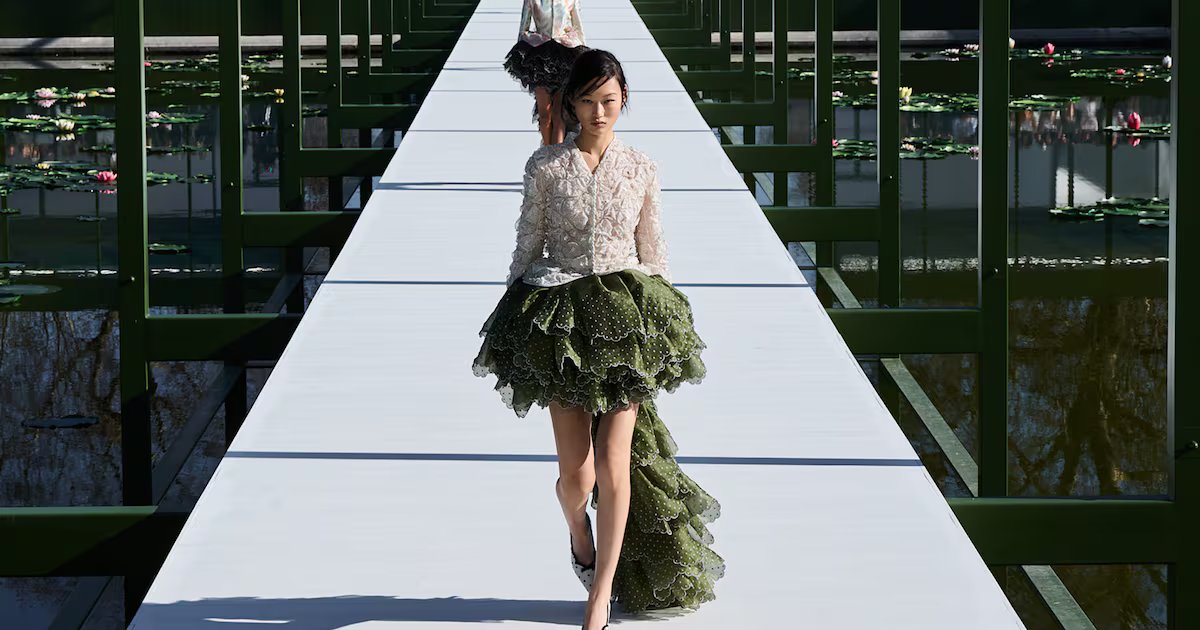
Jonathan Anderson has lately been showing his Dior collections in a giant tent in the Tuileries, the ornamental gardens in the heart of Paris that were once the playground of kings. But he has tired of tents. For his new presentation, he fancied something more open, more engaged with the reality of Paris, more reflective of his warmer feelings for the city. So Dior filled the massive Grand Bassin Octogonal with water, floated it with artificial water lilies (Monet’s “originals” being mere feet away in the Orangerie gallery) and bridged it so that Anderson’s models could parade through a spectacularly sunny spring day in a contemporary version of the fashion finery that Louis XIV mandated as the habit décent, the acceptable dress code, when the gardens were first opened to the public in 1667. It was the kind of elaborate, breathtaking visual conceit that only fashion’s deepest pockets could pull off. Resistance was pretty much futile.

Pre-show, the designer made the interesting point that showing in sunlight (who could ever have anticipated there would be quite so much of it given the awful weather of late?) meant everything really had to work. There were no shadows to hide in. So that was a challenge, given the couture-level complexity of many of Anderson’s designs. At the same time, the sun’s natural spotlight made stars of the fabrics: extraordinary gilded paisleys, sequin-trimmed denim, Donegal tweeds with woven-in sparkle, shearling shaved to a velvety smoothness, hammered silks, cut into trousers that were exhaustively side-trimmed with tiny covered buttons, the kind you’d find on a royal wedding dress.


The collection was a continuation of Anderson’s quest to lighten and youth-ify Dior signatures, the most obvious being the Bar jacket with its flared waist. In his earlier efforts, he’d already hiked the Bar so that it flared just below the bust. Here, he amplified that new silhouette by underpinning it with frothing layers of organza. The sugary colour palette compounded the girlishness of the look. But there were also classic men’s fabrics printed onto silk georgette which was then subtly plissé-ed and turned into a suit. The connection between the two ideas was the lightness. Apparently, there’d been an observation that Anderson’s designs were erring on the heavy side. There was now an effervescent new knitted bag style. That felt like Anderson’s not-so-veiled response to that earlier charge.


He closed the show with a piece he said was his favourite: a black cashmere coat with a draped satin shawl collar. Not the first time he’s proselytised for Christian Dior’s outerwear. The fact that it was such a stark contrast to much that had come before suggested other directions, more rigour, less frill and froth. And yet, there was also a heeled shoe with a lily pad appurtenance that reminded me of Anderson at his delightfully surreal peak. Only he knows what’s next, which is exciting.
If Anderson is wrestling with ways to fight preconceptions, Anthony Vaccarello’s ten years as creative director of Saint Laurent have already honed his response. “It’s a house where you always have an image in your head,” he said before his show, “and I like to play with the repetition of the same thing that you have in your mind.” Repetition — or, rather, the exploration of a couple of ideas per show — has always been Vaccarello’s modus operandi. On Tuesday night, that meant le smoking, to celebrate 60 years of tuxedo dressing at Saint Laurent, and an exploration of lace. In fact, the two notions were completely complementary: The tailoring was fluid, deconstructed, hard becoming soft, and the lace was silicon-coated, soft becoming hard. Innuendoes intended. Sexuality was, after all, a pillar of the original Saint Laurent pitch, and it was tinged with danger for the hard-living denizens of Yves’s world.


Vaccarello’s collection was stark, sensual and similarly edgy. For inspiration, he namechecked the legend Romy Schneider in “Max and the Junkmen,” a 1971 thriller in which she plays a hooker who wears little lace dresses. At one point, the soundtrack featured Barbra Streisand singing the theme from “Eyes of Laura Mars,” another ’70s thriller which features a serial killer who hunts models. Vaccarello’s suits, single-buttoned, sometimes double-breasted, had the ambiguous drama that Helmut Newton’s photos used to record so effortlessly in YSL’s designs. Pat McGrath’s makeup was similarly inclined. Of the many lace dresses, none was the same but the cumulative effect was numbing. It was also monumental, made even more so by massive, opulent furs conjured up from shearling, and trenches of silicon-coated mousseline.


All of which highlighted the fundamentally fetishistic nature of Vaccarello’s work. He’s as obsessed as Yves himself was, drawn to the erotic, the transgressive, the wilful. Brian Eno used to say that repetition is a form of change. I would say that depends on what’s being repeated.


