
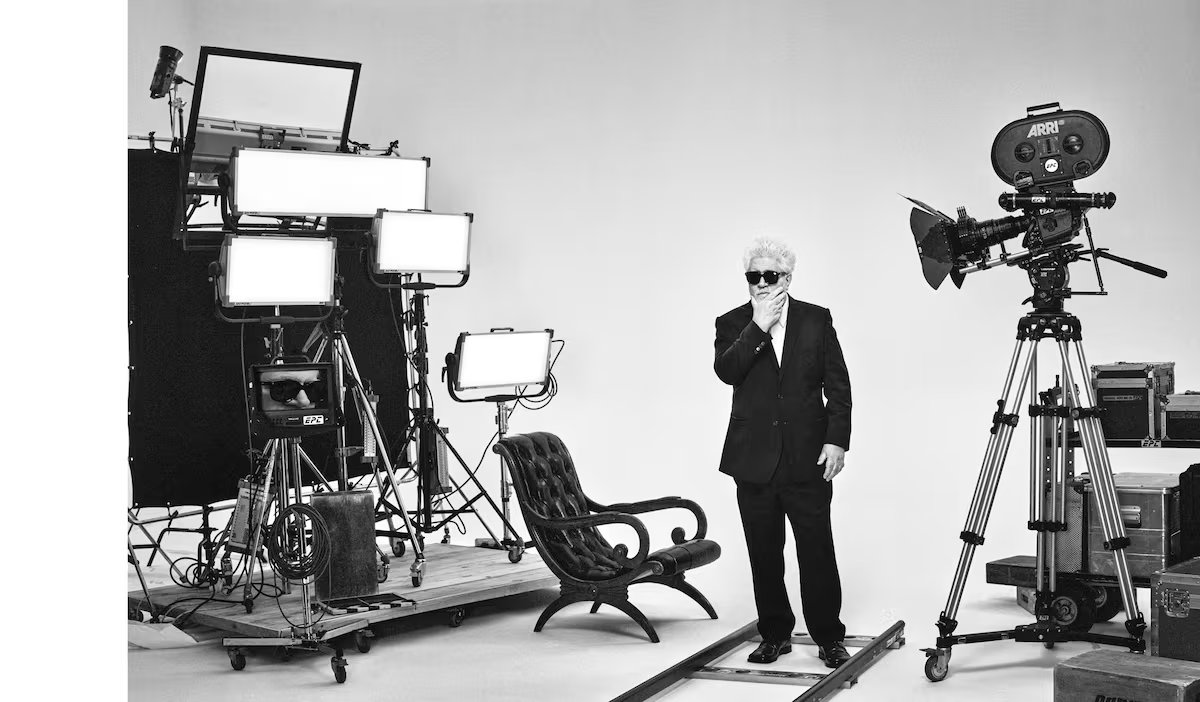
2026
We first see Pedro Almodóvar from afar, from the street: on the second floor of the building, a shock of white hair and a silhouette dressed in vibrant colors are visible through the glass. He’s leaning over the table, working with the stubborn concentration of someone still reviewing a line that others would have already deemed perfect. The office of his production company, El Deseo, occupies an unassuming alleyway near Las Ventas bullring, closer to the M-30 ring road than to the old-world luxury of the Paseo de la Castellana, in that outlying part of Madrid that still retains a touch of the old neighborhood.
When we go upstairs, we find ourselves seated in an office that feels like a home museum. To one side, on a blue wall with turquoise undertones, an immense mosaic of framed photographs — portraits with his actresses, group shots, mementos from his film shoots — serves as a reflection of a lifetime dedicated to cinema. On the other side, a bookshelf brings together books on art, photography and fashion, along with several awards — we see a Bafta, a César, a Goya, but not his two Oscars — and two movie posters: 8½ and All About Eve, beacons of a career devoted to visual storytelling.
Almodóvar slept poorly and admits he’s a bit unfocused. “I don’t know which version of myself will appear in this interview,” says the director, fully aware of the multitudes he contains. He’s happy and, perhaps, a little worried. He says he’s satisfied with his latest Spanish-language film, Amarga Navidad (in English, Bitter Christmas), which will be released on March 20. He tells us that the initial screenings have been unanimously positive. “The first reactions always give you an idea of what the future holds for a film. This one looks quite promising.”
At the same time, he knows that in this film — a multifaceted, autobiographical piece — he has exposed himself like never before. “I’m a modest person, but I’ve gradually lost that modesty in my recent films. I haven’t wanted anyone to know absolutely anything about anyone who has been part of my life, neither the men nor the women. I’ve always kept those doors closed. In recent years, that has changed a bit,” he acknowledges.
Bitter Christmas, titled after a famous bolero, alternates between two time periods and two narratives that ultimately reflect each other. The first takes place in December 2004, during a long weekend. It revolves around Elsa (Bárbara Lennie), an advertising director and “cult” filmmaker thanks to the only feature she made years ago. She is marked by grief over the loss of her mother and surrounded by two friends, Patricia and Natalia (Victoria Luengo and Milena Smit), who are also grappling with their own losses.
The second story unfolds in the summer of 2026 and centers on Raúl Rossetti (Leonardo Sbaraglia), a successful screenwriter and director who, nearing 60, is experiencing a long creative drought. He lives a secluded life, with his world shrinking to just a few people: his partner Santi (Quim Gutiérrez) and his assistant Mónica (Aitana Sánchez-Gijón), his right-hand woman, who has just left him to attend to a personal matter.
It soon becomes clear that Elsa’s story is in fact the screenplay Raúl is writing in search of a way out of his writer’s block: a tale fueled by his memories, his innermost thoughts, and the lives of those around him, used without their consent. Elsa is Raúl’s alter ego, and Raúl, in turn, acts as a double for Almodóvar, who also sees himself reflected in Elsa, a distant version of himself. In Bitter Christmas, all the mirrors repeatedly reflect the image of their creator.
In Almodóvar’s films, the written, the filmed, and the lived have always functioned as interconnected vessels. Bitter Christmas brings to the forefront this permeability between reality and fiction, between memory and invention, and also the moral dilemma that arises when a creator decides to use other people’s lives in his films. With the exception of Pain and Glory, which Almodóvar himself calls “a sister film,” he has never shot anything so close to autofiction. “It’s a film that clearly reflects me,” he admits. “There’s a lot of fiction, but no invention. I’m absolutely present and completely fictionalized. Actually, if I made a film about myself, it would be very boring. Fiction is always necessary.”
Even so, not everything aligns. Unlike Raúl Rossetti, who is sunk in a severe creative crisis, Almodóvar insists that he is going through a very fertile period, though he recognizes in that character certain traits of his own: the loneliness and disorientation of maturity, the conviction that his only true passion, the only thing that gives meaning to his life, continues to be filmmaking. “Raúl Rossetti only lives to tell stories that captivate him. Until he finds them, everything is emptiness and dissatisfaction,” he says. Once again, there is a familiar reflection: Almódovar¡s reputation for being obsessive and a workaholic precedes him.
— It’s hard not to read a certain identification with the character in those words.
—Yes, that part is very autobiographical, although my life hasn’t been that dramatic. But that’s how it is, for better or for worse. I write every day. I don’t want to imagine myself at a time when I have nothing left to say. I’m already over 70 [he will be 76 in September], and that makes me work much more now than I did in the last decade. It’s good practice so that the future finds me busy.
—The future, not to say death. Does this work addiction mask a fear of the void?
—Absolutely. By dedicating so much time to filmmaking, I’ve neglected other parts of my life. And I don’t know if they’re ever recoverable. Even in the 1980s, when I overdid it, I only overdid it just enough not to stop working. I miss that time a lot: the exhilaration, the sleepless nights, the wild times. But there comes a point when you have to choose between living and dying.
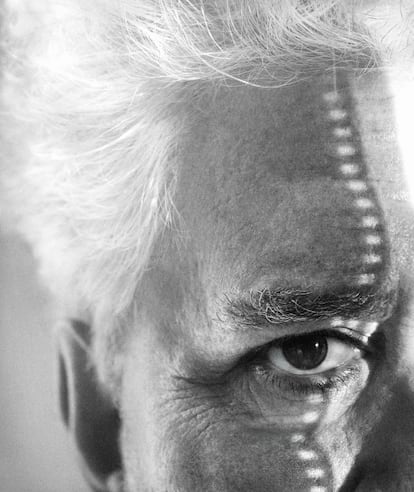
2003
The origin of Bitter Christmas lies in a short story written in 2003 and later included in El último sueño (in English, The Last Dream), the anthology of short stories that Almodóvar published a couple of years ago. That text was born when his body forced him, for the first time, to stop: his first panic attack. “Today everyone knows what it is, because even Isabel Pantoja had one on Survivor,” he jokes. “But back then I didn’t know what was happening to me. It was a mixture of migraine, an old acquaintance, and something completely different, like an alien stirring inside you. I felt brutally that I was going to collapse, that I was going to die.”
In retrospect, that crisis coincided with a moment of self-doubt: the first time he began to look back directly at his past to write his screenplays. At the time, he was rehearsing Bad Education, which he remembers as “a very complicated shoot.” It was also the first film in which he drew inspiration from his childhood. The first thing he uncovered in that archaeological dig was the darkest part: the wounds of a religious upbringing marked by guilt, repression, and abuse.
—Do you think the panic attack was related to those memories?
—I hadn’t thought about it, but now that you mention it… It’s true that it was the first time I really looked back. And from that retrospective look at my childhood, the first thing that came out was a film about the worst thing that could have happened to me as a child: being badly raised by the Salesians [a Roman Catholic religious congregation].
Once that door was opened, Almodóvar never closed it again. Two years later, he found the other half of the story: not the traumatic confinement of the religious upbringing, but the joy of the courtyards of Castilla-La Mancha, the Spanish region of his childhood. Not the violence, but the world of women in which he grew up. Not only the wound, but also the joy. From that discovery, Volver would be born. “I was surprised to discover something very positive: my early childhood in La Mancha, the courtyards, the neighbors, my mother, the feminine world in which I grew up. That was my true education. My mother would take me with her or leave me with the neighbor across the street, and I would hear them talking, singing, making bobbin lace, criticizing. For me, it was a spectacle.”
Actually, parts of his life were already in his films before they were explicitly autofiction. Haven’t his great heroines, in one way or another, been projections of himself? “It depends on which one…” the director dodges. We give him a list. Pepa, in Women on the Verge of a Nervous Breakdown? “Yes, absolutely.” Leo, in The Flower of My Secret? “One of the most.” Marina, in Tie Me Up! Tie Me Down!? “A little less, because she does heroin and porn. What represents me in the film is the exaggerated romanticism of that couple.” And Manuela, in All About My Mother? “Her too, although with nuances. In great gay authors, like Lorca or Tennessee Williams, there is a constant identification with a female voice. The difference is that my characters start with me, but then they become real women. They are never men in disguise.”
The year 2003 was not only the year of his first major crisis, but also the moment of his rebirth as a filmmaker. It also coincided with the beginning of his relationship with his partner of two decades, who appears fleetingly in Bitter Christmas — a rare revealing move from someone so protective of his privacy. “Yes, he appears in it. But I’m not talking about that.”
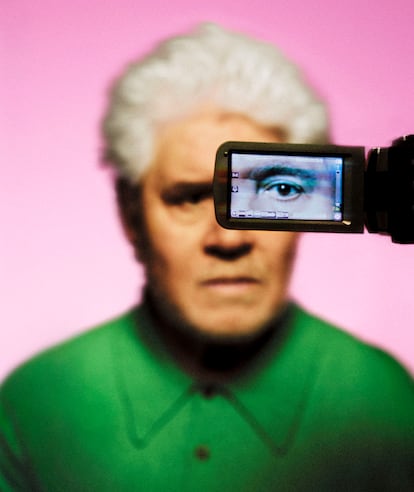
1999
It’s a rather classic paradox. At the very moment the world was hailing Almodóvar as a cinematic genius, he was falling apart inside. In 1999, All About My Mother triumphed at Cannes, accelerated his conquest of the United States, and paved the way for the Oscar, which would come a few months later. From the outside, it seemed like a turning point: the director was moving from the scandals of yesteryear to international acclaim and finally entering the canon. The inner turmoil, however, was palpable: that same year his mother died. After her death, Almodóvar continued working almost without interruption, like Bárbara Lennie’s character in his new film, as if that could soften the blow. Until, years later, a delayed grief arrived.
—Did the death of your mother open a new stage in your filmmaking?
—Yes, there’s a very clear turning point. It also coincided with my having just turned 50. The three films that came after, Talk to Her, Bad Education, and Volver, are key to my filmography. That’s where I entered a different tone. I became a mature director.
Since then, his cinema has been shaped by memory and death. Bad Education opened the black box of childhood. Volver brought the mother back from the realm of the dead, as if trying to resurrect her. Then came Julieta, Pain and Glory, Parallel Mothers, and The Room Next Door, all of them marked, in one way or another, by finitude. That shift in focus hasn’t diminished the pleasure of filmmaking. “There’s nothing comparable to shooting,” he says. “It takes away all my ailments. When I had surgery in the past decade, I thought I wouldn’t be able to shoot again. Until I discovered that, on set, the pain disappeared.” And that it returned the moment he shouted “cut.”
In the obituary he wrote for this newspaper, Almodóvar recalled his mother’s last words. In the hospital, she asked him if there was a storm. It was a sunny day, and sunlight streamed through the window. A few hours later, she died. Twenty-seven years later, the question still haunts him: “What storm was she referring to in her last dream?” And he remembers himself, at the height of his fame, weeping beneath his sunglasses, caught between pain and glory.
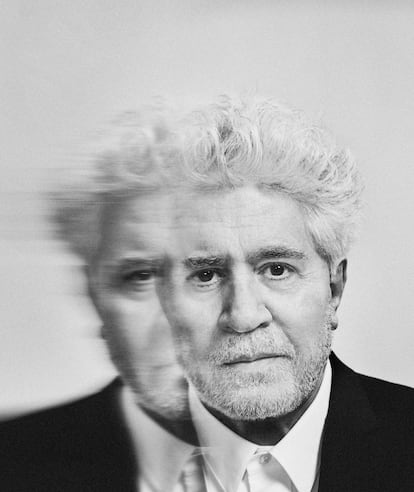
1959
More than filmmaker or a screenwriter, Almodóvar defines himself as a storyteller. Perhaps because the word evokes an origin prior to any vocation: the oral tradition of the courtyards of La Mancha and Extremadura, his mother’s voice as his first storyteller. “She gave me the ability to tell stories,” he admits. When she read letters to illiterate neighbors, she didn’t just decipher them: she completed them, softened them, or added details. “If a sick grandmother wasn’t mentioned in the letter, she would ask about her.” As a boy, Almodóvar was scandalized by these white lies. “Much later I understood that she was giving me the greatest lesson of my life: that reality needs fiction to be more bearable.”
In Madrigalejo, the village in the western province of Cáceres where he spent part of his childhood, Almodóvar took up the mantle when he was about 10 years old. He would go to the cinema in the town square on weekends. Upon his return, his sisters always asked him the same thing: “Pedro, tell us the story.” He would reinvent it. “My narrative delirium was such that I ended up turning it into a different film altogether, fueled by the inner fire that kept building as I told it.” There, in miniature, is everything that defines his cinema.
To that emotional education was added another: the experience of feeling singled out as different. In his village, and later at school, he very early on sensed a look of disapproval. “I didn’t yet know how to name it, nor did I know what homosexuality was, but I was perfectly aware that my difference wasn’t acceptable,” he recalls. Children, he says, are cruel. So were the priests. But he never lost the ability to defend himself. “I didn’t keep quiet. If there was a fight, I fought.” He speaks of recess and his belligerent attitude when the Franco regime was winding down. “Experiencing the end of the dictatorship at age 20 is something that marks your life. Going out into the street and realizing that you’re no longer afraid of a policeman is a very powerful experience. And you never forget it.”
His calling did the rest. When he arrived in Madrid and discovered that the Franco regime had closed the Film School, he looked for work, bought a Super 8 camera, and started filming. Above all else, he wanted to tell stories. “I believe that storytelling saved me.”
2024
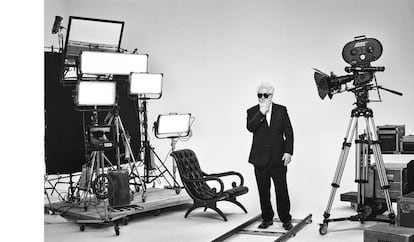
After his English-language adventure with The Room Next Door, Almodóvar returned to Spain with the feeling of returning not only to his native language, but also to his natural way of making films. That film, starring Tilda Swinton and Julianne Moore, allowed him to fulfill a long-held curiosity: to film in another language and with Hollywood stars, to test himself in another system, to measure his cinema in a different context. He doesn’t regret the experience. On the contrary, he insists that his three forays into English — the feature film and two short films, The Human Voice and Strange Way of Life — have been satisfying. But they have also confirmed what he already suspected: that his place is still in Spain.
— What is it about Hollywood that hasn’t won you over?
“I’m more comfortable with my own way of producing, which is more artisanal. Sometimes, Americans overcomplicate things. You have a huge crew you don’t need, but the unions force it on you, and you have to accept it. If I come up with another script in English, it will have to be one with few locations, few characters, and a contemporary setting. That’s why I dropped the adaptation of A Manual for Cleaning Women with Cate Blanchett: it seemed too complex to take on that scale of filming, plus it was a period piece. I’m too old to start changing cultures. I suspect the rest of my career will continue to unfold in Spain.”
Many of his films are born from an initial image, a guiding reference. The ending of John Huston’s Dubliners inspired The Room Next Door, just as Opening Night gave rise to All About My Mother, and Georges Franju was at the root of The Skin I Live In. In Bitter Christmas, there isn’t such an explicit reference, but there is an image that encapsulates the film’s tone: the black beach of Charco de los Clicos in Lanzarote, a volcanic, stark and almost post-apocalyptic landscape where the characters seem to be exposed to the elements. Seeing the image, it’s hard not to think of Bergman, of another beach like the one in The Seventh Seal, with the silence of the sky in the face of human suffering. “Within my capabilities, and filtered through my own perspective, Bitter Christmas is my most Bergmanesque film,” Almodóvar agrees. “Bergman was much darker, of course, but it shares some of his elements: that silence, the illness, the awareness of death.”

1967
Almodóvar arrived in Madrid at age 17, in the midst of the hippie era, without knowing a soul and after what he remembers as his only major argument with his parents. He had finished high school and his family had already found him a job at a bank. He refused to accept this position: “I told them I was going to Madrid.” His father, used to making decisions for everyone, threatened him with calling the Civil Guard: Almodóvar was still a minor. “You can start calling them now, because I’m leaving,” he replied. “He saw how determined I was and didn’t object.”
The late 1960s and 1970s feature little in his story, as if there were only an ellipsis between his childhood in La Mancha and his creative explosion in the 1980s. But there, in reality, lies another decisive moment. “It’s true that it’s a decade that’s not often discussed in my life. I had a project about the 1970s that I never got around to doing.”
The first Madrid he encountered wasn’t yet the Madrid of La Movida — the cultural and social revolution that hit the Spanish capital in the 1980s —, but rather a city that was half-awake. “The trendy spots were in Plaza de Santa Ana square,” he recalls. Almodóvar grew his hair long, made beaded bracelets, and entered the film industry as an extra, recruited from among the long-haired residents of that central square to fill out musical numbers in the movies of the time. In one of them, Con ella llegó el amor (in English, With Her Came Love), starring the rumba singer José “Chacho” María Valenti, he says you can clearly see his face, “dancing like crazy with a long mane of hair.”
Penniless and unable to study film, he decided to take the entrance examinations for a job at Telefónica, a Spanish telecommunications company that was then largely state-owned. He not only passed, but came in first. “Eight months later, I had to start.” He didn’t work in the switchboard, as the legend goes, but in the department that assigned phone numbers. That job gave him a steady income, reassured his parents, and, above all, allowed him to finance his first short films. Between 1973 and 1979, he filmed numerous short films with friends that were already imbued with the themes that would later characterize his work: sex and desire, the blend of melodrama and comedy, transsexuality, and provocation.
At that time, he would get up early to go to Telefónica, leave at 3 p.m., party all night and show up at the office in the morning. In 1972, he came into contact with Los Goliardos, a theater company with which he performed a raucous version of Bertolt Brecht’s A Respectable Wedding. “I don’t understand how they didn’t throw us in jail.”
It was in that circuit that he crossed paths with a decisive figure: Carmen Maura. He met her in 1978, during a performance of Sartre’s Dirty Hands. “She was already a renowned actress; I was little more than an apprentice. But she was the only one in the company who showed an interest in me. She was the one who truly discovered me.”
It was also Maura who, a decade before their famous falling out, helped Almodóvar, along with Félix Rotaeta, raise the “three hundred thousand-plus pesetas” needed to buy the film stock with which he filmed his debut, Pepi, Luci, Bom and Other Girls on the Heap, in 1980. The shoot was pure guerrilla warfare: they had no permits, hardly any money, and the shoot stretched out for a year and a half. “No one was aware that I was going to release it. I was the only one who knew that, one way or another, I would see it through to the end.”
1988
Long before autofiction became a prestigious label, Almodóvar was already grappling with the question that runs through Bitter Christmas. What right does a creator have to turn someone else’s life into fiction? He maintains that drawing inspiration from others has never caused him any conflict, with one exception. It happened with Women on the Verge of a Nervous Breakdown, released in 1988. The story of Candela, María Barranco’s character, stemmed from an episode involving a close friend, a well-known figure in the Movida Madrileña movement, with whom he had lived for several years. In the film, Candela bursts nervously into Pepa’s house: she has unknowingly fallen in love with a man linked to a terrorist cell, she has helped him hide, and now she fears the police will accuse her of being an accomplice. “Except that its real protagonists weren’t Shiites, but members of [the Basque terrorist group] ETA,” he recalls. Almodóvar transformed the anecdote into a comedy. When his friend saw the film, she flew into a rage. “How dare you put that in?” Almodóvar took refuge in the classic argument: no one would recognize her, fiction had transformed everything. Her response was swift and decisive: “He will recognize himself.” That line, which he reuses for a dialogue in Bitter Christmas, taught him a lasting lesson: no matter how much you change the names and disguise the facts, there will always be someone who feels targeted.
— Is there guilt when one is inspired by others?
— Sometimes you flirt with that feeling. Not while you’re writing, because then the passion for the story takes over. But when you finish, the question arises: whether you’ve gone too far, whether you had the right to tell that story. Of course you ask yourself that, because otherwise you’d be a psychopath. I think everyone knows where the line is.
— And what’s yours?
— I don’t have a rule. When I write, I feel completely free. But I also believe there’s a moral sensibility that lets you know your limits. It’s about not hurting anyone. You can’t write your script regardless of who gets hurt.
Bitter Christmas, which draws some inspiration from the lives of people who live and work with the director, makes this conflict a central part of the film. “It’s a film that turns against itself,” he says. Towards the end, in a magnificent confrontation sequence filmed in a replica of Madrid’s Retiro Park, Mónica, Rossetti’s assistant, reproaches him for having used other people’s lives. But also for repeating himself for years. For having lost his touch. For dramatically exploiting, film after film, the grief for his mother. These are attacks that Almodóvar himself has received in recent years. Once again, the character and his creator are confused.
— We had never seen you be so self-critical.
— You’re right, I never have been. But the idea amused me; I felt like messing with myself. I’ve made 24 films: any idea that surprises me, even if it’s at my expense, I take advantage of it. If an idea is worthwhile, it goes into the film, even if it goes against my own interests.
2019
Pain and Glory marks another decisive turning point in Almodóvar’s cinema. From then on, his reflection in male characters has become much clearer. He readily admits it: “It’s a deliberate move. My modesty, in recent films, has also been eroding in that sense.” From this emerge figures like Salvador Mallo, the filmmaker played by Antonio Banderas in Pain and Glory, and now, Raúl Rossetti.
In his latest projects, the image of masculinity has also changed. In Bitter Christmas, men are no longer just emblems of desire and brutality as they were at other points in his career. They are also supportive and caring characters. This is true for both Santi and Bonifacio (Patrick Criado, perhaps the film’s biggest surprise), a firefighter and a stripper. The former lives next door to Rossetti, devoted to a silent and selfless loyalty. In the short story that inspired the film, Almodóvar had already written this clearly: “In moments like this, what’s important is to be there, to provide company, as animals do.”
— Has your image of men changed?
—Yes, although there were precedents, like the characters played by Darío Grandinetti in Talk to Her and Julieta. Masculinity has changed so much that it doesn’t seem like a new thing to me. Curro Jiménez [a popular TV character of the 1970s depicting a dashing highwayman] is a model from another century, although it’s true that it’s a breed that’s hard to eradicate.
— The issue of caregiving occupies an increasingly prominent place in your films. Why has it acquired such importance?
— Firstly, because the world is aging. Spain, certainly, is getting older and more precarious, and more than ever people need help. Caring for others has become one of the moral imperatives of our time.
When speaking of caregiving, he returns to La Mancha and his mother’s neighbors, who would knock on her window every day until they heard a reply. “If she didn’t answer, it meant she had died.” In Almodóvar’s later work, caring is a form of love, of social responsibility, and, in such harsh times, also an act of resistance.
2027
Almodóvar is already writing his next film. He’s finishing the script for a new movie that, barring any unforeseen circumstances, he should begin filming next year. Bitter Christmas continues the trend of his recent work: increasingly stripped-down cinema, less protected by artifice. “Yes, I’m becoming more direct and raw. I feel more exposed in the films I make.” The film is also born in harmony with the times in which it was created. It contains grief, accidents and loss, but also humor, desire, color, and a vitality that refuses to be buried in the shadows, like a beautiful scene illuminated by Amaia Romero’s voice. “It’s a dark film, made in a dark time,” the director confirms. “But I strive to be optimistic, daily, almost deliriously, because there’s no objective reason to be so. I think of [writer] Almudena Grandes, who said that optimism is a wonderful form of resistance.”
Since the Covid pandemic, he finds it increasingly difficult to deal with what he sees when he turns on the television: wars, brutality, the rise of the far right, political violence he thought banished from the European landscape. “I find it unbearable to watch the news. Aside from the part of the dictatorship I experienced firsthand, which I did not consciously grasp because I was so young, this is the worst time I’ve ever lived through. When we were fighting for our freedoms, we never imagined that in 2026 we’d be talking about wars. Now you can go back to being a Nazi, embrace it, and behave like one, and nothing happens. I’m very worried and I wonder what I can do to change it.” He speaks of Spanish politics, of the fear of a brutality he thought was a thing of the past, of general elections that will be held, at the latest, in 2027. He is troubled by “that alliance between extremism and unbridled neoliberalism” looming on the horizon as a global threat, and by the ripple effect of what is happening in the United States, which “fuels and legitimizes the European far right.” And yet, he forces himself to resist fatalism.
In Bitter Christmas, there’s an anecdote about his beloved Chavela Vargas that also seems to describe the current state of his cinema. When she sang La Llorona, at a certain point in her career, Chavela began “to speak the song more and sing it less.” His interest in the later Chavela isn’t due to her supposed decline, but rather to her superior form of artistic intelligence. “When she lost her voice, she didn’t try to pretend she was still the same: she economized and reserved the explosion for the end,” Almodóvar recalls. Nor is he the same as he once was, either. His cinema has entered a similar stage: it’s less sung and more spoken. Perhaps that’s why it also resonates more deeply.
Production credits
Styling: Juan Cebrián.
Makeup and hair: Pedro Cedeño.
Lighting assistants: Pablo Mingo and Carlitos Givaja.
Digital assistant: Nahuel D’Angelo.
Set design: Virginia Sancho.
Production: Room Service.
Production head: Sara Renteria.
Director of Txema Yeste Studio: Carles Arnan.
Retouching: Txema Yeste Studio.
Acknowledgements: EPC.
