
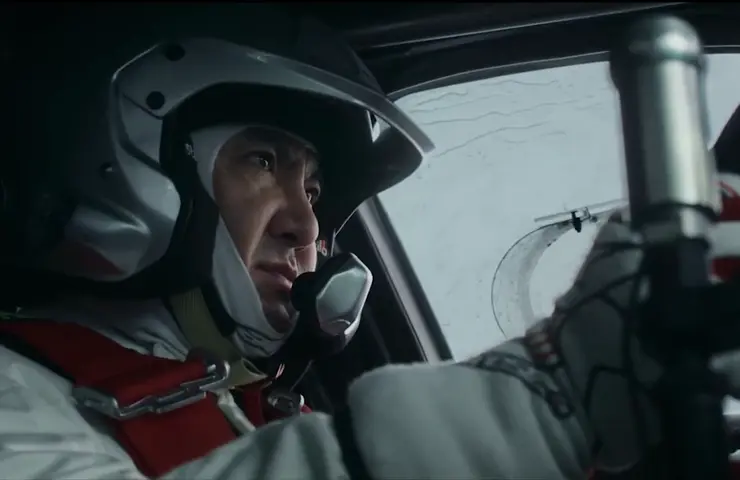
Racecar movies are too often labelled as “dad films,” as their appeal lies in being action-oriented stories aimed at men over 40. It’s a demeaning shorthand—one that flattens the real reason these films resonate. Capturing the thrill and danger of sitting behind the wheel of a machine that can go from 0 to 100 mph in under three seconds. Reproducing that intensity on film is notoriously difficult, especially when safety is paramount on set.
But when your writer-director is a former rally car driver, you’re working with someone who understands that intensity better than most due to that lived experience. Han Han, the writer and director of Pegasus 3, the third instalment in the Chinese rally car franchise, delivers exactly that: a reminder of what true spectacle looks like.
Taking place after the events of Pegasus 2, the film opens with Zhang Chi’s team having won the final Bayanbulak rally, yet still failing to save the factory, whose warehouse is given to Zhang Chi’s team as a gift. Zhang Chi is once again struggling, scraping by through cameo-style video appearances just to survive day to day. Everything shifts when he’s offered the chance to serve as team leader for China’s national squad as they prepare for the Muchen 100. Determined to earn his place, Zhang Chi decides to enter the qualifiers himself.
For the first hour, the racing is kept to a minimum, giving us time to reacquaint ourselves with the characters of Pegasus 3. Prior knowledge of the earlier instalments isn’t required, as the film does an effective job of recapping the key beats from the first two entries, though fans will naturally benefit from understanding the full context. It seems that Zhang Chi can never seem to catch a break, while co-driver Sun Yuqiang does his best to keep him focused and not overly anxious about the Muchen 100. Zhang Chi remains the quintessential self-made driver, someone who rose from nothing and repeatedly defied the odds.
Yet his lack of funding continues to hold him back; entering races isn’t as simple as signing up when building a competitive car costs millions of yen. That’s why the offer from a major company to fund him and appoint him as team captain is so enticing. Having access to cutting-edge technology and brand-new parts is unfamiliar territory for him. A significant portion of the film revolves around AI-assisted systems and the growing belief that the car, rather than the driver, determines success. This man versus machine dynamic has become increasingly common as AI rises in prominence, but Pegasus 3 takes a more nuanced approach, focusing on assistive technology rather than fully autonomous, AI-driven racing.
Pegasus 3 never fully commits to an anti‑AI message; it does take the stance that AI will never be able to replicate or be as advanced as a human driver with track experience. Zhang Chi and Sun Yuqiang succeed not because of machines or learning algorithms but because their partnership operates on a level that feels almost transcendent. This is captured beautifully in what feels like one of the year’s defining moments. When the engines roar, and we transition to Muchen 100, Zhang Chi and Sun Yuqiang must do a tyre change, and the sequence is electric. Featuring long takes, sharp split screens, and a merciless countdown displayed across the windshield. It’s brilliantly executed and genuinely edge-of-your-seat filmmaking.
What makes this dynamic so enthralling is the fantastic work from Shen Teng and Yin Zheng as Zhang Chi and Sun Yuqiang. They deliver performances that are both heartfelt and sharply comedic, allowing the drama and humour to land with equal force. The supporting cast is equally strong. Benyu Zhang, as mechanic Ji Xing, has a standout moment in which he delivers a line that perfectly captures the passion one can have for their craft and the standards they hold themselves to. Wei Xiang, as Manager Ye, also plays off the ensemble in consistently effective ways.
Han Han has continued to evolve as a filmmaker throughout this franchise, and he understands exactly what makes rally racing so exhilarating. The Muchen 100 serves as the film’s final sequence, and while I cannot say precisely how long it runs, it feels like a breathless forty minutes. Pegasus 3 blends practical driving with CGI at a level of near-perfect precision. Digital camera moves let us glide seamlessly from one cockpit to another, pulling off otherwise impossible angles that heighten the intensity. But these flourishes are grounded by drone photography and, presumably, classic U crane work, combining to create a climactic race that is both nerve-wracking and enthralling.
Even outside the Muchen 100, the film delivers several standout moments of filmmaking. One highlight is the sequence in which a destroyed car is rebuilt as Zhang Chi walks slowly toward it, culminating in him climbing in and launching into the final race. On the lighter side, the film’s comedic beats land exceptionally well; a pool table scene in particular is uproariously funny and had the entire cinema laughing at the top of their lungs. The humour is woven throughout and helps balance the more serious stretches of the story. The only element that feels absent is the remarkable ghost car effect from the previous film, but the tyre change sequence more than compensates for its omission.
Pegasus 3 could easily be labelled a “dad film,” but it rises well above the clichés. It delivers a rally car story that is both heartfelt and genuinely thrilling, one that feels like it could only have been made by someone with real driving experience. Even if you haven’t seen the previous instalments, Pegasus 3 stands on its own as a must-watch and one of the year’s strongest films.
★★★★1/2
Out Now in UK Cinemas / Shen Teng, Yin Zheng, Benyu Zhang, Wei Xiang, Duan Yihong / Dir: Han Han / CMC Pictures / PG
Related
Discover more from
Subscribe to get the latest posts sent to your email.
