
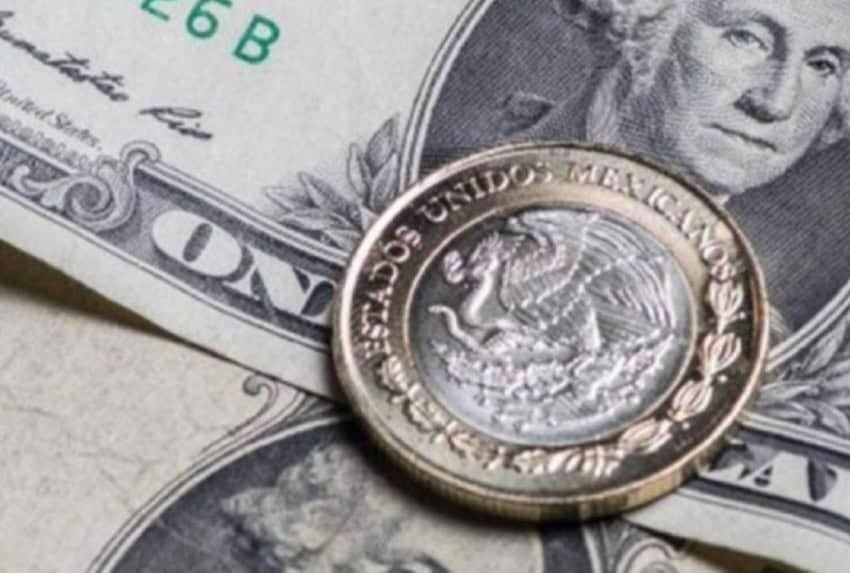
The Mexican peso depreciated sharply against the US dollar on Tuesday morning as appetite for risk assets waned amid the conflict in the Middle East.
After closing at 17.28 to the dollar on Monday, the peso weakened to around 17.80 to the greenback on Tuesday morning before recouping some losses.
The USD:MXN exchange rate at midday Mexico City time was 17.68, according to Bloomberg. Based on that rate, the peso depreciated around 2.2% from its closing position on Monday.
The reduced appetite for risk assets, such as the peso, allowed the US dollar to appreciate.
At around 9:30 a.m., Banco Base’s director of economic analysis said that the US Dollar Index, which measures the greenback against a basket of foreign currencies, had recorded its largest single-day gain since November 2024.
“The dollar index is up 1.17% today, its largest gain since November 6, 2024, the day after the [U.S.] elections when Donald Trump won,” Gabriela Siller wrote on X.
Shortly after midday, the greenback was up 0.82% on the Dollar Index. The US dollar is considered a safe-haven currency amid uncertainty and market turbulence. Janneth Quiroz, director of economic analysis at the Monex financial group, said that the peso would continue to depreciate as demand for dollars grows amid the conflict in the Middle East.
In a separate post on X, Siller highlighted “heavy losses” in capital markets, including on the Mexican Stock Exchange, due to “risk aversion.”
Meanwhile, oil prices, including those for Mexican crude, have increased due to what the Associated Press called “worries that war with Iran could clog the global flow of crude and make inflation even worse.”
The outlook for the peso amid the Middle East conflict
The Mexican peso ended 2025 at just over 18 to the greenback, meaning that the currency has appreciated close to 2% this year, based on the USD:MXN exchange rate at midday.
Still, the depreciation on Tuesday morning returned the peso to levels not seen since January.
In a written analysis, Siller set out optimistic, central and pessimistic scenarios for the peso “in the context of the war in the Middle East.”
“The war in the Middle East implies a risk of greater exchange rate volatility and inflationary pressures through the [changing] prices of oil and other energy sources,” she wrote before detailing three scenarios for the USD:MXN rate.
The optimistic scenario
Siller wrote that in such a scenario, the war will end quickly “without a significant escalation” in attacks or “prolonged disruptions” to the supply of energy sources.
In her analysis — published before the peso’s depreciation on Tuesday — she said that the peso could appreciate to “levels close to” 16.80 to the dollar before the end of the first half of 2026.
The central scenario
Such a scenario assumes that the war will last longer and will escalate, albeit gradually, Siller wrote.
It also assumes that there won’t be “severe” or “sustained” disruptions to “energy trading,” she said.
In this scenario, the peso, amid “greater inflationary pressures,” a possible suspension of interest rate cuts by the U.S. Federal Reserve and “greater aversion to risk”, could depreciate to between 17.60 and 18.00 to the dollar, Siller wrote at a time when the peso was still trading at closer to 17 to the greenback than 18, as is currently the case.
The pessimistic scenario
Such a scenario assumes a “major escalation” of the conflict in the Middle East, “openly involving other countries in the region and causing a lasting blockade of of the energy supply from the Middle East as well as impacts on oil infrastructure,” Siller wrote.
In this scenario, there would be “significant inflationary pressures that force the Federal Reserve to consider interest rate increases” this year, the Banco Base analyst said.
There would also be a “significant increase” in aversion to risk, she added.
“In this pessimistic scenario,” Siller opined, the peso could depreciate to above 20 to the US dollar.
With reports from El Financiero, Milenio and El Economista
